27 March 2011

Salley Mavor's book illustrations


Cover, Salley Mavor's delightful new book.

Massachusetts is full of surprisingly good local museums and in January my husband and I drove to one of them, the Danforth Museum of Art, in Framingham. We enjoyed an exhibit of original children's book illustrations by Falmouth artist Salley Mavor, all from her new volume of nursery rhymes. The exhibit ended January 23, 2011; however many of the works will travel through 2013. It's worth the trip, and the remaining schedule, and much additional info about this artist, can be found at Ms. Mavor's website http://www.weefolkstudio.com/

The Old Woman Who Lived in a Shoe.

We read Ms. Mavor's earlier works with our children while they were growing up, and enjoyed the books very much. In the latest volume, though, Ms. Mavor has exceeded herself, achieving results with her unique low relief fiber techniques that are better than ever.

I have always liked low-relief sculpture, whatever the specific medium. One highlight of my Italian honeymoon, many years ago, was viewing Lorenzo Ghiberti's Gates of Paradise doors in Florence.


Detail, Adam and Eve panel, Gates of Paradise.
http://en.wikipedia.org/wiki/File:AdamEveGhiberti.jpg#filelinks

It took Ghiberti twenty-one years to make his panels. It took Ms. Mavor about one month to make each illustration for her book, which should be at least nominated for a Caldecott prize.

Detail, The Cock Crows in the Morn.

She deftly manipulates materials on the surface layer and then introduces other elements which just break free of the surface, creating depth that is all the more profound for the slim margin between the second and third dimensions.

Miss Muffet, with bowl of curds.


A spirit sheltering from the rain,
beneath a beautifully hand-dyed felt toadstool.


Old King Cole, with fiddlers.


Blanket stitch and felt create a stone castle.


A collage of cottages.


Pretty maids all in a row in contrary Mary's garden.


Ms. Mavor uses many found objects,
including driftwood and acorn caps.

If you have any excuse at all - a friend or relative with a new baby, for example - to buy this book, you'll be delighted with it. Just enjoy the book yourself for a while before giving it away. ISBN 978 0 618 73740 6.

Ms. Mavor signs my books, at the
New England Quilt museum, December 10, 2011.

This just in: Back in 2010, when I first published this post, Jay and I were not able to attend the book-signing at the Danforth. But life gives second chances, and to my delight the NEQM hosted Ms. Mavor in December, 2011. Hie we to Lowell, with our books, and I purchased another copy too. Ms. Mavor graciously signed them all and sat for her picture.

04 March 2011

Sheila Hicks at the Addison Gallery


Right, Trapeze de Cristobal, 1971. Left, Lianes Nantaises, 1973.


A blurry photo of Tresors et Secrets, 1990-1995.
Ms. Hicks calls these "soft stones."

In February, Jay and I drove to the Addison Gallery, on the campus of Phillips Andover Academy, to see the first-ever major retrospective of work by textile artist Sheila Hicks.
Nebraska-born Ms. Hicks, now in her eighties, works and lives in Paris. She studied at Yale, formally with Josef Albers and informally with his wife, weaver Anni Albers. Ms. Hicks’ education continued through travels in South America on a Fulbright. Later journeys to India influenced her palette; her saturated colors might be direct from the dye vats of Goa.
File:Indian pigments.jpg
http://en.wikipedia.org/wiki/File:Indian_pigments.jpg

Much has been written suggesting that her woven and wrapped wool creations are some kind of soft, feminine counterpart to the harsh, masculine materials of modern architecture – glass, steel and concrete. More interesting to me though, is the fact that she obtained large scale commissions from institutional and corporate clients, including entities as disparate as Air France and Target, as well as commissions for public art installations. The studies for some of these monumental works were in the show – for example, a mock-up of a large installation for a Ford Foundation conference room.

2.60 x 10³ meters, five tons of linen thread
The Four Seasons of Fuji, 1999
Fuji City Cultural Center, Japan

 To create these large scale pieces, Ms. Hicks developed and managed teams of assistants; this aspect of her process is only touched upon in the videos accompanying the show and it would have been instructive to have learned a bit more about this aspect of her process. In largely ignoring the implementation of her ideas this show wasn't that different from most monographs of the famous architects who are Ms. Hicks' mentors and colleagues. When the work of a star architect is presented, the design and office staff are seldom credited in any way for their role in implementing the vision of the maestro. Museums perpetuate the cultural trope of the visionary genius with this approach. Were curators and biographers to sufficiently credit the management abilities and practical application exercised by designers in realizing their visionary concepts, we 'd have to recognize the teams of people whom the artists indirectly or directly supervise. Somehow, artist as supervisor is less romantic or impressive than artist solely as innovator. The "great man" - now expanded to include the "great woman" - approach to art history continues, and this approach doesn't feel particularly modern.

While I admire the large scale works, I wanted to see the small weavings Ms. Hicks has made throughout her career on a compact portable loom, and which she calls "minimes." In scale these weavings are like manuscript pages, narratives in warp and weft. These are exquisite, and prove that a soaring idea doesn't have to be three hundred feet long.


Olympic Bravery, 1979.

I wasn't able to satisfactorily photograph the small works, but more examples can be seen at http://www.davisandlangdale.com/Pages/SheilaHicks.html
There are also two recent books about Sheila Hicks, including the companion to this exhibit, Sheila Hicks 50 Years, ISBN 978-0-300-12164-3, and an award-winning book from a Bard Center exhibit, Sheila Hicks: Weaving as Metaphor, ISBN 978 0300116854.

16 February 2011

Colonial schoolgirl samplers at MFA Boston


1. Sampler, detail.
When I was twelve, I was doing my homework in front of "Gilligan's Island", and trying to survive middle school. Twelve-year-old Boston girls in the 18th century made better use of their time, learning necessary stitching skills while composing delightful exercises in color and pattern. Museum-goers are more conditioned to appreciate oil paintings and monumental sculpture, but interest in samplers often perks up at the news that a Boston schoolgirl sampler fetched an auction record price of $465,750 in 2009.
Another wonderful attribute of these items, unlike so much work done by women, is that most are signed and dated. That said, during my somewhat rushed visit to this gallery, I didn't have time to note the artist of every sampler I photographed, so I apologize to our schoolgirls for the lack of authorship. (I will amend this entry if I have a chance to return to the show.)

2. Sampler, Hannah Storer.

The stitched message sternly admonishes: In prosperity friends will be plenty, but in adversity not one in twenty. (White spots on image are glare from overhead lights.)

3. Detail, sampler, Hannah Storer.

The samplers were all made by girls living in Boston, and studying with women who often developed distinctive styles of stitching. The samplers usually feature an alphabet, bands of decorative geometric and floral motifs, often some kind of adage or proverb, perhaps a Biblical scene, and are finished with a border as well as name and date.


4. Detail, sampler, Sarah Erving, 1750, age 13.

I especially like the samplers worked primarily in cross-stitch, with occasional use of satin stitch, such as in these strawberries by Miss Erving.

5. Detail, sampler, Sarah Erving.

A popular figural motif, used in many samplers, depicts Biblical scouts Joshua and Caleb returning from Canaan with their haul, as recorded in Numbers 13: 23. "And they came to the Wadi [stream] Eshcol, and cut down there a branch with a single cluster of grapes, and they carried it on a pole between two of them." The symmetry inherent in this literary motif - two men on either side of fruit - lends itself to the technique of counted cross-stitch, as the young artist can repeat the pattern of the first figure for the second.

6. Sampler, Sarah Erving, overall view.


7. Detail, sampler, Sarah Lowell.

Sarah Lowell also illustrated the exploits of Joshua and Caleb in her sampler, with bright red grapes. Her sampler also featured some lovely, spikey foliage.

8. Detail, sampler, Sarah Lowell.


9. Detail, sampler, Sarah Lowell.


10. Detail, sampler.

Adam and Eve, with snake and fig leaves, were another popular theme for the figural part of a sampler (see also the first image in this blog.) Again, the figures tend to be mirror images of each other, with Eve perhaps having more hair.

11. Detail, sampler.

The colors of the samplers have faded over time, and I kept wishing there was some way to see the backs of the samplers, as viewing photographs or scans of the reverse side might give us an idea of the original colors. Images of the reverse sides accessible on some kind of portable screen would have been a good use of technology. Any curators listening out there?

12. Detail, sampler.
Leaves are outlined in buttonhole stitch.


13. Detail, sampler.


14. Crewel embroidery flowers
emerge from a cross-stich basket.


15. Detail, sampler.

The needlework teachers were from Great Britain, and it would be interesting to compare these samplers with contemporaneous items created by girls in England. This last sampler definitely has a unique New England flavor, however, with its bird-watching moose.

14 February 2011

Fresh Ink exhibit at Boston MFA


Detail, Nine Dragons scroll.
Artist Chen Rong, dated 1244.

On February 11, Jay and I visited Fresh Ink, an installation at the MFA on view from November 20, 2010, until February 13, 2011. Ten Chinese and Chinese-American artists created new works, each responding to a masterpiece in the museum's collection. Most of the works utilized traditional materials such as ink, silk and paper; imagery and applications were the variables.

Entrance to the exhibit.

Given that the masterworks eliciting the responses are in the artistic firmament, the newer work is almost guaranteed to suffer in any direct comparison. However, it was still interesting to see how a group blessed with, or saddled with, a very long tradition of entrenched cultural expectations grappled with this tradition. Reactions were varied, ranging from straight forward re-interpretation to gentle parody, from outright homage to personal responses that defied easy categorization. Engaging with one's heritage - always an interesting point of departure.

Nine Dragons scroll, left, 13th century.
Nine Trees, by artist Zeng Xiaojun, 2007-2010.

The Nine Dragons scroll, unfurled in a special case, is one of the most spectacular works owned by the MFA. Nine dragons cavort and gambole in a billowing background which is as animate as the living creatures. Here, ink, made from mere lampblack and water, reaches its apotheosis as a medium. "Drawing" is an inadequate verb with which to describe the action of brush and pigment, as ink is scumbled, spattered, pounced and layered, creating an atmosphere of clouds, fog and water as full of energy as are the dragons.

Zeng Xiaojun gamely chose this work as his launching pad, although he is a painter of landscape, not figures. However, with every kink and twist, the nine trees in his landscape come as close to mobility as possible for rooted objects.

Left, Secluded Valley in the Cold Mountains, Arnold Chang, 2008.
Right, Number 10, Jackson Pollock, 1949.

Arnold Chang, a New York native, chose a work by another American, Jackson Pollock, but this juxtaposition is not as strange as it might initially appear. In traditional Chinese ink painting, each brush stroke records every incremental decision made by the artist. Similarly, Pollock created a paint diary, every drip a scribbled record of his choices in color and sequence, and of his every movement over the canvas.

The link between the two artists is further emphasized as Mr. Chang exhibits Mr. Pollock's painting flat, in another one of those long horizontal cases, rather than hanging it vertically on the wall. The viewer sees it in the same orientation in which the painting was created, and this simple displacement was more affecting than the almost grandiose scale of some of the other works in the show.

Left, Fangyi-Shaped Ritual Vessel, 11th - 10th century, BC.
Right, Civilization Landscape Series, Qin Feng, 2010.

In an awkwardly sectioned off area of the exhibit an ancient bronze vessel, with traces of very early Chinese writing, was surrounded by large folding screens and hanging scrolls by artist Qin Feng. Although I found the bronze vessel fascinating, somehow this dialog between artifact and response just didn't jell for me. It might have been the cramped space, or the singularity of the folded items in a cohort of scrolls.

Li Jin, various works.

Contemporary artist Li Jin selected an early figurative painting, Northern Qi Scholars Collating Classic Texts, from the 7th century, as his point of departure. This work, which was impossible to photograph, shows a group of well-fed, bearded men organizing cumbersome scrolls.

This artist visited Boston briefly during the project, hence the Bosox cap in the image above. Behind the baseball fan it appears that two of the ancient scholars, as well as some court ladies, came along for the ride, a humorous touch.


Museum patron with Honorable Old Man Rock,
Ming Dynasty, 1368-1644.
Background, nine photographs of
Honorable Old Man Rock, Liu Dan, 2010.

Finally, a contemporary work that is a very direct homage to its inspiration. Liu Dan deploys nine photographs in a worshipful arc around their subject. The rock, the personification of self-possession, engaged in a silent dialog with the woman in the red shoes.

Note on photography: white spots in images are glare from overhead lights.

21 January 2011

Read about Red

Cover of A Perfect Red

I finished a very good book this month: A Perfect Red: Empire, Espionage, and the Quest for the Color of Desire, by Boston-area writer/researcher Amy Butler Greenfield. Status and power, consumerism, alchemical mysteries and a host of personalities from Cortez to botanist Joseph Banks - it's all in here, as Ms. Greenfield spins her yarn. (Pun intended.) We take color for granted and forget that for much of history humans dressed in garments with hues ranging from light mud to dark mud, emphasis on the mud. The bright plumage of birds and the pigments of flowers must have seemed magical. In search of color, pre-historic people utilized the mineral ochre, found in southern France near Rousillon, among other mineral sources. And, as Ms. Greenfield asserts, an affinity for red seems hard-wired in the human brain.

Her focus is largely on the dye cochineal, derived from a scale insect which grows on an
opuntia cactus in Central America. The bodies of the tiny insects are harvested and dried, and the prepared dye, vastly superior to the pigments native to Europe, became the most important monopoly export from New Spain. Tricky to cultivate, cochineal never became one of the plantation crops, such as cocoa or coffee, and perhaps that is one reason it's overlooked in many conventional histories, which tend to focus on food and spices, and the role of these monocultural crops in the development of the slave trade. Even Niall Ferguson's excellent book on Britain's global aspirations, Empire, mentions but does not index cochineal, although botanist Joseph Banks expended much energy and time trying to include cochineal in his plans for Britain's agriculture empire.

However, there is a lesson for today - Since cochineal could not benefit from economies of scale, coercive labor systems utilized for other crops proved useless. So instead of enslavement of the native peoples, or forced quota production, Spain provided incentives to the indigenous populations, including a credit system, lending money to the Indians who then repaid the loan and interest with cochineal. The system worked very well and was one of the few sources of credit available to these rural populations. The legacy of this system is one reason that the cochineal-producing areas of Mexico were able to better preserve their culture and language.


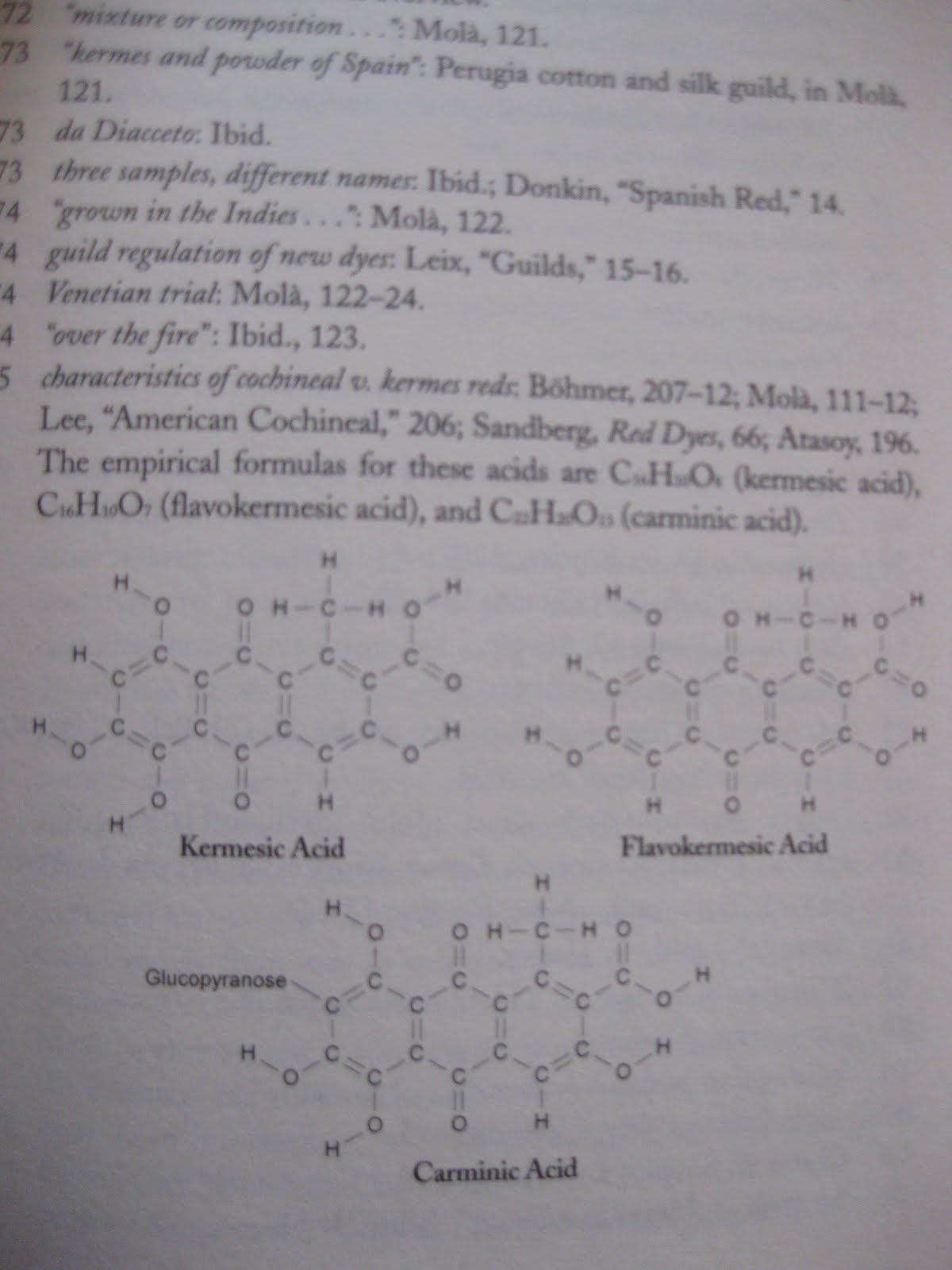
Molecular diagram of carminic acid, the actual pigment in cochineal.

The market for cochineal hit the basement, of course, when aniline dyes were invented in the mid-19th century. Ms. Greenfield covers the demise of cochineal, and its partial revival with the renewed interest in natural dyes; she wraps up her book with the "power red" suit worn by Nancy Reagan, neatly book-ending her opening discussion of our desire for red by the yard.

The book is a fascinating inter-disciplinary study of commerce and colonialism, science and fashion.
Ms. Greenfield's work is well-researched and the notes are excellent. My only quibble is a middle chapter on French espionage - a plot to smuggle insect-covered cactus pads out of Mexico - dragged on a bit. And of course, I would like to see many more pictures of people wearing wonderful red!

The images of Renaissance luminaries in their red finery are wonderful.


02 December 2010

Chuck Close at the MFA


One of two books recently published about Chuck Close, by Christopher Finch.

On October 14, 2010, DH, son and I enjoyed a sold-out presentation at the Boston Museum of Fine Arts, a conversation between writer Christopher Finch and artist Chuck Close. Usually the format of this lecture series is that a single person talks at the worshipful audience; this dyad varied the tenor and made me think that perhaps all gifted celebrities should consider bringing a verbal foil with them to such events. Mr. Close has an easy conversational manner, but the engagement with Mr. Finch, who enjoys a long association with Mr. Close, meant the evening never lagged or foundered.

Detail, self-portrait.

Throughout his work Mr. Close has utilized the grid, first as a diagramming device in the planning stage of his so-called photo-realist works, but later as an overt feature of his portraits. These works, which don't reproduce a likeness so much as invent a new way to see it, are to me much more interesting. Mr. Close won my heart when mentioning what he calls (I paraphrase) the general undervaluing of traditional women's work, and gave as an example the beautiful crochet tablecloths made by his grandmother. She crocheted hundreds of individual squares, stitched them together, and finally starched the textiles using sugar (yes, sugar - anyone heard of this process?). Mr. Close reflected that he had grown up viewing large items painstakingly constructed of many small squares, and had no doubt that this influenced his own work.


Detail, Amish quilt from Amish: The Art of the Quilt, text by Robert Hughes.

Finding endless possibilities in the restriction imposed by a grid is nothing new, as generations of quilters know. Sometimes restrictions, whether external or self-imposed, provide the best scaffolding for exploration.

Another portrait from Chuck Close: Work.
Grids can also be radial, as well as rectilinear.


Mr. Close and Mr. Finch, signing books.

After the talk, Mr. Close and Mr. Finch were kind enough to sign our books; unfortunately the MFA gift shop ran out of the Chuck Close: Work book, but I had purchased mine before the talk. It would make a nice holiday present: Isbn 978-7913-4466-9. Of course it's a big, heavy book - why are art books so often physically unwieldy? - but opens a wide window on one artist's process. There's a companion biography by Mr. Finch, but I haven't looked at that closely yet.

01 December 2010

Solo Quilt Show Arsenal Center

Quilt and show title.

My show officially opened yesterday. Beverly Snow, program director, and her staff have exceeded all expectations and did a fabulous job handling, hanging and labeling the quilts. Now, if folks only come to the Center! The show is up until December 24.
NOTE: There will be rehearsals in the space from 10 am to 6 pm on December 10, 11, 12. Best to visit another time.

Here's the info:

The Arsenal Center for the Arts
321 Arsenal St. Watertown MA 02472

Third Floor, Rehearsal Hall
.

The hours are Tues - Sat, 12 - 6 pm.

There's a small but very good boutique on the first floor for holiday shopping, and free parking in the garage opposite the Panera restaurant. On week-days, best just to go up to the top levels of the garage, as office workers' cars fill the lower floors.


Website:
http://www.arsenalarts.org/

For some reason, my show is still listed up Coming Soon (under Visual Arts tab on home page.) I hope center staff will have a chance to update the site soon.


SPECIAL EVENT - On Saturday, December 4, from 4-6 pm I will have a "petting zoo" with lots of vintage fabrics and design-related items from the 1950's. There's no formal presentation, but of course I'll be babbling away and answering questions.

The entrance to the Arsenal complex.

Entrance to the Arts Center; notice next to elevator.


The show - the space has great light.


The title of my show - Vintage Geometry - has a sort of double-meaning. First, my quilt designs are based on traditional geometric patterns, featuring triangles, square, rectangles and so forth. In addition, I use many vintage fabrics in my quilts, because I love old fabrics, and using them broadens my available palette beyond whatever is for sale in quilt fabric stores today.

Quilt-making is a tradition in my mother’s family – I have a quilt made by my great-grandmother in 1931. She saved the fabric scraps leftover after making clothing for her family. My grandmother Nelda made quilts too, and I began quilting by helping her replace worn bindings on quilts during school vacation.

Quilt featuring vintage panel print.


Ad for dress made from same panel print as used in quilt.

Grandma Nelda had a sense of humor, and liked to sew aprons, curtains and even blouses with fun fabrics that we call conversational prints – patterns with designs of birds, sports cars, antique musical instruments; just about any theme or motif could be explored by the imaginations of the hundreds of textile designers who worked for American companies when the US still produced millions of yards of apparel and home furnishing fabrics.

Reused curtain panel; fabric designed by Doris Lee in 1952.

Many of these fabrics were woven on 36”-wide looms, discarded when most textile production moved overseas in the mid-1960’s. This loss of manufacturing (well before NAFTA) was a detriment to the US economy, but a gift for the vintage shopper - if you see a fabric at an estate sale that measures 36” wide, you know it was made before 1970.

I love the old fabrics – memories of childhood? – and find them at Brimfield, estate sales and, yes, online. These old fabrics play nicely with new fabrics in the geometries of my quilts.


Another view of the show.

Posted by Picasa