02 April 2016

Quinobequin Guild Quilt Show

Elinor Nelson, Diamond Rainbow.

The always-fabulous bi-annual Quinobequin Quilters' show opened its two-day run on Friday, April 1.  As befits April Fool's Day, some of the quilts feature light-hearted subject matter (see giraffe, below).  All the quilts were a delight; those featured in this blog will give an idea of the variety of artwork on display.

Marlene Thurston, Love from Above, based on a design by Charley Harper.

Enjoying the quilts.


Evy Megerman, Johanna's Joyous Jungle.

Evy Megerman made the animal-themed quilt above for a 4-year-old granddaughter - lucky girl!  Although the quilt label did not discuss technique, I think the blocks were created using the paper piecing technique.  Another quilter employed this method, which ensures very accurate assembly, in the quilt below, which was machine-quilted by Mary Ann Zonnenshine.

Jane Evans, Amanda's Quilt, "Tumbler" pattern by Four Paws Quilting.

Amanda's Quilt, detail.

Other wonderful pieced quilts just glowed with color.  Kaffe Fassett's striped fabrics were cut and sewn to make the "handkerchief corner" blocks of the quilt below.

Winnie Wong, Around the Corners with 30 Strips 2.


Marleen Kroll, Tula Pink meets Paula Nadelstern.

Fabrics designed by quilting world royalty, Tula Pink and Paula Nadelstern, were used to great affect in the quilt above, machine quilted by Concessa Shearer.  It's hard to see in my image, but the grayish sashing fabric is metallic, and makes a wonderful contrast with the black borders of each square block.

It's tempting, of course, to touch artwork which has so much tactile appeal, but the friendly white-glove hostesses are there to show off the backs of the quilts - often as fun as the front - and keep the quilts in pristine condition. 

A reminder.

CharAnn Brown, Vintage Timing.

 It was hard to resist touching the quilt above, made from a pattern by Jen Kingwall, "Steampunk".  There's a lot to see in this artwork, and a real sense of motion and energy.


Vintage Timing, detail.

Red, white and blue never goes out of style, and the patriotic quilt is a time-honored tradition. The quilt below is a Minick and Simpson pattern, "Birmingham Stripe", #1304, and was machine quilted by Concessa Shearer.


Carol Miller, Strips.


Great quilts come in all sizes.

In honor of the spring season, the last two images feature floral themes, both done with applique but very different in flavor.


Charlotte Surgenor, My Whimsical Quilt Garden, details.


Linda Evans, Bud Garden, detail. From a pattern by Lisa Bongean.

27 March 2016

Everywhen - Indigenous Art from Australia at Harvard


Naata Nungurrayi, Untitled, 2006, detail.

In his review for the Boston Globe, Australian-born critic Sebastian Smee writes "If 'Everywhen' is not quite the show of Aboriginal art I've always secretly longed to see, it is probably the best I've actually seen". The exhibit, at Harvard's newly renovated art museum complex, is formally (and somewhat awkwardly) titled Everywhen: The Eternal Present in Indigenous Art from Australia. The compact show of 70 select paintings and objects is worth the trip, even considering the eternal battle to find parking in Cambridge.

The portmanteau everywhen tries to convey a meaning for which there really is no cognate in English - a way of understanding existence in a particular place  without reference to constructs of linear time or the lines of latitude and longitude. The guest curator, Stephen Gilchrist, who belongs to the Yamatji people of Western Australia, has divided the show into four areas,  "Seasonality", "Transformation", "Performance", and "Remembrance".

Three larrakitj in foreground.

The "Seasonality" gallery includes the three works in the image above, by artists Djambawa Marawili, Yumutjin Wunungmurra and Djirrirra Wunungmurra. Traditionally, these hollow log forms, known as larrakitj and decorated with earth pigments, were the customary vessels for the bones of the dead; now they are created as art objects. 

Details, larrakitj.

The wavy patterns, and images of fish and other aquatic animals, reference the emptying of fresh water estuaries into the sea, as well as the cycles of evaporation and precipitation which replenish fresh water rivers.

Gulumbu Yunupingu, Garak IV (The Universe), 2004; detail at left.

Although indigenous people in Australia having been making marks on their landscape for millenia, the creation of paintings on canvas, and other works detached from their ceremonial origins, began in the early 1970's.  A white schoolteacher Geoffrey Bardon, working in Papunya, began encouraging Aboriginal men to record their traditional designs using brushes and paint.  The subsequent commercial success of indigenous art gave the artists some measure of economic independence.  Moreover the art medium clearly also provided a forum in which to record colonial events from the indigenous perspective, and even to achieve some measure of justice, by revealing unpleasant histories in works collected and shown publicly around the world.

Lena Nyadbi, Hideout, 2002.

One highlight of the exhibit is a video sequence of some of the artists, including Lena Nyadbi, producing their work.  In the video, Ms. Nyadbi sits on the ground, with the canvas flat in front of her, and, using a plump brush makes stroke after stroke of white paint on a black ground, in a  deliberative motion recalling  the repetitive actions inherent in agricultural work, ceremonial dances, and even ambulation. 

Ms. Nyadbi is explicit about the content of the painting, which recalls an episode in which her family and others had to hide in caves, fleeing from those who used Aboriginal ancestral lands for sheep grazing and pastoral activity.

"Transformation" gallery.

Another painting whose content is explicit is shown below.  The title refers to two ancestral women traveling in Western Australia. They place their coolamons, or wooden troughs, on the ground; the vessels  transform themselves into desert wells.  Through traditional knowledge of the landscape, which seems almost like a magical power, the receptacle for water is filled with the precious liquid.

Ronnie Tjampitjinpa, Two Women Dreaming, 1990.

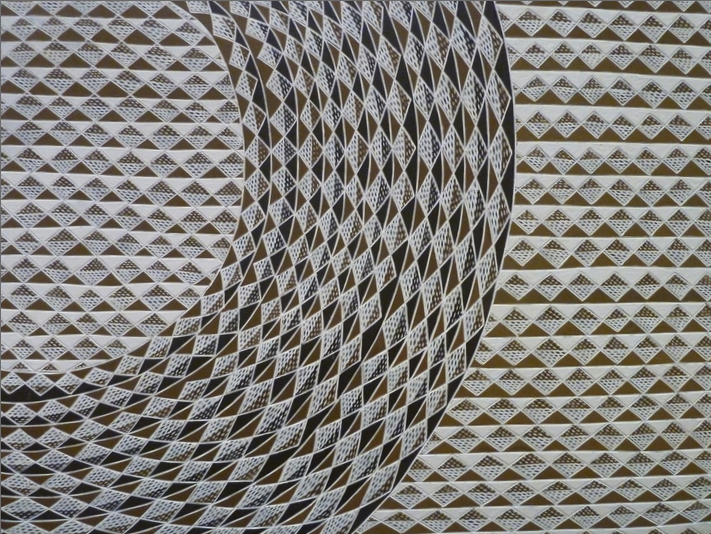
Gunybi Ganambarr, Buyku, 2001.


The work above is painted on recycled building material, incised, and then colored with natural pigments. The restricted color palette places the emphasis on the pattern, inspired by traditional fish nets, or buyku.

Buyku, detail.

"Performance" gallery.

The image above features two paintings which are  stand-outs in the show. To the left of the visitors is an untitled 2007 work by Doreen Reid Nakamarra.  Again a restricted color scheme puts the focus on the vibrating pattern of white, black and ochre lines, which close inspection reveals are made of many, many dots, like grains of sand in the desert, produced by touching brush to canvas, again and again.

Doreen Reid Nakamarra, Untitled, 2007.

Below, artist Dorothy Napangardi uses just three colors - black, red and white - to create her masterpiece, in the "Performance" gallery image above (to the right of the visitors) and, in detail, below.  Although the painting does not reference a specific location,  it does suggest the vast Western desert, dotted with clumps of spinifex grass, as seen in the aerial photo (below the painting detail) by photographer Mike Gillam.

Dorothy Napangardi, Karntakurlanju Jukurrpa, 2002, detail.

Source: http://www.nma.gov.au/exhibitions/extremes/australia/australia_slideshow?result_6095_result_page=2

The exhibit is strengthened by material from Harvard's extensive ethnographic collection,  including wooden vessels and baskets collected by  anthropologist William Lloyd Warner.  As noted in Lee Lawrence's  Wall Street Journal review of the show, the inclusion of these pieces shows the continuity between the objects made before the 1970's, and the modern, acrylic-on-canvas transmissions of the same body of knowledge.

Unidentified artist, Batjparra (skirt), c. 1928.

Tom Djawa, The Burala Rite, 1972.

The piece above is painted using earth pigments on eucalyptus board. It references a story of families eating catfish, and placing the piled-up fishbones in a hollow log pictured in the center.  This developed into traditional burial rites and ceremonies which we, as outsiders, would not attend. But we don't need to be initiates to appreciate the skillful abstract representation of the turtle as a true work of art.

The Burula Rite, detail.

29 February 2016

An elementary school for the 21st century - new Angier School opens

Original Angier School, circa 1921.

On Friday, February 26, I attended the official opening of the first all-new elementary school to be built in Newton in fifty years.  The new Angier School replaces the original building from 1921, named for Newton native Albert E. Angier II, who left his Harvard studies to fight in WWI. He was killed in action in September, 1918, and received the Distinguished Service Cross posthumously.  The building had not aged well, and it is very difficult to bring these older institutional structures in to conformance with modern energy and barrier-free building codes. After a long, convoluted planning process, the new building is finally here, and it's a winner.

The new building, designed by DiNisco architects, has a fairly straight-forward layout - classrooms and other spaces on both sides of a central corridor. As seen in the image below, the media center, aka the library (in yellow), turns a corner at one end of the corridor, and the gym (in coral) forms an "ell" at the other end.

Planning stage, courtesy http://www.wabanareacouncil.com/issue/angier-school-project

Construction almost complete, courtesy http://joslinlesser.com/projects/k-12/angier-elementary-school/

Front facade, nearing completion. Image from the "Angier Building cam."

Entrance, new Angier school.

If I have a quibble with the building, it's that the exterior is a bit busy - a veritable catalog of exterior cladding materials, including stone veneer, terra cotta units, and several different types of metal panels in several different colors. However the interior is light and bright, low maintenance without being clinical, and the windows are operable!

Mayor Setti Warren addresses audience in the new gym.

The opening ceremony program began with attendees - students, staff and faculty, parents, neighbors, and dignitaries - reciting the Pledge of Allegiance. Remarks by the principal Loreta Lamberti and Mayor Warren followed. Jack McCarthy, of the funding agency Massachusetts School Building Authority (MSBA) also spoke, mentioning that the Angier project came in on time and on budget, in contrast to Newton's previous project, Newton North High School. This bit of editorializing was unnecessary, and was the only down note during an otherwise very upbeat occasion. 

Final comments came from Superintendent David Fleishman, followed by songs by the students - the highlight for this attendee - and an emotional ribbon-cutting, with giant scissors wielded by Ms. Lamberti.

Music teacher Ms. Goldstein leads students in song.

The "cafetorium".

While the students returned to class and prepared for dismissal, we older folks were invited to the "cafetorium", a portmanteau of auditorium and cafeteria, for coffee and cake.

Celebratory cake.

The school was open for self-guided exploration, but 5th graders were on hand to lead more structured tours, and I joined one led by a very articulate and poised young lady named Lily.

Dedicated art room.

Art room.

The art room is to die for. The media center, which I suspect is still referred to as a library by most folks, had plenty of books, but also headsets and computer stations.

Media center.

Upper floor plan.

All the specialist spaces - art, music, library - are located on the first floor of this three-story building.  Lily led us up the stairs to the second floor, which houses kindergarten, first and second grades. Each room has a white board with overhead projectors, as well as rather nifty chairs, which are "tip-proof" and stack neatly onto the desks. 

Classroom.

The outdoor space - recess is key, after all - features two climbing structures, as well as a play field for games.

Climbing structure, almost ready for use.

After-school program kids at play.

Going forward, Newton is replacing or renovating multiple schools, and seems to be in good hands with the Owner's Project Manager, Joslin/Lesser and Associates, who handled the Angier project, and will also oversee current and future projects.  Few small cities  have the in-house expertise to ensure a good outcome with such complicated building projects, so the small (compared to the overall budget) extra expense of professional oversight is well worth it.

21 February 2016

Celebrating Blue - cyanotypes at the Worcester Art Museum

Annie Lopez, Medical Conditions, printed on paper and stitched, 2013.
The Worcester Art Museum is  over-shadowed by Boston's Museum of Fine Arts, and we don't visit this marvelous institution as frequently as it deserves.  Prompted by an article in the New York Times, we went to see Cyanotypes: Photography's Blue Period, an exhibit showcasing 78 works by 40 artists, including photography pioneers such as Anna Atkins,  and contemporary names like Christian Marclay. (Thank you for driving, Alex and Robin.)

Artists are continually confronted by disruptive technology, but for over 150 years photographers, both professional and amateur alike, have created cyanotypes, on paper and fabric, in a process basically unchanged since the method was discovered by British chemist John Frederick Herschel (1792-1871).

View of exhibit.

Anna Atkins, Honey Locust Leaf and Pod, circa 1854.
In the process, a mixture of potassium ferricyanide and ammonium ferric citrate is brushed onto paper or cloth.  After the cloth or paper dries, away from direct light, a photographic negative or an object is placed on the substrate, which is then exposed to sunlight.  Following exposure, the print is washed in water, and the ferrous ions react with the potassium ferricyanide to produce ferric ferrocyanide, or Prussian blue.

The chemicals involved are stable, posed little or no particular health hazard as long as they are not ingested, and making the prints involves no darkroom. Hence it was a popular medium for amateur photographers, who made the three postcards below, using photographic negatives.


Three home-made cyanotype postcards, early 1900's.

This ease of use, however, seems to have made the medium unsuitable for "real" photographers, such as  Edward Sheriff Curtis, who "proofed", or tested, his negatives using this quick and easy process.


Edward Curtis, Clayoquot Shaman Woman, circa 1915.

Although quilt makers such as Tafi Brown are part of the current cyanotype revival, the only textile work in this show was a large linen piece by Hugh Scott-Douglas; the darker areas are formed by the irregular distribution of iron salts. The monochromatic palette means that tonal variations have a heightened impact, especially in contrast to the rigid grid.


Hugh Scott-Douglas, Untitled, 2012.

As long as the object being printed is in close contact with the paper or fabric, the medium handles details extremely well, as seen below in this print of a piece of lace.  Contemporary artists often use plexiglass on top of the object or negative,  to form a "sandwich" while the print is exposed to light.  This is how Annie Lopez made the prints for the dress in the first image in this post, above. A meditation on her father's Alzheimer's disease, Ms. Lopez printed images, using acetate negatives, onto tamale paper, which her family uses every Christmas, and found the paper held together well through printing and stitching.


Maker unknown, Lace Sample, French, early 20th century.

The exhibit was organized by Nancy Burns, Assistant Curator at the Worcester Museum, and Kristina Wilson, Associate Professor of Clark University; Dr. Wilson's students prepared engaging essays for the excellent catalog, ISBN 978-0-936042-06-0. For those wishing to experiment with the process, prepared fabric and paper, as well as the chemical preparations, can be found at http://www.blueprintsonfabric.com/index.php