19 May 2019

Quilters Connection Quilt Show

G Wong, Peace Out on my Starship.

After a long hiatus, I reconnected with my quilt guild, Quilters' Connection, by attending this year's quilt show, held at Keljik Hall, part of St. James' Armenian Church in Watertown, Massachusetts. The show was up Friday, May 17, and Saturday, May 18, and here are some of the quilts which particularly caught my eye.

The show's title, "Creative Expressions in Fabric," is all-encompassing and, indeed, every kind of quilt, and technique, was on display, including contemporary quilts, landscape quilts, traditional quilts, both pieced and applique, and documentary pieces.  Some examples of each are grouped together in this blog, just for ease of presentation.  Enjoy.

Contemporary graphic quilts - riffs on traditional designs:

Jen McPhilimy, Flying Geese.

Rita Alesi, A Dozen Pluses.


A Dozen Pluses, detail.


Deborah Rocha, 2 Zigs : 3 Zags.
 
Deborah Rocha, Red Squares.

Missy Shay, Contempo Twist. (Quilted by Georgette Gagne.)

Stephanie Shore, Water Grasses 4.

Water Grasses 4, detail.

Terry Greenstein, Starry Night.

Pictorial (representational) work, in techniques old and new:

Karen Hohler, Berlin Crows.

Don Hileman, Love Birds. (Quilted by Felicity Hileman.)

Love Birds, detail.

Karen Pulaski, Rose.


Renate Parisek, Black Eyed Susans.

Nancy Wasserman, The Girl and Her Dress, detail.

Wendy Drobnyk, Sea Creatures, detail.

Sea Creatures, detail.

 Landscapes:

Diana Galson-Kooy, Trees at Dusk.

Tricia Deck, Lincoln Bridge.

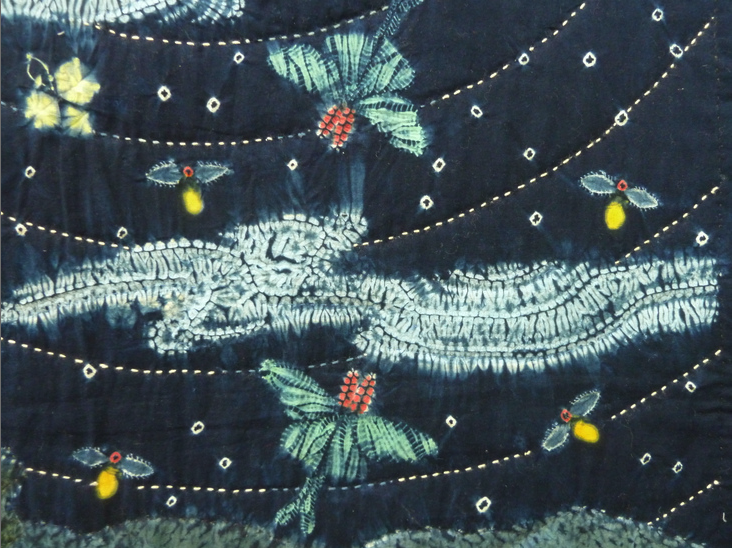
Carol Anne Grotrian, Soiree at Walden.

Soiree at Walden, detail of shibori dyeing.

Soiree at Walden, detail.

Documentary - a record of a historical event, in this case a Red Sox World Championship:

Rosemary Bawn, Mookie Magic.

 Highlights in applique and embroidery:

Nancy Howard, Mrs. Lincoln's Sampler.

Mrs. Lincoln's Sampler, detail.

Susan Holsing, Salem Witches, detail.

Salem Witches, detail.

Salem Witches, detail.

Marla Richmond, Jo's Kitties, detail.

Precision piecing:

Cathy Papazian, Kaleidoscoping.

Ginny Such, Peace Cranes.

Peace Cranes, detail.

Sara Schechner, Ian's Astro-Electrical Wonder. (Quilted by Kate and Tom Wellen.)

Some images of the show:

Visitor and quilts.

The ever-popular boutique.

Finally, here in New England it's been a slow start to spring, but we are saying "good-bye" to winter at long last. The quilt below captures the feeling of a bleak yet beautiful snowscape. I would have added a shadow to the tree as, even in the heat of summer, the shadow of inevitable winter remains.

Deborah Kuhlman-Hussey, Solitude.

13 May 2019

In Praise of Silk exhibit at the New England Quilt Museum


Unknown Maker, France, Boutis Fenetre, c. 1890, detail.

The theme for the current exhibit, on view from May 1 - August 4, 2019, at the New England Quilt Museum is silk, that most luxurious and lustrous fiber.  DH and I attended the curator's reception, hosted by Pamela Weeks, Binney Family curator, and the highlight - a lecture, "The Silk Mills of Lowell," given by Dr. Robert Forrant, distinguished University professor at the University of Massachusetts, Lowell.  Fortunately DH was able to assist with some technical difficulties to help get the presentation underway.

This blog post will be a little bit different - just a sample of the quilts in the exhibit is presented, more or less in chronological order, with captions, but the text, rather than describing the quilts, provides an outline of the history of silk in Massachusetts, extracted and condensed from Dr. Forrant's marvelous talk.  So two different streams of information, one visual and one textual.  In addition to quilts, both antique and contemporary, the exhibit displays some nineteenth-century ladies' garments from the Emma Bowen Collection at the University of New Hampshire, Durham. 

Mrs. Almira Capon, Crazy Quilt, 1888.

The demand for silk thread and fabric, initially using raw materials sourced from China, Japan and France, grew with the invention of the sewing machine, diminished by the Great Depression, and unravelled (pun intended) with the development of synthetics such as nylon and rayon.

Silk thread on an industrial scale began during the period from 1832 - 1846, with the invention of the "machine twist" process developed by Samuel Hill.  In 1842 socially-conscious investors formed the Northampton Association of Education and Industry, establishing a utopian community to manage all aspects of silk production, from growing the mulberry trees, which are the silkworms' sole food source, to raising the silkworms, to processing the cocoons for silk fibers.  Mill buildings were operated by water power, abundant in New England.

Capon quilt, detail.

The goals of these idealistic capitalists aligned with the goals of abolitionists; both groups hoped that silk could supplant cotton, cultivated and processed by slave labor, and disrupt the economy of the South, where cotton was king.  Silk did not displace cotton but the enterprise, now the Nonotuck Silk Company, thrived in the period following the Civil War, and became one of the largest silk thread manufacturers in the nation. In the late nineteenth-century the company adopted the brand name Corticelli - the Italian-sounding name lending cache to the product.

Log Cabin quilt, c. 1900,  and outfit, c. 1890's.

The industry spread beyond Northampton, to towns in western Massachusetts such as Springfield and Holyoke.  William Skinner re-established his silk mill in Holyoke following the destruction of his earlier factory when a dam on the aptly-named Mill River failed and flooded the area. Skinner's enterprise thrived in its new location. In 1961 the family sold the business to Indian Head Mills, which closed the mills; the buildings were destroyed by fire in 1980.

Swatches of silk on display.

Ruth McDowell, Two Shadows, 1984.

Two Shadows, detail.

In the meantime, Lowell, of course, had well-established cotton and woolen mills producing underwear, stockings, carpets, and upholstery fabrics, among other items.  Silk production arrived in a somewhat roundabout way. A silk mill had been established in Newmarket, New Hampshire, by the early 1900's but labor unrest and other issues led the Newmarket concern to relocate their business to a Lowell mill, expanding their silk operations already in the city.  

Nancy Ota, Universal Ties, 2000.

Universal Ties, detail.

In the beginning of World War II parachutes were still made of silk, and production at the silk mills turned to war work. At the height of production, mills turned out as many as 2400 parachutes a week and employed over a thousand women stitchers, earning many times the wages offered during peace time. However, with supplies of silk from Japan curtailed, beginning in 1942 - after Pearl Harbor - synthetics such as nylon substituted for silk.

Anne Horton, Sacred Gifts, 2006.

Nylon and other synthetics, washable and durable, were developed by Dupont and other companies beginning in the 1930's. Much less labor was required to produce monofilament fibers; labor costs were one of the reasons cotton and woolen mills relocated first to the American south and finally overseas. The demand for silk plummeted following the war - in 1930 there were approximately 100,000 silk looms operating in the United States. By 1950, only 3,000 or so were left.

Tomie Nagano, Hexagon Log Cabin, 2008, made from antique kimono.

Tomie Nagano, with a kimono from her collection, and her quilt, talks about her work

In 1954 the Newmarket facility was purchased by Textron, Inc., which closed the factory and took a tax write-off.  At least we have the quilts, and wonderful museums such as the NEQM, to preserve and document this part of America's textile history.

Margaret Solomon Gunn, Bouquet Royale, 2015.

Bouquet Royale, detail.

Jamie Fingal, Over the Edge, 2015.

Pat Delaney, Modern Reflections, 2017.

Maker Unknown, France, Rose and Black Silk Boutis Fenetre, c. 1890.

19 April 2019

Gender Bending Fashion - Boston Museum of Fine Arts


Alessandro Trincone, Annodami dress, 2017.

The unexpected popularity of the attendance record-setting 2011 show featuring Alexander McQueen's work, at the Metropolitan Museum of New York, kicked off a movement of fashion arts exhibits in museums traditionally known for collections of painting, sculpture and decorative arts. A recent example these big fashion installations in major cultural institutions is Gender Bending Fashion, curated by Michelle Finamore, Penny Vink curator of Fashion Arts at the Museum of Fine Arts, Boston, and on display from 21 March 2019 through 25 August 2019.  This exhibit is making a splash, with favorable write-ups in both The New York Times and The Wall Street Journal.

Kudos to the design and installation fabricators of this exhibit, which features custom plinths and lighting in a rainbow of colors, creating a display environment responsive to the artifacts and content.

Exhibit intro wall text - rainbow foil lettering.

The dress in my first image above, intended for a male wearer, is a mix of Italian and Japanese influences;  characters in anime and in video games introduced elements of samurai dress to westerners.  Remember Teenage Ninja Turtles? A samurai warrior costume included a kimono topped with a pleated overskirt. The "Annodami" dress above has layered elements which are halfway between pleats and ruffles, but the Japanese influence is unmistakable in the parasol/hat and the tied straps and belted elements.

Source: http://factsanddetails.com/japan/cat16/sub107/item502.html

I'm currently reading the first volume of the Usagi Yojimbo graphic novels (hey, I learned to read with comic books) and am enjoying the adventures of this rabbit ronin, dressed in an outfit that is a first cousin to the Trincone dress.

Another action hero in karate-ready garb takes me back to my teenage years.  Actually a heroine - Mrs. Peel (actor Diana Rigg) from the television series, The Avengers. Below is the sketch for one of Mrs. Peel's form-fitting outfit, and a black-and-white photo of Ms. Rigg wearing the garment. Finally, Ms. Rigg, shown below as Lady Olenna Tyrell, continues to wear character-defining costumes in HBO's Game of Thrones.

Diana Rigg outfit for The Avengers, John Bates, c. 1965.


Source: http://www.heavymetal.com/news/20-pictures-of-diana-rigg-as-the-deadly-adorable-emma-peel/

Source: https://wikiofthrones.com/14035/diana-rigg-thrones-end-olenna-tyrell/

I enjoyed seeing fashion sketches, in addition to actual outfits, as it gives a sense of the designer's working process. Below is a sketch by Lucien Lelong, with fabric samples, for a menswear-influenced woman's evening outfit.  Broad shoulders and narrow hips create a masculine-ized silhouette, while the lower part of the ensemble is ambiguous - a skirt or palazzo pants? (It's a skirt). Gold net, with metallic thread embellishment, at neck and lower sleeves gives a bit of sparkle and reminds me of the lace collars and cuffs from men's outfits of the 18th century.

Lucien Lelong, sketch "Le Grandin" (the Dandy), 1935.

Men's ensemble, 17th c. Collection Victoria & Albert Museum.

The theme of gender identity aside, luxury fabrics remain one constant throughout the exhibit; of course this is partly due to the survival of more expensive clothing worn only on occasion. Garments of lesser quality and which experienced daily wear would have been discarded or repurposed.  My grandmother (1900 - 1994) would make rag rugs out of ripped-up, worn-out garments.

Invitation for O'Rossen fashion show, Robert Polack, early 20th c.

The drawing above was used as the cover for a fashion show invitation. Reminds me of the dress for success books aimed at women in the 1970's; the popular, research-based book by John T. Molloy was also displayed in the exhibit.

First edition, The Woman's Dress for Success, 1977.

The show featured numerous images of entertainers crossing, or blurring, gender lines in dress, including the well-documented - Marlene Dietrich, David Bowie, Jimi Hendrix - as well as figures such as maverick Harlem Renaissance performer Gladys Bentley.

Ensemble worn by James Marshall "Jimi" Hendrix, 1967.

Although he was a stellar entertainer, Jimi Hendrix's music was not my soundtrack of my youth; rather, I used to wash the dishes while listening to station WXYZ in Detroit.  Mouthing the words to "Stop in the Name of Love" I'd wave the dishcloth in the air, mimicking Diana Ross's "stop" hand motion. "Girl singers" of that era wore beautiful pageant-ready gowns and had elegantly styled wigs and hair. Such presentation made them acceptable to all audiences.

While much of the exhibit was devoted to the role of entertainers as "influencers" one gallery devoted a sizeable display to women in active wear as well as in uniform. As women entered the work force clothing became more practical, and was often adapted from the male wardrobe for work and recreational.  The image below shows women's attire for swimming, riding astride, and auto racing. Of course, women aspiring to be like men - perceived as addressing a deficiency - was in some way less threatening than men appearing in women's clothing, which still has the power to discomfit.

Dressing for the active life in colorful installation.

Turner-prize winning artist Grayson Perry. Source: https://www.britannica.com/biography/Grayson-Perry   

https://www.nytimes.com/2019/03/06/style/jason-momoa-scrunchies-for-men.html

For most straight men, just wearing pink makes a statement. Check out the matching scrunchie on Mr. Momoa's right wrist, above.  I found myself best liking the outfits that subtly combined masculine and feminine elements, such as the outfit below, where a black man-tailored suit is partly obscured by a beautifully embroidered kimono-like garment.  Mixes business with pleasure.

Rei Kawakubo for Comme des Garcons, Dress/jacket, 2006-7.

Dress/jacket, detail.

I also really like the red ensemble, below center, worn by Janelle Monae at the 2018 Oscars.  In eye-catching red, the tailored bodice starts to descend into a skirt, but the skirt volume is cut back in front, revealing red trousers. The skirt does continue in back into a train; a fascinating meld of menswear tailoring and red carpet glamour.

Christian Siriano, Evening Suit, 2018.

The final gallery of the exhibit is really a set design, with panel backdrops and nine pedestals bathed in diagonal aurorae of projected light, almost outshining the nine outfits displayed in this gallery.  In an exhibit examining self-presentation, it is fitting that the galleries themselves have personality.

Gallery overview.

31 March 2019

Table-scaping and sashiko placemats

New casual dining dishes and linens.

A move into a new house is an opportunity to refurbish and renew. I decided it was time to retire our 20+ year-old Fiesta dishes and inject some new color and pattern onto our tabletop. While unpacking my textile supplies, I also excavated some pre-printed sashiko fabric purchased in Japan in 2012.  As well as kits, the Olympus company produces pre-printed panels as well as yardage in a number of patterns.  The fabric available by mail through https://www.athreadedneedle.com/collections/kits-patterns and other suppliers.

I knew I wanted to go in a blue and white direction with the new dishes, as that's a timeless combination and so many accessories are available in that colorway.  Found new plates in Villeroy and Boch's Artesano pattern but didn't like the bowl shape, so back to Fiestaware for the bowls - the new color Mulberry went very well with the Villeroy salad plate design, seen above in the first image. Fiesta's classic color cobalt goes very well too.

Motivated, the next step was making color-coordinated sashiko placemats.

Materials used:
Two meters Olympus sashiko fabric, 46" wide, used for front and back of placemat
Olympus sashiko thread, color 103, indigo, and color 19, purple
Sashiko needle
Wash-out marker (Used Clover water erasable marker, fine point)

"Bobbins" made from toilet paper rolls.

Do not pre-shrink the fabric - this will remove the stitching guidelines.  I did iron the material before cutting, but did not use steam. Some feel that ironing will "set" the print lines, but I did not find that to be so.

Cut size of placemat = 13" by 19", determined by the motif - I wanted to work with the pattern.  From the two meters purchased in Japan I was able to cut six placemats.

I marked 1" from the cut line for my hand-stitched border and 1/2" inch from the cut line for my machine stitching line, then sewed both front and back pieces together, right sides facing. I left about 3" open, to turn the placemat right side out.


Right sides together, machine-stitch on blue marker line.

Top-stitched at edge; orange thread marks border.

After trimming the seam close to the stitching, I turned the placemat right side out, then topstitched in matching thread (topstitching also closed the turning opening). The orange thread (used for blog example) is my guideline for the hand-stitched border.

Generally, it's best to sew the border first in sashiko, so the field stitching can "meet" the border stitches nicely.  I picked out the orange machine stitching as I sewed the purple sashiko thread; the holes left by the machine stitching helped me achieve evenly-spaced hand stitching.  Once the border was finished I began stitching the wave pattern.

Orange machine stitching guided purple sashiko stitching.

In progress.

In the image above I show the wave stitching before the border is completed; this is just to show the pattern and colors used in this blog.  Thread is carried between the layers of fabrics to minimize starting and stopping. It's a little tricky stitching through two layers of fabric  - check occasionallly to ensure stitches secure both layers.


Stitching finished - ready to be washed in cold water and line dried.

Back of placemat - left is before laundering, right is after.

Of course the pattern won't align on the back. I could have used a plain fabric for the back, but I preferred to have both sides match exactly in color.


Chilewich napkin in blue finishes the setting.

23 March 2019

John Singer Sargent paints textiles at the Museum of Fine Arts, Boston

John Singer Sargent, Mrs. Edward Darley Boit, 1887.

The polka-dot-clad lady above is Mary Louisa Cushing Boit, Boston matron and mother of the four girls in the well-known Sargent painting, the Daughters of Edward Darley Boit. Mary Louisa's portrait is part of Exhibition Lab: Sargent and Fashion, at the Boston Museum of Fine Arts, on view from November 10, 2018 until June 23, 2019.  As explained in a video dialog between curators Pamela Parmal and Erica Hirshler, this exhibit is really a preview of what will be a larger show, to open in 2022, of Sargent works, with a focus on his representation of apparel.  Patron feedback is solicited via iPad as well as paper and pencil in this gallery. So, visit and weigh in!

It can be dangerous to consider painters as textile historians. In the portrait of Mrs. Boit, first image above, Mrs. Boit is dressed in an assortment of fabrics, including tulle, velvet and satin. Most eye-catching, however, is the black polka-dot fabric with the pink ground. According to the wall text, while polka-dots were fashionable at the time, the pattern was found more commonly in juvenile apparel, and it does seem at odds with the sober black of her overall costume.  Was this outfit part of her usual wardrobe or something assembled at the behest of Sargent, responding to what author Henry James called the "eternally juvenile" facet of her personality?

Gallery overview.

Hung on the wall nearby were actual samples of taffeta, satin and velvet fabrics, all black, welcoming patrons to touch and examine. The fabric "petting zoo" is a great idea but the dark color made it a bit more difficult to see the weave structure.

Two portraits, two dresses.

The image above reveals additional examples of Sargent's approach to textiles in his society portraits. On the wall to the left is a reproduction of Portrait of Mrs. J. P. Morgan, Jr., nee Jane Norton Grew (1868-1925).  The gown she wore for the portrait, designed by French couturier Jean-Phillipe Worth and owned by the MFA, is displayed in the foreground. Although it's difficult to tell in my image, Sargent only hints at the woven pattern of the dress He also seems to reduce the reflective nature of the fabric; in the portrait the surface is depicted as almost matte, with few highlights to distract from her face, bosom and arm.  This is a distinct departure from earlier attitudes towards shiny fabrics, which gave painters a chance to show off their skill in depicting reflectivity.  Almost more important than the dress is the feathery (furry?) white stole, which practically buries her right hand, barely modelled, and holding a fan.  Jane Morgan almost looks enveloped in a protective cloud.

To the right above is  Mrs. Charles E. Inches (Louise Pomeroy), painted in 1887.  The lush red silk velvet dress on display, copied from a Worth gown by the Boston company of Auringer and Lewis, may be the same dress. I gather the documentation is uncertain.  Whether or not the dress retains it original neckline, in the painting Sargent lowered the neckline as much as he dared in this portrait of a wealthy physician's wife, who was pregnant at the time with her third child. The right strap (from the viewing perspective) of the dress has been minimized, exposing more skin and emphasizing the bow, and the left bow seems to have disappeared altogether, emphasizing the elegant curve of the arm.

Sargent clearly "tailors" his sitter's apparel to suit his technique and goals. I look forward to learning more in the finished exhibit in 2022.

An aside: a brief Google search for "Auringer and Lewis" yielded nothing; perhaps an enterprising fashionista will write a history of couture in Boston.