30 April 2020

Have sewing machine, will stitch - face masks

Finished cloth face mask with bias tape ties.

So, I've been sewing a few face masks for friends and family.  Patterns and directions can be found on the internet; even The New York Times has published directions.  My husband and I found that the commonly used elastic-over-the-ears model fit neither of us, so my masks have ties. 

The easiest way to make ties is to use single- or double-fold bias tape.  Because I never throw anything away, I had some vintage packets of bias tape in black, purple, yellow and white, hence the color schemes of my masks.  

Supplies:
Fabric, different prints for front and back of mask
Single- or double-fold bias tape
Sewing notions - thread, needle, etc.

Supplies and template.

Cut:
Two pieces of fabric, 6" x 9" for an adult mask
Four ties, 16 1/2"long

I made a cardboard template to speed up cutting; we're not too concerned here about being perfectly on grain. 

Cut and ready to stitch.

Single-fold tape on the ironing board, folded and ironed.

If you have double-fold bias tape, just stitch the edge. My purple tape was single-fold, so I folded and ironed it, then stitched.  I've also made some masks using leftover quilt binding; again, just fold, iron and stitch the binding to make a narrow, hemmed tie.

Pin the stitched tie to the corner of the right side of the fabric.

I pin and sew each tie to a corner, with a few machine stitches, just to keep everything in place before stitching front and back together. To keep those ties out of the way when I stitch back and front together, I use masking tape to hold them in the center of the assembly.  Don't sweat the seam allowance - I used the width of the presser foot.

Ties tacked to corners and corralled with masking tape.

Back and front pinned and ready for stitching.

Leave about a 2" gap for turning.

After turning, trim corners to reduce bulk.

Turned right sides out.

The masks have three pleats; it's not critical that the pleats be absolutely equal, just do your best. Again, remember to keep the ties out of the way when stitching the next step.

Pinned pleats, ready to top stitch.

Pinned pleats.  I iron before stitching, so use glass-head pins.

I top-stitch close to the top and bottom edges, to catch the turning opening, but on the pleated sides again use the width of the presser foot as my seam guide. Stitch around twice, to make everything sturdy, tuck in your thread ends and done!

These can be washed and air-dried.  Someday, when this situation is in the rear view mirror, maybe these can be re-used as doll hammocks, or something.

DH in homemade fabric mask with ties.

02 April 2020

From the pantry - Hummus with canned beets

Beet hummus on crackers - yum!

So, it may be difficult to find toilet paper and diapers, but there are plenty of canned beets.  Not to mention tahini, which we often find near the peanut butter in our local grocery store, as they don't really know where to put this slightly exotic, and delicious, substance made of ground sesame seeds.

Any kind of tahini will do.


Beet Hummus

1  14-ounce can sliced beets, drained
¼ cup olive oil
Juice of 1 lemon
3 cloves garlic
½ cup tahini
1 teaspoon cumin
Salt and pepper, to taste

Combine all ingredients in a food processor or blender.  Blend until smooth, adding a bit more oil if necessary. Serve with pita bread, pita chips, crackers, or veggies.

Optional
Add one 14-ounce can drained and rinsed chickpeas.


Thank you for reading my blog. It means a lot to me, especially during these challenging times.


07 March 2020

Taking a Thread for a Walk - Museum of Modern Art

Wall Hanging: Entrance II, Dolores Bittleman, detail.

Textiles have been something of a stepchild at the Museum of Modern Art, (MoMA) so the exhibit "Taking a Thread for a Walk", installed in the newly renovated museum, is a welcome display of work in fiber.

In the gallery at MoMA.

MoMA's approach to collecting textiles has been haphazard, at best, and I found it difficult, despite engaging wall text, to find a thematic thread (pardon the pun) in the exhibit.  So, I'll look at the items as a sort of bildungsroman - an imaginary biography of encounters with textiles from childhood to maturity.

Let's begin with  toys developed by German education innovator Frederick Froebel (1782-1852), such as crocheted soft balls - the forerunners of today's soft foam Nerf ball. The image below features modern versions of these tactile toys next to another Froebel item, flexible wood strips for weaving.  By the early 20th century, Froebel toys were mass-produced and distributed worldwide.  Frank Lloyd Wright's mother gave him a set of Froebel wooden blocks.

Left: Balls, soft crochet.  Right: Slatwork, stained wood.

Playing with the Froebel weaving strips might lead to study at the Bauhaus, a German school of modern architecture and design with a textile department headed by Gunta Stozl. Below is her pencil study for a wall hanging, and an image of the wall hanging.

Working drawing for wall hanging, Gunta Stolzl, c. 1924.

Wall hanging, Gunta Stolzl, c. 1924.


Anni Albers, who also studied at the Bauhaus, came to America in 1933 with her husband, Josef Albers; the Bauhaus student now became an instructor in weaving.   Learn more about Anni and Gunta here: https://www.designtex.com/bauhaus-project

Artist Sheila Hicks studied painting with Josef Albers at Yale but her meeting with Anni Albers led Hicks to adopt fiber as her medium.

Loom used by Anni Albers, designed by Louis Strohacker, c. 1952.

Tapestry, Anni Albers, 1948.

After receiving her MFA from Yale, Hicks' career included commercial commissions, such as the embroidered panel below, for the interior of an Air France Boeing 747.  She also designed textiles for Knoll, but helped establish fiber as a sculptural medium in its own right, independent of any functional role.  Another student, Dolores Dembus Bittleman, said of her lessons with Albers:
...We'd talk about threads and textiles and how they behaved. The important lesson I absorbed was that when you'd 'listen' quietly, threads would suggest what could be done with them.  We ranged the world from there...This instruction slowly allowed possibilities of the materials to reveal themselves to me over time.

Airplane interior panel, Sheila Hicks, 1969-1977.

Wall Hanging: Entrance II, Dolores Dembus Bittleman, 1964.

Fabrics for window treatments, various designers.  Chair by Harry Bertoia.

A fiber MFA graduate might build a career in industrial design, creating textiles to meet the need for window treatments for post-war glass curtain-wall skyscrapers. These tall buildings featured perimeter walls of windows.  Interior designers utilized miles of sheer, scrim-like fabrics, known as casements, which helped to prevent glare and control light.  The look was re-created for the AMC cable show about a 1950's Manhattan advertising agency, "Mad Men."  Note the curtains on the far wall.

A set for "Mad Men".  Source: https://www.bloomberg.com/news/articles/2015-04-09/want-don-draper-s-office-from-mad-men-here-s-how-to-get-it

As we left the exhibit, we stopped by the participatory studio space and admired the work in progress on communal looms, and a wall hanging created from some of the small finished woven pieces.

Weaving in progress.

Made from communal weavings.

28 February 2020

In Pursuit of Fashion: The Sandy Schreier Collection at the Met


Offering Bearer, Egypt, c.1981 - 1975 BC.

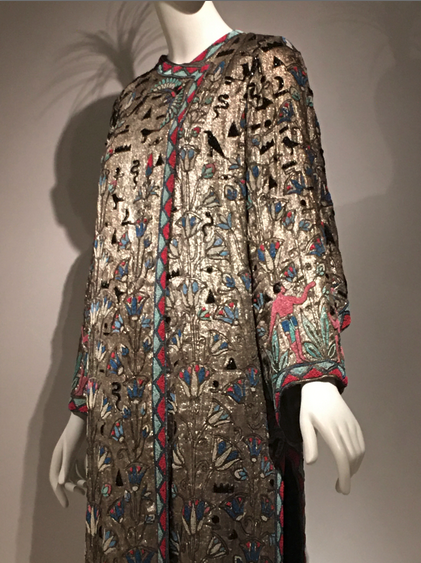
Egyptian-inspired evening dress, Madeleine & Madeleine, c. 1923.

Evening dress, detail.

Recently, DH and I took a fantastic group tour, Fashion in Art with Special Exhibit: The Sandy Schreier Collection  at the Metropolitan Museum in New York. I used the Events menu to find this tour.

I blogged about the first part of the tour here, and this post explores the Schreier collection of 20th century fashion, with a focus on pieces which reference historic costume or have interesting narratives. Also, I feature items which just appeal to me; after all, it's my blog.

Now, the first image in this blog is a 4,000 year-old representation of ancient Egyptian dress. The second image, of an evening dress by Madeleine and Madeleine, clearly references the Egyptian revival motifs which became all the rage after the discovery of King Tutankahmun's tomb in 1922, not to mention silent film star Theda Bara's portrayal of Cleopatra in 1917.

While the 1920's dress features a girdle of an Egyptian-inspired bird delineated in fake jewels, the silhouette of the dress is thoroughly 1920's.  While the ancient dress clings to the body, showing every curve, the flapper-era dress falls straight and away from the body, with no accent on the bosom; only the bird motif girdle creates a feminine emphasis at the hips.

Mariano Fortuny Y Madrazo, more widely known just as Fortuny,  was another designer who translated aspects of ancient dress into contemporary fashion. His famous Delphos dress, an elegant straight gown whose infinite tiny pleats skimmed the body, references ancient Greek female attire.  Fortuny still exists and made some of the outfits for Downton Abbey.

Marble statue of a woman, Greek, 4th century BC.

Fortuny gown and tunic, 1920's.

Downton Abbey Delphos-style dress by Fortuny.

So clearly, fashion designers, just like artists in many media, looked to the past for inspiration, one theme of this exhibit. Another theme is the manner in which designers respond to economic or political conditions.  Some of the garments were designed by Gilbert Adrian, a busy Hollywood designer best known by the monomym Adrian.  The ensemble below was designed during World War II, when Regulation Order L-85 (scroll down to the "Dressing for War" section) put limitations on the use of silk, among other fabrics. So, designers used alternative materials such as rayon, seen in this burgundy sheath style dress.  Fringe, however, was unrestricted, so could be used with abandon.

Rayon dress with fringe, Gilbert Adrian, c. 1943.

Adrian, who designed Judy Garland's blue-and-white gingham outfit in the Wizard of Oz, also produced one of my favorites in the show, below.

Rayon dress with printed cats, Gilbert Adrian, 1944.

The garments exhibited also featured examples of amazing handwork - beading, embroidery, passmenterie and so forth, and it's great to see this craftsmanship celebrated, on accessories as well as clothes.  It's also time to be no longer ashamed of the decorative impulse.  Imagine the dress below on a Bright Young Thing out on the town and dancing, fringe flying and light sparkling on the beads.

Evening dress, French or American, c. 1925-28.

Helmet hat, 1920's. 

As noted in the exhibit, hats and other accessories  made couture a bit more inclusive - these items of clothing were independent of body shape and offered a way to experience a bit of high fashion with less of an investment.  Hats were also a way to introduce a little bit of levity into the fashion equation.

Hat, Philip Treacy, 2003.

You may remember admiring Treacy's hats at the wedding of Prince William and Katherine Middleton in 2011.  Within the compass of headgear, Treacy exhibits a lot of creativity.

Well, this post covers just a fraction of  the items on view, and, judging from the crowds, this is a popular exhibit.  The Met is lucky Ms. Schreier is donating much of her collections to its Costume Institute.  There is a catalog available.

I'll book-end this post with a view of another Egyptian revival-inspired garment which, if given to me, I would never take off. 

Evening coat, detail, French, 1923-28.  This view captures the glimmer of silver lamé.

26 February 2020

Fashion in Art tour at the Met

Marble statue of a woman, Greek, 4th century BC, with our wonderful guide.

Recently DH and I caught a tour at the Metropolitan Museum of Art. Titled Fashion in Art with Special Exhibit: The Sandy Schreier Collection, this 1 1/2-hour tour, led by a terrific guide whose name I didn't catch, sadly, took us all over the museum. We time-travelled, too, from ancient Egypt to Second Empire France.

Item #1 - Marble statue of a woman. Location: Great Hall
Our first stop was a statue with draped and pleated clothing depicted marvelously in stone.
Her robe, or chiton, represents finely pleated linen. In ancient Greece such  fine pleats were created by dipping the fabric into vegetable-based starch, folding the wet fabric around a pole and then drying the assembly in the sun.
Around her body, and draped over her left arm, she wears a himation, like a cloak, made of wool and hence less finely pleated or folded than the  thin linen.
A cord tied under her bosom gives an elegant silhouette to her outfit and holds everything in place.
The goddess Artemis is sometimes shown with a cord like this, but our guide said this is more likely Themis, goddess of custom and law.

Item #2 - Bust of Alexander Menshikov. Location: Gallery 551

Alexander Menshikov, unknown artist, c. 1704.

Alexander Menshikov rose from humble beginnings to become a military leader and advisor to Peter the Great. At the time, Tsar Peter was heavily influenced by the culture of the French court under Louis XIV.  French courtiers were clean-shaven and wore wigs, following the example of the balding Louis, so Peter wanted Russian nobles to abandon their traditional facial hair and emulate the French.  Those who did not were fined. Alexander's armor serves only a decorative purpose, and is illustrated with scenes from the life of another famous Alexander, Alexander the Great.  The frothy jabot at his neck is a fore-runner of the modern necktie and adds to the sense of motion imparted by the slight turn of the head. Clearly a successful military man, he also exhibits the status conferred by courtly dress.  Fun fact - according to our guide, these huge wigs are the origin of the phrase "Big Wig".

Item #3 - Toilet Set in Original Leather Case. Location: Gallery 551

Toilet Set in Original Leather Case, Germany, c. 1743 - 45.

We had a brief stop at this elaborate dressing table set up. Members of the nobility got dressed and ready for their day with others in attendance as part of court ritual. Note the pair of tea cups - milady could share her tea or chocolate.

Item #4 - Condesa de Altamira and her daughter, Maria Agustina.  Location: Gallery 958

Condesa de Altamira and her daughter Maria Agustina, Goya, 1787-88.

The Condesa has a fashionably teased hairstyle called "hedgehog".  She also wears a fine fichu around her shoulders and tucked modestly into her bodice. Her excellent posture and nipped waist are courtesy of a corset.  Her skirt is shaped by a hoop.  Lace and embroidered silk establish her status and her young child wears lace too.  In 2014 the Met was able to present a sort of family reunion, displaying all four of the Altamira family portraits by Goya.

Condesa de Alamira, detail. Embroidery on silk at her hem.

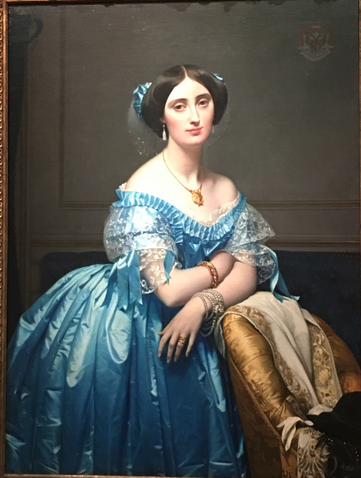
Item #5 Josephine-Eleonore-Marie-Pauline de Brassac de Bearn. Location: Gallery 957

Josephine de Brassac de Bearn. Ingres, 1851-53.

For purposes of discussion, I'll abbreviate the title of the painting to Josephine de Brassac de Bearn.  De Brassac de Bearn was a member of the Second Empire elite, and known also by the courtesy title Princess de Broglie. Here she is prepared to go out, with her evening shawl, gloves and black cloak draped over a chair upholstered in golden damask.

The full skirt of her blue silk dress did not have a bustle but there may have been a small pillow, tied around the waist, lifting and filling out the back of the skirt, and a stiff crinoline providing more structure and volume.  Lace and ruching frame her decolletage; her sleeves are trimmed with lace and ribbons and matching ribbons, as well as feathers, ornament her hair.  The Princesse's arms are portrayed as meltingly soft and on her left wrist is wrapped by a pearl necklace functioning as a bracelet. 

Josephine de Brassac de Bearn, detail.
 
Sadly, this beautiful woman and mother of five died of tuberculosis at age 35. Her broken-hearted widower kept the portrait behind a curtain and never remarried.

Item #6 -  The Life and Miracles of Saint Godelieve. Location: Gallery 305

The Life and Miracles of Saint Godelieve, Master of the Saint Godelieve Legend, 15th c.

Next we travelled back to the fourth quarter of the fifteenth century, and learned about Saint Godelieve, a  young noblewoman born around 1052.  The painter portrayed the characters in contemporary costume of his century, and we see Godeliever's life and role changing with her dress.


Alterpiece, detail, left panel.

The story begins in the two panels above - Godelieve, a teenager, is shown in the left panel at the bottom between her two sisters.  Her parents sit at the top and are handsomely dressed in red and brocade as befits minor nobility.  Godelieve's loose, flowing hair tells us she is not yet married.  In the panel on the right she is sneaking food from her wealthy family to distribute to the poor.  Her suspicious family had a servant confront her, but, miraculously, the stolen food became woodchips, so she evaded detection. 

Saint Godelieve, detail, middle panel.

In the leftmost panel of the central part of the altarpiece Godelieve is betrothed to a knight in the service of the Count of Burgundy.  She weds the knight in the middle panel; both are opulently dressed in brocades.  However,  Godelieve continues to feed the poor, now using food from her new home. Her mother-in-law, shown in the black gown and white whimple in the rightmost panel above, tells a young maid to follow Godelieve and report back to her.

Saint Godelieve, detail, right panel.
 
Unhappy with her daughter-in-law, the knight's mother convinces her son to have Godelieve murdered by two henchman.  In the left panel above these two villains, dressed in striped hose - stripes are a sure sign of villainy - pull Godelieve out of bed.  She wears only a simple night gown over her shift as the henchman strangle her.  In the last panel, foreground, the villains tip her head first into a well, perhaps to make it look as if she drowned, and then arrange her on a bed, trying to mask any sign of violent murder.  A cult developed around her, she was attributed with four miracles, and made a saint very soon after her death. Her faithless husband remarried, but remorse seems to have overcome him and he became a monk.

Item #7 Offering Bearer. Location: Gallery 105

Our  last stop took us 4,000 years back in time, to ancient Egypt. Almost by accident archaelogists discovered an intact tomb in 1920, containing many models of Egyptian life as well as this figure bearing food for the afterlife.

Offering Bearer, or Estate Figure, c. 1981 - 1975 BC.

Depicted in mid-stride, her dress clings to her body and mimics dresses made of multi-colored feathers.  Her ankles and wrists feature jewelled bands.

Offering Bearer, back view.

After this stop we headed to the Costume Institute and the Sandy Schreier exhibit, which I will cover in the next post. Stay tuned.
This was a great tour and I wish the Met and other museums would program more of this approach to art history.


19 February 2020

Yukigata sashiko - stitched snowflakes

Finished mat.

Just finished a sashiko project. Title is "yukigata", which translates, more or less, to snowflake pattern.

Pre-printed design on fabric and stitching diagram.

The stitching diagram. Self-explanatory.


I found this on ebay and plan to give it as a gift.

Looks good with KLM Delft houses.

DH was a consultant to KLM airlines for a time, so we have a small collection of their Delft houses given to businessclass passengers.  These charming items are actually bottles filled with jenever, or Dutch-style gin.

Close-up of stitching.


14 January 2020

Ruth Asawa in Women Take the Floor


Untitled, detail.

Untitled (S 407 Hanging Five-Lobed Continuous Form within Form with Two Spheres)
.

The Boston Museum of Fine Arts has a sizable new installation of work by female artists titled Women Take the Floor.  Gallery 328, in the American wing of the museum, displays part of this overall installation, with the theme Beyond the Loom: Fiber as Sculpture/Subversive Threads.  A stand-out piece in this gallery is the woven wire sculpture by Japanese-American artist Ruth Asawa, created about 1952, in the image above.

The image of the gallery below gives an idea of the scale of the sculpture.

Gallery 328, with work by Sheila Hicks, Olga de Amaral and others.

From the wall text:

Born in California to Japanese parents, Ruth Asawa overcame great adversity to achieve renown as an artist.  During WWII, she and her family were forcibly relocated to Arkansas, as part of the U. S. government's internment of American of Japanese ancestry.  Later, she was denied opportunities that would qualify her as an art teacher.  In 1946, however, she began studying at Black Mountain College with Josef Albers.  During her tenure at the college, she also studied with dancer and choreographer Merce Cunningham, mathematician Max Dehn, and visionary architect Buckminster Fuller.

A trip to Mexico in 1947 led Asawa to experiment with the technique of wire-looping, inspired by traditional Mexican basket weaving.  The resulting forms, hovering suspended from the ceiling as here, became her signature style.  The method of continuous looping was key to her art, and Asawa noted:
 "I was interest in the economy of a line, making something in space, enclosing it without blocking it out.  It's still transparent.  I realized that if I was going to make these forms, which interlock and interweave, it can only be done with a line because a line can go anywhere."

Untitled, detail.