19 August 2013

Meet the Musk Ox - DH in Alaska

Musk ox farm near Anchorage, Alaska.

My husband recently traveled to Alaska on business, so of course this eager textile junkie suggested he enable my addiction and investigate the purchase of some qiviut yarn.  Pronounced kiv-ee-ute, this luxury fiber is spun from the undercoat of  musk oxen. Well, DH got into the spirit of things and even went to a musk ox farm, where he met these survivors of Pleistocene megafauna. This is his report, straight from the horse's - um, ox's - mouth.

Seasonal farm visits are popular with tourists.


Both adult males and females have horns.

I look like a cow, but I'm more of a cousin of sheep and goats.  I like to butt heads at up to 35 mph, and always wear my helmet just in case.  I'm panting because it's freaking hot today at 65 degrees (Fahrenheit).  It would be a lot worse if those nice people had not combed out my undercoat in the spring.  Did you know that there are city slickers from places like Newton who will buy an ounce of my yarn for $95 (200 yards)?

Left: skein of qiviut. Right: Naturally shed hair.
Yearling.

I'm just one year old. It takes me four years to grow to full size.

Calf.

I'm about 3 months old.  My species is only now being domesticated at the Musk Ox Farm project.  If I'm friendly toward people, I will be invited to reproduce when I grow up.

Musk ox were extinct in Alaska in the 1800s, possibly due to hunting.  My cousins from Greenland were re-introduced into the wild in the 1930s.  Our DNA has a common root about 10,000 years ago.

How I spend my day.

When I'm not doing one of the activities on the sign above, or pretending that I like people, I enjoy reading about my home, Musk Ox Farm, on my iPhone.

http://muskoxfarm.org/
http://www.uwcc.wisc.edu/info/farmer/pre2001/030400k1.html


13 August 2013

Boston Modern Quilt Guild in Lowell


Comfort quilt made from blocks donated to the BMQG.
Click on any image to enlarge it.
 
Thursday, August 8, found me seated at a table with another volunteer, both of us gallery attendants at the Boston Modern Quilt Guild's three-day exhibit at the Appleton Mills Gallery, part of a housing complex full of artists and musicians. The invitational display was part of the Lowell Quilt Festival, and featured about fifty quilts.  Highlights of the show included quilts made by the guild from blocks sent in from all over the country as part of a comfort quilt drive for those affected by the Boston Marathon bombing in April.  I believe a BMQG member named Natalie spear-headed this effort, and she and the guild did a fabulous job.

Adaptive reuse of old factory into apartments.

The Appleton Mills complex is an example of the transformation of former industrial buildings into new mixed-use developments in Lowell's ongoing revitalization. The renovated shoe factory made a stunning backdrop for the quilts. 

Atrium, Appleton Mills Gallery.

On the Plus Side, Jane Fitzpatrick.

Jane's quilt above exemplifies many attributes of "modern" quilts - a color palette which generally includes white, off-white or gray, in combination with solid fabrics or geometric prints, and piecing which merges precision with a bit of "wonkiness," as the plus symbols in the quilt above are a bit askew within their squares.

Quilts on display.
 
PB Complete, pieced by Tina Guthmann, quilted by Krista Ellis.

Many modern quilt designs have roots in traditional approaches, such as the quilt above, pieced with hexagons, a popular shape for quilters since the 18th century. The quilt below, from a pattern by modern quilt icon Denyse Schmidt, is a riff on the double-wedding ring pattern, but, as the name implies, in modern times quilts are for everyone, married or not.  In this quilt the artist used DMC Perle cotton, a beefy thread, so that the quilt stitches are quite prominent against the white background fabric.

Right: Single Girl, Natalie Sabik. Left: Detail.

Mounting a show like this is quite a bit of effort, but viewing their work in a gallery setting gives the makers a communal "pat on the back," and renewed energy as they continue their artistic explorations.

09 August 2013

Samurai at Boston Museum of Fine Arts

Helmet and mask, detail.
On August 2 DH and I viewed the Samurai! exhibit at the Boston Museum of Fine Arts. This show, which closed August 4, featured over 150 objects from the collection of Dallas-based connoisseurs Ann and Gabriel Barbier-Mueller. Holland Cotter reviewed the show for the New York Times.

Entrance to the show.

Helmet and armor, Matsudaira family.

Only the oldest pieces in the show, primarily helmet bowls,  actually saw combat.  From the 12th century until the Tokugawa shogunate began in the early 17th century, Japan was a militarized society, with warring clans endlessly engaged in attacking and counter-attacking each other.  The introduction of firearms in 1543  made warfare that much more brutal.  Most of the armor in the show was made after 1615, however, and, while based on historical styles, was used for ceremonial purposes and for families recalling their samurai lineage and status. 

After Ieyasu Tokugawa became the shogun, or military dictator, in 1603 and moved the capital from Kyoto to Edo (now Tokyo), the samurai class eventually demobilized and became the governing bureaucracy. Bushido, or the way of the warrior, remained part of the culture.  Moreover, since making money was considered low-caste (merchants were at the bottom of Edo class system) former samurai reinforced their high status by becoming patrons of the arts and acolytes of refinements such as tea ceremony and calligraphy.  Samurai retained and donned their armor during special occasions.

Components of samurai kit.

The individual items needed to outfit a samurai are shown above in a rare complete set of armor and clothing from the Mori family. This set stayed intact as it was purchased by an English clergyman in the 20th century.  The set includes: silk trousers worn beneath the armor, abdomen and thigh protection, arm gauntlets, shoulder guards, shin guards, helmet, shoes and, at the right, a surcoat to wear over the armor, to keep everything dry. Another key item is the half-mask, seen to the right of the helmet, above. This protected the neck and lower face.

After the 1923 Tokyo earthquake many Japanese families had to sell heirlooms for ready cash.  It was also a time of increasing Western influence, which didn't sit well with many bureaucrats, whose ancestors had been samurai, or with reactionary nationalists such as novelist Yukio Mishima. The glorious samurai past was used, or misused, for propaganda purposes.  The exhibit doesn't really address issues of art and politics in this particular area of Japanese culture, or the path from "warrior thought" to aggresive nationalism.  To be fair, that would require another type of exhibit. Meanwhile, it was enough to contemplate so much beauty and drama, with the specter of violence at a very comfortable remove.
Samurai armor 101.

Weapons and armor had more than a simple utilitarian role.  Much has been written about early Japanese technology and skill in making the steel sword blades used by samurai, and the iron helmets and armor are also masterpieces of the metal workers art.  Surface decoration provides clan identification and, as soldiers everywhere are often superstitious, motifs encode talismanic properties, bringing good luck, or invoke protection from a deity such as the bodhisattva Fudo Myoo, the Immovable One.  Invoking a Buddhist deity may seem odd, but there was a long tradition of warrior culture in Buddhism -  somewhat like the church militant in the West - and the monks at the monastery of Mt. Hiei, for example, were famous fighters.

Unlike Western armor, Japanese armor is made of many overlapping, laced lacquered iron plates; this lamellar structure means that strong cords formed a critical part of the defensive carapace, and these cords were woven in a variety of colors.  The color identified the wearer and made him conspicuous to his followers and fellow warriors during a chaotic melee. The theory is that when firearms arrived, with the noise and smoke of the arquebusiers, easily-recognizable armor became even more important to avert friendly fire.


Folding screen, Battle of the Uji River, detail.

Much artwork was inspired by the martial past, including the folding screen above and below, created in the 18th century, and depicting warriors on horseback crossing a river during the Genpei war of 1180-1185.  At this time bows were the dominant weaponry, and archers stood up in their platform stirrups to aim and loose their arrows.

Folding screen, detail.

Highlight of the show, designed by Keith Crippen and his team, were full scale equestrian figures, in full gallop, displaying not only the samurai armor, but the equally elaborate and ornamented horse armor. Again, most of this armor was made after 1615, the beginning of the Edo period, so was used for pomp and pageantry during festivals and processions.  Dress to impress, indeed!

Mounted samurai.
Left: chest protection, detail. Right: stirrup, detail.

The surface design on all of the metalwork is exquisite.  The show specifically showcases the fantastic helmets, made in a seemingly infinite number of variations on the basic bowl-shaped theme.  The lacquered iron helmet below was made by Unkai Mitsahisa, about 1630. The cut-out in front features a stylized heart of Marishiten, goddess of archers. 

Helmet with flames and heart ornament.


Ridged helmet with large rivets, c. 1730.

The helmet above is made of iron, gold, silver, bronze, leather and shakudo, an beautiful bluish alloy of gold and copper. The panels depict dragonflies on rice plants.  The metal craftsman who made this helmet based the design on historical styles from the Kamakura era, 1185-1333.

The exhibit, co-curated by Nina Barbier-Mueller Tollett, daughter of the collectors, and Jessica Liu Beasley, did not address in any depth the appropriation of samurai culture by the West, but the cultural transfer is hard to miss, at least in Hollywood products, where a sort of mash-up of samurai and ninja imagery results in Teenage Mutant Ninja Turtles and iconic villain garb.

Top:http://www.hrwiki.org/w/index.php?title=File:Darth_Vader.PNG&limit=250

In the image above, the top picture is, of course, Darth Vader's helmet, unmistakably inspired by helmets such as the one in the bottom of the image, the oldest item in the exhibit, a large-riveted helmet from the Kamakura period, 1185-1333.
Left: warrior dolls. Right: boy's armor.

Samurai items came at every scale. In the image above, a set of boy's armor sits on its storage box, a rare survivor. To the left are figurines which would have been displayed as part of Boys' Day celebrations.

Armor with feather sashimono.

The suit of armor above was made around 1600, using iron, lacquer, bear fur, horsehair, bamboo and washi paper. The three tall feather ornaments, painted to resemble hawk feathers, attach to a bracket on the wearer's back; banners or other insignias worn on the back are called sashimono.  According to the exhibit label, this was probably not worn in battle, but it would have made a striking, inspiring standard, like one of Napoleon's golden eagles.


28 July 2013

Pocket Picasso - more Tammis Keefe


Handkerchiefs designed by Tammis Keefe.

After a flutter of photography by me, and several hours of patient website editing by my DH, we've added more than seventy recently-acquired handkerchiefs to the more than four hundred already on view at www.tammiskeefe.com, our website featuring the artist, Tammis Keefe (1913 - 1960.) 

Article by NEA journalist Gaile [sic] Dugas, 1956.

Tammis Keefe employed New York fashion publicist Rea Lubar (1920 - 2004) to promote her work, and Ms. Lubar created and sent press releases to such outlets such as the National Editorial Association (now the National Newspaper Association), an organization which provided features for community newspapers. NEA writers prepared articles such as the one in the above image, which would be published in multiple community newspapers in the US and Canada.

Text of the article:

Open up your handbag right now and take out your handkerchief.  If it's a print linen, the chances are very good that is bears the signature "Tammis Keefe" in one corner. 

For what bone is to china, Tammis Keefe is to handkerchiefs.  She's been at handkerchief design only nine years, but those years have seen a revolution in handkerchief styles.

From bunches of roses (or violets) coyly tied with ribbon, we've graduated to subtle (or bold) color and striking design.  All in good taste.

Women collect her handkerchiefs, which probably accounts for a high percentage of their phenomenal sales.  For one can, after all, blow one's nose on a paper tissue. But it isn't half so much fun as a satisfying honk into a Tammis Keefe design.
From the drawing board of her East 61st Street studio, Tammis Keefe readily admits that the role of the handkerchief has shifted in the last few years.

"More and more, they're becoming fashion accessories," she explains. "Women like to use them as a flash of color in a belt, at the neck of a shirt or tied through French cuffs in place of link."

In designing, she has many things to consider. The special holidays: Christmas, birthdays, Mother's Day, Valentine's Day and such things as bon voyage and get-well-quick.

She does about 50 handkerchiefs designs a year.  Then, she must consider color.  Not only must it be in good taste and original in use, it must also follow the current fashion trends.

"I can't use a lot of brown if everything's pink," she says.  "Then, too, I must watch seasonal color.  The handkerchiefs I've just completed for spring are creamy, pastel and delicate. For fall, I use color boldly, vividly."

American good taste, she thinks, is at the highest level ever. It's been improving steadily in the last decade.  Never before were there so many things in such good design for so little money.

"When I first started designing, it was because I was literally driven to it," she says.  "My mother loved pretty handkerchiefs and I found it nearly impossible to get her something really lovely at the price I could pay. That was how I started."

Tammis Keefe now also designs glasses. shower curtains, drapery and upholstery fabrics, table linens  and towels, dress fabrics and scarves.

Practically everything finds its way to a Tammis Keefe handkerchief sooner or later: watches, antiques, hitching posts and weather vanes, Persian people and animals, Christmas angels and ornaments. But no more nosegays and ribbons. 
Keefe's point about American taste is more than just a note of patriotism. After the war, the European fashion industry, led by Paris, sought to resume exports of its products to the American market. At the same time leaders in American retailing, such as Dorothy Shaver, president of Lord & Taylor, strove to promote American design and production. 

Also interesting is Keefe's ability to "cross over" from fashion accessories into home furnishings. Although this is now common - think Ralph Lauren for the home, not to mention Calvin Klein - I think this was unusual for the late 1950's.  The research continues...


04 July 2013

Harisho Studio - sekka shibori

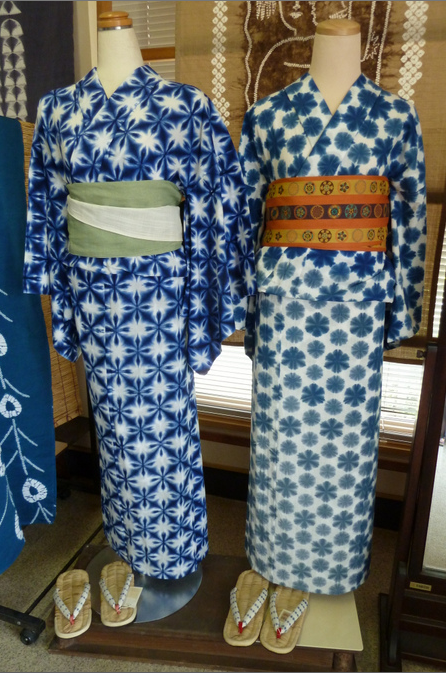
Sekka shibori fabrics.

Sekka kimono.

As part of a textile study tour, our group visited a true rara avis of Japan - the last remaining studio producing traditional sekka-style shibori fabric. 

First, have you ever made paper snowflakes?  The process involves folding paper, snipping into the folds, and then carefully opening up the paper to reveal a lacey and almost magically symmetrical snowflake. My children and I used to decorate our dining room windows with these every winter.

The paper snowflake process is a very basic cousin of the process that the artists of the Harisho studio in Arimatsu use to create beautifully patterned cloth in the sekka pattern.  The Japanese word sekka is translated as snowflake or "folded flower." Narrow lengths of cotton are folded, clamped and dyed in a very deliberate manner to produce one of the traditional patterns developed over generations.

Left: rolls of cloth. right top, bottom: street, storefront of studio.

Precision-folding yards of fabric.

Stack of folded fabric grows ever higher.

It takes 12 yards or more of the traditional 15-inch wide fabric to make a lightweight summer kimono.  First, the length of fabric is folded, along its length, accordion-style - if you made paper fans in kindergarten, you've done this part. Then the folded fabric is further manipulated into triangular folds, with the help of an iron, as seen in the image above. The craftsman, or craftswoman,  also uses a spray bottle of water, as damp fabric is easier to manipulate.

Compressing the folded cloth using  a special vise.

The triangular stack of fabric is then squeezed using clamps in a vise. In the image above a kimono forms a sheer curtain behind the craftsman, whom I assume is the studio owner, but I'm not sure about this.


Folded and clamped cloth.

The end result is a bundle of folded fabric, each edge and face precise and crisp, clamped between two triangles of wood. The blue on the wood is the stain from previous dye baths.

Another view of folded fabric.
In the image above gives another look at the folded fabric. (The blue and white textiles behind were patterned using other techniques.) Once clamped the fabric will be dyed. There are many options for the dyer - including, for example, immersing the entire bundle in one color, or, alternatively, dipping each point  in a separate color, resulting in a polychrome effect.  Also, the folds can be varied, to obtain different "snowflake" patterns.  Traditionally, the background is left white.

Rolls of sekka cloth.

Bolts of ikat fabric mixed in with sekka shibori.

After viewing the work in progress at the studio store, we walked to the factory location, where the dyeing is done and where, I gathered, there used to be larger-scale production of sekka and mame shibori  (mame shibori merits its own blog post in the future.) There was also a display area with current and historical sekka samples. At one time Harisho was exporting shibori cloth to Africa and we saw some samples from that era, in colorways tailored to the African market.

Samples of sekka shibori for African retail.

To the rear in the image above we see traditional blue and white sekka shibori, with samples for the African market displayed horizontally, and a piece of blue and white mame shibori draped in front.

Polychrome effects - colorful snowflakes.

Factory dyeing area.

Top, cloth drying. Bottom, left: vintage packaging, right: dye vats.

During the Arimatsu Shibori Festival (future post, I promise) rolls of sekka are for sale. However, placemats and napkins can be purchased from http://shop.yoshikowada.com/boutique. The current colorways on offer are limited to blue-and-white and pink-and-white. The pink-and-white would be fun for outdoor entertaining.

Placemats and napkins to order; image courtesy Yoshiko Wada.

Historically, nappery associated with eating is where it all began in Arimatsu, and its sister village Narumi, as the inns along the 17-century road called the Tokkaido needed bulk supplies of washable towels and napkins and other items for guests making their way to Edo, as Tokyo was known then. So, everything old is indeed new again.


22 June 2013

Shoyeido Incense Workshop Tour


Craftsman preparing jinkoh wood for incense.
Incense has a long history in Japan.  At the ancient court, men and women alike scented their kimono, their rooms, and even their writing paper with signature blends of incense that admirers were sure to mention later in their love poems.  - Kiyoko Morita, The Book of Incense.
(Click on any image to enlarge)
During a 2012 textile study tour one of our fellow participants named Francine, from Switzerland, arranged a special treat for us - a tour of the Kyoto headquarters of the venerable Shoyeido incense company, founded in 1705.


In the video above, the craftsman is chopping  and grading pieces of jinkoh wood. This rare and costly material can be burned separately or used in blends.

The Way of Incense, or Koh-Do, is the enjoyment of incense, and is somewhat analogous to the tea ceremony, and to other structured esthetic experiences, such as flower arranging or even wine tasting.
  
Incense in many shapes - sticks, cones, coils and fancies.
While Japanese courtiers once had to make their own incense, Shoyeido employs an ultra-modern production facility near Kyoto to produce all types of blended incense. The Kyoto corporate headquarters, with a shop on the ground floor, has enthusiastic English-speaking guides  explaining the ingredients and the process of making incense.

The uniform logo perfectly captures the drift of fragrant smoke.

Map with sources of raw materials for incense.
First, the ingredients, whose names conjure a travelogue of exotic locales - myrrh from Arabia, sandalwood from India, camphor from Sumatra. Almost none of the ingredients come from Japan, evidence of global trade well before the G8. 

From top left, clockwise: Sandalwood logs, ingredients, myrrh, benzoin.

Myrrh.

Grinder.

Close-up.
Although some materials, such as costly jinkoh (aloeswood) might be burned singly, most incense is blended.  The materials to be mixed are crushed in a grinder;  the resulting paste is then pressed into a cake.

Press - incense is compacted in the metal cylinder.

Incense sticks extruded onto a wooden board.

The cake of incense is then put into the extruder, which pushes out spaghetti-like strands of moist incense. The craftsman catches the strands on a wooden board and trims the strands to size.

Trimming the incense.

Incense trimmings fall into the hopper under the extruder.

Trimmed sticks.
After leaving the extruding station the sticks  of incense are transferred from the wooden boards onto larger shelves and trimmed once more.  The shelves are stacked for drying.


Sticks given final trim.

Our guide explains the process.

Bundles of incense sticks.
Finally, once dry, the sticks are bundled for shipping. I assume the factory which handles the bulk of production is automated but it was nice to get a glimpse of an older tradition.


Many fragrances and shapes from which to choose.
When compared to Shoyeido's incense, American scented candles seem crude and blunt, so for home fragrance we now order incense, as Shoyeido offers mail-order (the company has a branch in Boulder, Colorado.) The assortment packs we like come with a small holder for the sticks.

Beautiful packaging.

Sticks and round holder.

To learn more, consider The Book of Incense, by Kiyoko Morita, ISBN 978-4-7700-3050-4. The Metropolitan Museum in New York also provides information on  Japanese incense, with a slide show of lovely incense burners.