27 June 2020

Social distance scarf

Scarf, Stacy Charles Luna Effects, colorway Fireglow.

So, no movie theaters, concerts, parties, fiber arts classes or coffee with friends.  But we are lucky - no sickness either.  Time to knit and decrease that stash (pun intended). I'd bought this Stacy Charles mohair/silk blend a while back, thinking to blend it with a tonal solid, as the "pooling" of color in self-striping yarns can be awkward.

Instead, decided to use two balls of this yarn on its own for a scarf. One ball pulled from the outside, gray to coral, the other ball pulled from the inside, coral to gray. You have to use two skeins which more or less match in terms of color gradient.

Adapted from a Stacy Charles e-pattern, the Turtle Bay Shawl. That pattern uses size 8 needles however, and, although it might knit up faster, I've learned that the resulting fabric doesn't hold its shape very well. This is true for another mohair blend favorite, Debbie Bliss' Angel yarn, as well.

So, here's my pattern for a scarf with some body to it.  I do like this yarn; it was like knitting a pet.

Finished measurements:  7 1/2" wide by 62" long

Materials: 
1) 2 balls Stacy Charles Luna Effects, 70% kid mohair, 30% silk, colorway Fireglow
Nota bene: Both balls featured the color gradient gray to coral, outside to inside
2) Size 4 needles, 16" length
I like Hiya Hiya Sharp circular
3) Tapestry needle, markers (optional)

Gauge:
20 stitches and 28 rows = 4" in stockinette stitch
BUT the gauge doesn't matter that much in a scarf

Cast on 58 stitches

Ribbing:
Row 1: Knit 2, purl 2 across row
Row 2: Purl 2, knit 2 across row
Alternate Row 1 and 2 for a total of 6 rows of  2 x 2 ribbing

Pattern stitch:
Right side: [k2, p2] twice, [k10, p2, k2, p2] 3 times, k2
Wrong side: Knit the knit stitches and purl the purl stitches as they face you.

A tip: If it will help you keep track of pattern, place one marker after the first [k10, p2, k2, p2] sequence and another marker after the second sequence.

Work the first skein, then join yarn to reverse the color gradient. Knit in pattern until about 62" or until you've finished the reverse gradient, ending with a wrong side row, then finish with 6 rows of ribbing to match the first six rows.

Finishing:
Cast off all stitches in the ribbing pattern, and weave in ends. 


Fluffy scarf with coral center blending to gray at ends.

01 June 2020

Tammis Keefe towels

Linen dish towels by Tammis Keefe, c. 1957.

My wonderful DH just processed a batch of twenty-six towels to add to our Tammis Keefe website.  Visit the website and see more of these charming domestic linens, which brought color, and a little humor, to kitchen chores back in the day.

31 May 2020

Crunchy horseradish carrots

Matchsticks of multi-colored carrots.

I read in a newspaper that some home-bound parents are encouraging children to see how loudly they can munch and crunch raw veggies; anything to encourage kids to eat carrot and celery sticks.  I haven't posted a recipe in a while so here's a family favorite with lots of crunch from the dear departed Brasserie Jo restaurant, closed in 2018.

The recipe is in two parts - first, directions for a variation on French dressing which was the house dressing at the brasserie.  Some of the dressing is then mixed with the remaining ingredients. As my home-ec teacher from 8th grade, Mrs. B, used to say, the first step is to read the recipe through first. Then, chop and mix!

Horseradish Carrots a la Brasserie Jo
House Dressing
1 tablespoon Dijon mustard
5 tablespoons champagne vinegar
Juice from 1/2 lemon
6 tablespoons olive oil
1/2 cup plus 1 tablespoon vegetable oil (we use safflower oil)
1/2 teaspoon sugar
Salt & pepper, to taste

In a large bow, whisk together all the ingredients. Set aside until ready to use. Cover and refrigerate any leftover dressing to use with a salad or another vegetable dish.

Carrots
2 lbs pounds carrots, cut into bite-size sticks about 1/4 inch wide (see note)
1 1/2 teaspoons bottle horseradish
2 tablespoons chopped fresh parsley
Salt & pepper, to taste
1/3 cup House Dressing (from recipe above)

Gently toss all ingredients together in a large bowl.  Serve as an appetizer with crusty bread.

Note: DO NOT be tempted to substitute prewashed, precut carrots in this recipe. Sticks cut from whole carrots taste fresher and retain their crunch when tossed with dressing.

Another note: we like horseradish, so we double the amount, using 1 tablespoon. 

Plated!

30 April 2020

Have sewing machine, will stitch - face masks

Finished cloth face mask with bias tape ties.

So, I've been sewing a few face masks for friends and family.  Patterns and directions can be found on the internet; even The New York Times has published directions.  My husband and I found that the commonly used elastic-over-the-ears model fit neither of us, so my masks have ties. 

The easiest way to make ties is to use single- or double-fold bias tape.  Because I never throw anything away, I had some vintage packets of bias tape in black, purple, yellow and white, hence the color schemes of my masks.  

Supplies:
Fabric, different prints for front and back of mask
Single- or double-fold bias tape
Sewing notions - thread, needle, etc.

Supplies and template.

Cut:
Two pieces of fabric, 6" x 9" for an adult mask
Four ties, 16 1/2"long

I made a cardboard template to speed up cutting; we're not too concerned here about being perfectly on grain. 

Cut and ready to stitch.

Single-fold tape on the ironing board, folded and ironed.

If you have double-fold bias tape, just stitch the edge. My purple tape was single-fold, so I folded and ironed it, then stitched.  I've also made some masks using leftover quilt binding; again, just fold, iron and stitch the binding to make a narrow, hemmed tie.

Pin the stitched tie to the corner of the right side of the fabric.

I pin and sew each tie to a corner, with a few machine stitches, just to keep everything in place before stitching front and back together. To keep those ties out of the way when I stitch back and front together, I use masking tape to hold them in the center of the assembly.  Don't sweat the seam allowance - I used the width of the presser foot.

Ties tacked to corners and corralled with masking tape.

Back and front pinned and ready for stitching.

Leave about a 2" gap for turning.

After turning, trim corners to reduce bulk.

Turned right sides out.

The masks have three pleats; it's not critical that the pleats be absolutely equal, just do your best. Again, remember to keep the ties out of the way when stitching the next step.

Pinned pleats, ready to top stitch.

Pinned pleats.  I iron before stitching, so use glass-head pins.

I top-stitch close to the top and bottom edges, to catch the turning opening, but on the pleated sides again use the width of the presser foot as my seam guide. Stitch around twice, to make everything sturdy, tuck in your thread ends and done!

These can be washed and air-dried.  Someday, when this situation is in the rear view mirror, maybe these can be re-used as doll hammocks, or something.

DH in homemade fabric mask with ties.

02 April 2020

From the pantry - Hummus with canned beets

Beet hummus on crackers - yum!

So, it may be difficult to find toilet paper and diapers, but there are plenty of canned beets.  Not to mention tahini, which we often find near the peanut butter in our local grocery store, as they don't really know where to put this slightly exotic, and delicious, substance made of ground sesame seeds.

Any kind of tahini will do.


Beet Hummus

1  14-ounce can sliced beets, drained
¼ cup olive oil
Juice of 1 lemon
3 cloves garlic
½ cup tahini
1 teaspoon cumin
Salt and pepper, to taste

Combine all ingredients in a food processor or blender.  Blend until smooth, adding a bit more oil if necessary. Serve with pita bread, pita chips, crackers, or veggies.

Optional
Add one 14-ounce can drained and rinsed chickpeas.


Thank you for reading my blog. It means a lot to me, especially during these challenging times.


07 March 2020

Taking a Thread for a Walk - Museum of Modern Art

Wall Hanging: Entrance II, Dolores Bittleman, detail.

Textiles have been something of a stepchild at the Museum of Modern Art, (MoMA) so the exhibit "Taking a Thread for a Walk", installed in the newly renovated museum, is a welcome display of work in fiber.

In the gallery at MoMA.

MoMA's approach to collecting textiles has been haphazard, at best, and I found it difficult, despite engaging wall text, to find a thematic thread (pardon the pun) in the exhibit.  So, I'll look at the items as a sort of bildungsroman - an imaginary biography of encounters with textiles from childhood to maturity.

Let's begin with  toys developed by German education innovator Frederick Froebel (1782-1852), such as crocheted soft balls - the forerunners of today's soft foam Nerf ball. The image below features modern versions of these tactile toys next to another Froebel item, flexible wood strips for weaving.  By the early 20th century, Froebel toys were mass-produced and distributed worldwide.  Frank Lloyd Wright's mother gave him a set of Froebel wooden blocks.

Left: Balls, soft crochet.  Right: Slatwork, stained wood.

Playing with the Froebel weaving strips might lead to study at the Bauhaus, a German school of modern architecture and design with a textile department headed by Gunta Stozl. Below is her pencil study for a wall hanging, and an image of the wall hanging.

Working drawing for wall hanging, Gunta Stolzl, c. 1924.

Wall hanging, Gunta Stolzl, c. 1924.


Anni Albers, who also studied at the Bauhaus, came to America in 1933 with her husband, Josef Albers; the Bauhaus student now became an instructor in weaving.   Learn more about Anni and Gunta here: https://www.designtex.com/bauhaus-project

Artist Sheila Hicks studied painting with Josef Albers at Yale but her meeting with Anni Albers led Hicks to adopt fiber as her medium.

Loom used by Anni Albers, designed by Louis Strohacker, c. 1952.

Tapestry, Anni Albers, 1948.

After receiving her MFA from Yale, Hicks' career included commercial commissions, such as the embroidered panel below, for the interior of an Air France Boeing 747.  She also designed textiles for Knoll, but helped establish fiber as a sculptural medium in its own right, independent of any functional role.  Another student, Dolores Dembus Bittleman, said of her lessons with Albers:
...We'd talk about threads and textiles and how they behaved. The important lesson I absorbed was that when you'd 'listen' quietly, threads would suggest what could be done with them.  We ranged the world from there...This instruction slowly allowed possibilities of the materials to reveal themselves to me over time.

Airplane interior panel, Sheila Hicks, 1969-1977.

Wall Hanging: Entrance II, Dolores Dembus Bittleman, 1964.

Fabrics for window treatments, various designers.  Chair by Harry Bertoia.

A fiber MFA graduate might build a career in industrial design, creating textiles to meet the need for window treatments for post-war glass curtain-wall skyscrapers. These tall buildings featured perimeter walls of windows.  Interior designers utilized miles of sheer, scrim-like fabrics, known as casements, which helped to prevent glare and control light.  The look was re-created for the AMC cable show about a 1950's Manhattan advertising agency, "Mad Men."  Note the curtains on the far wall.

A set for "Mad Men".  Source: https://www.bloomberg.com/news/articles/2015-04-09/want-don-draper-s-office-from-mad-men-here-s-how-to-get-it

As we left the exhibit, we stopped by the participatory studio space and admired the work in progress on communal looms, and a wall hanging created from some of the small finished woven pieces.

Weaving in progress.

Made from communal weavings.

28 February 2020

In Pursuit of Fashion: The Sandy Schreier Collection at the Met


Offering Bearer, Egypt, c.1981 - 1975 BC.

Egyptian-inspired evening dress, Madeleine & Madeleine, c. 1923.

Evening dress, detail.

Recently, DH and I took a fantastic group tour, Fashion in Art with Special Exhibit: The Sandy Schreier Collection  at the Metropolitan Museum in New York. I used the Events menu to find this tour.

I blogged about the first part of the tour here, and this post explores the Schreier collection of 20th century fashion, with a focus on pieces which reference historic costume or have interesting narratives. Also, I feature items which just appeal to me; after all, it's my blog.

Now, the first image in this blog is a 4,000 year-old representation of ancient Egyptian dress. The second image, of an evening dress by Madeleine and Madeleine, clearly references the Egyptian revival motifs which became all the rage after the discovery of King Tutankahmun's tomb in 1922, not to mention silent film star Theda Bara's portrayal of Cleopatra in 1917.

While the 1920's dress features a girdle of an Egyptian-inspired bird delineated in fake jewels, the silhouette of the dress is thoroughly 1920's.  While the ancient dress clings to the body, showing every curve, the flapper-era dress falls straight and away from the body, with no accent on the bosom; only the bird motif girdle creates a feminine emphasis at the hips.

Mariano Fortuny Y Madrazo, more widely known just as Fortuny,  was another designer who translated aspects of ancient dress into contemporary fashion. His famous Delphos dress, an elegant straight gown whose infinite tiny pleats skimmed the body, references ancient Greek female attire.  Fortuny still exists and made some of the outfits for Downton Abbey.

Marble statue of a woman, Greek, 4th century BC.

Fortuny gown and tunic, 1920's.

Downton Abbey Delphos-style dress by Fortuny.

So clearly, fashion designers, just like artists in many media, looked to the past for inspiration, one theme of this exhibit. Another theme is the manner in which designers respond to economic or political conditions.  Some of the garments were designed by Gilbert Adrian, a busy Hollywood designer best known by the monomym Adrian.  The ensemble below was designed during World War II, when Regulation Order L-85 (scroll down to the "Dressing for War" section) put limitations on the use of silk, among other fabrics. So, designers used alternative materials such as rayon, seen in this burgundy sheath style dress.  Fringe, however, was unrestricted, so could be used with abandon.

Rayon dress with fringe, Gilbert Adrian, c. 1943.

Adrian, who designed Judy Garland's blue-and-white gingham outfit in the Wizard of Oz, also produced one of my favorites in the show, below.

Rayon dress with printed cats, Gilbert Adrian, 1944.

The garments exhibited also featured examples of amazing handwork - beading, embroidery, passmenterie and so forth, and it's great to see this craftsmanship celebrated, on accessories as well as clothes.  It's also time to be no longer ashamed of the decorative impulse.  Imagine the dress below on a Bright Young Thing out on the town and dancing, fringe flying and light sparkling on the beads.

Evening dress, French or American, c. 1925-28.

Helmet hat, 1920's. 

As noted in the exhibit, hats and other accessories  made couture a bit more inclusive - these items of clothing were independent of body shape and offered a way to experience a bit of high fashion with less of an investment.  Hats were also a way to introduce a little bit of levity into the fashion equation.

Hat, Philip Treacy, 2003.

You may remember admiring Treacy's hats at the wedding of Prince William and Katherine Middleton in 2011.  Within the compass of headgear, Treacy exhibits a lot of creativity.

Well, this post covers just a fraction of  the items on view, and, judging from the crowds, this is a popular exhibit.  The Met is lucky Ms. Schreier is donating much of her collections to its Costume Institute.  There is a catalog available.

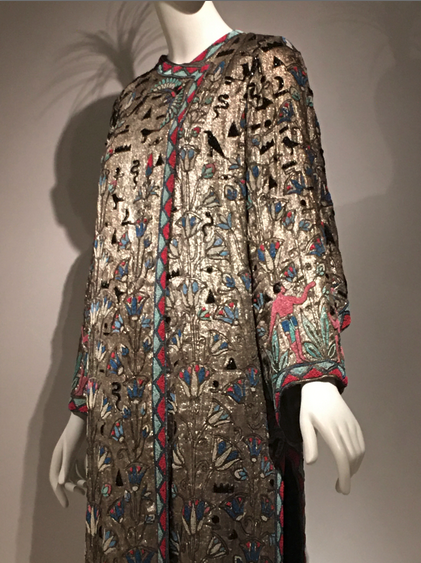
I'll book-end this post with a view of another Egyptian revival-inspired garment which, if given to me, I would never take off. 

Evening coat, detail, French, 1923-28.  This view captures the glimmer of silver lamé.