15 August 2020
Ruth Asawa postage stamps
Just a quick post. Postage stamps honoring sculptor Ruth Asawa (1926-2013) are now available. If you can't find them at your local post office, stamps and first day covers may be ordered here: https://store.usps.com/store/home
You have to set up an account, but it is a convenient way to purchase stamps, especially in these pandemic times.
This tribute to Ms. Asawa is long overdue; learn more about her here: https://www.nytimes.com/2020/07/20/t-magazine/ruth-asawa.html?searchResultPosition=1
14 August 2020
Eco Printing with Mary Delano
![]() |
| Plants arranged on a length of cotton. |
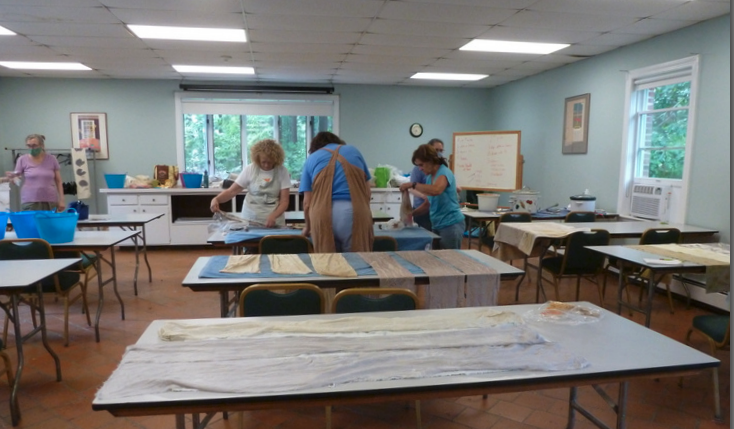
On a very hot recent August day, seven women, including me, joined fiber artist Mary Delano for a full day workshop of eco printing, sponsored by the Massachusetts Horticultural Society.
What is eco printing? It's making designs on treated fabric using found plant material. The pigments found in the leaves and flowers deposit onto the fabric, resulting in one-of-a-kind creations. Results are hard to replicate, so the emphasis is on experimentation and exploration, although there are some procedures to follow. Some well-known practitioners, in addition to our instructor, include India Flint and Jane Dunnewold.
Our hard-working instructor gave each participant eight narrow lengths of diverse fabrics - including repurposed tablecloths, raw silk, and a hemmed silk scarf - all of which she had soaked in mordant.
![]() |
| Flowers and leaves positioned on fabric. |
![]() |
| End result! (detail) |
First, I took the mordanted cotton fabric and wet it in plain water, wringing it out well. For this exercise we also dipped this fabric in tannin, which acts as a modifier. Then I placed the damp piece of fabric, treated both with mordant and tannin, on plastic wrap. Next, geranium and Japanese maple leaves and black-eyed susan flowers were positioned onto the fabric. Finally another piece of cloth - NOT mordanted but dipped in a solution of iron (ferrous sulfate) was placed on top, forming a sort of sandwich of vegetation between two differently-treated lengths of cloth. Finally, the "sandwich" is rolled up, plastic and all, on a plastic wrap-covered wooden stick (looked like a piece of broom handle.)
NOTE: it's really important to wear gloves while working with the iron solution, as it will stain your hands. Also, never use utensils and tools used for dyeing for food preparation. The dyes and plants are natural but the chemical mordants and modifiers can be toxic, so take precautions when working with these substances.
![]() |
| Leaves and flowers "sandwiched" between treated pieces of cloth. |
![]() |
| Fabric and leaves rolled around a thick wooden stick. |
The tightly rolled bundle is then tightly tied with string. It's really important to roll and tie tightly, as the flowers and leaves need good contact with the fabric to deposit pigments. Once we had all rolled a bundle, Mary steamed them in a lobster pot, fueld by propane and outside the studio. The bundles steam for an hour, with an old towel draped over the steaming pot to slow down evaporation.
![]() |
| Fabric bundles steaming away. |
Using old slow cookers, Mary also had some dye pots ready for us, including dye made from purple beech leaves. I put the raw silk length into this dye bath for about 30 minutes, resulting in a muted brown. I imagine Friar Tuck, from the Robin Hood tales, wearing robes of this color.
![]() | |||
| Raw silk dyed with purple beech leaves. |
I placed a number of birch leaves and hydrangea florets onto this cloth, rolled and steamed it, but the imprints were almost invisible. However, with this approach to surface design, you can try again - just take the damp fabric and put more, and different, leaves and flowers on it and re-bundle. I did this, using Japanese maple leaves and coreopsis stems and had much better results.
For another dye bath, Mary dumped goldenrod - leaves, stems, flowers and all - into another slow cooker, let it stew and voila! - a beautiful bright yellow, seen below.
![]() |
| I like this just as it is. |
After the bundles steam for an hour or so, it's time for the Great Reveal. Here we are, in our pandemic masks, unrolling one creation on an old towel. It was so exciting we could hardly wait for the bundles to cool off, and steam escaped as we opened the work.
![]() |
| Anticipation. |
![]() |
| Removing the spent leaves. |
![]() |
| Andrea had done this before and brought some plants from home. |
![]() | |
| Some of our materials - birch leaves and hydrangea. |
![]() |
| Drying in the sun. |
![]() |
| Our workspace. |
Do you see the air-conditioner in the image above, in the window to the right side? This piece of HVAC equipment imitated the sound of a jet engine, so most of the time it was turned off, so we could hear Mary. The room became a bit toasty, but we must sacrifice for art.
![]() |
| Mary printed petals of a giant hibiscus flower. |
![]() |
| My seven samples, at the end of the day. |
Back home, I heat set my sample with a steam iron, and won't wash for 3 weeks, if indeed I wash them at all. Mary often adds embroidery to her pieces and I can see that stitching would add texture and some depth to these pieces.
![]() |
| Queen Anne's Lace, stems and all, on silk. |
Resources and supplies, courtesy Mary Delano
woolery.com: tannin, iron, copper, alum, natural dyes
maiwa.com: tannin, natural dyes
dharmatrading.com: silk scarves and fabric
prochemicalanddye.net: alum and sodium acetate
hillcreekfiberstudio.com: iron sulfate and copper sulfate
Facebook Group: Printing with Botanicals
Some of Mary's favorite plants for printing:
Japanese maple, other maple, sumac (leaves and cones separated into little pieces), birch, oak, locust, threadleaf coreopsis (flowers and stems with leaves), rose leaves, Lady's mantle, peony leaves, lupine leaves, begonia flowers and red leaves, osteospermum (dark red flowers), perennial geranium (leaves and flowers), raspberry, blackberry, strawberry (leaves), black-eyed susan (trim cone so flower lies flat), goldenrod (flowers and stems with leaves), false indigo or baptisia (leaves), marigolds, purple smokebush (leaves and "smoke")
31 July 2020
Tammis Keefe ad in Vogue magazine
Every now and then some Keefe-related ephemera comes my way, such as this advertisement I found on ebay. It's part of a page from Vogue magazine, 1952. This page also featured ads for Wisconsin Cheese, "Mother 'N' Daughter" aprons, and Nefertiti Egyptian Designs, vases from Kipp Ceramics.
Several interesting discoveries in this ad: the copy gives a name, "Hokus Pokus", to two of Keefe's designs and the image prominently displays her packaging design for the set. Finally, the ad lists Bloomingdale's as the retailer. The late Phoebe Ann Erb, an independent scholar who had spoken with some of Keefe's contemporaries, was told that Keefe's designs, signed as "Tammis Keefe", were exclusive to Lord & Taylor. We now know that some designs were sold at Bloomingdale's as well.
Both of these designs are shown on our website; when my husband has time, we'll re-label them as Hokus Pokus 1 and Hokus Pokus 2.
![]() |
| Hokus Pokus 1, gray |
![]() |
| Hokus Pokus 2 |
![]() |
| Hokus Pokus 1, black |
04 July 2020
Happy Fourth of July!
27 June 2020
Social distance scarf
![]() |
| Scarf, Stacy Charles Luna Effects, colorway Fireglow. |
So, no movie theaters, concerts, parties, fiber arts classes or coffee with friends. But we are lucky - no sickness either. Time to knit and decrease that stash (pun intended). I'd bought this Stacy Charles mohair/silk blend a while back, thinking to blend it with a tonal solid, as the "pooling" of color in self-striping yarns can be awkward.
Instead, decided to use two balls of this yarn on its own for a scarf. One ball pulled from the outside, gray to coral, the other ball pulled from the inside, coral to gray. You have to use two skeins which more or less match in terms of color gradient.
Adapted from a Stacy Charles e-pattern, the Turtle Bay Shawl. That pattern uses size 8 needles however, and, although it might knit up faster, I've learned that the resulting fabric doesn't hold its shape very well. This is true for another mohair blend favorite, Debbie Bliss' Angel yarn, as well.
So, here's my pattern for a scarf with some body to it. I do like this yarn; it was like knitting a pet.
Finished measurements: 7 1/2" wide by 62" long
Materials:
1) 2 balls Stacy Charles Luna Effects, 70% kid mohair, 30% silk, colorway Fireglow
Nota bene: Both balls featured the color gradient gray to coral, outside to inside
2) Size 4 needles, 16" length
I like Hiya Hiya Sharp circular
3) Tapestry needle, markers (optional)
Gauge:
20 stitches and 28 rows = 4" in stockinette stitch
BUT the gauge doesn't matter that much in a scarf
Cast on 58 stitches
Ribbing:
Row 1: Knit 2, purl 2 across row
Row 2: Purl 2, knit 2 across row
Alternate Row 1 and 2 for a total of 6 rows of 2 x 2 ribbing
Pattern stitch:
Right side: [k2, p2] twice, [k10, p2, k2, p2] 3 times, k2
Wrong side: Knit the knit stitches and purl the purl stitches as they face you.
A tip: If it will help you keep track of pattern, place one marker after the first [k10, p2, k2, p2] sequence and another marker after the second sequence.
Work the first skein, then join yarn to reverse the color gradient. Knit in pattern until about 62" or until you've finished the reverse gradient, ending with a wrong side row, then finish with 6 rows of ribbing to match the first six rows.
Finishing:
Cast off all stitches in the ribbing pattern, and weave in ends.
![]() |
| Fluffy scarf with coral center blending to gray at ends. |
01 June 2020
Tammis Keefe towels
![]() | ||
| Linen dish towels by Tammis Keefe, c. 1957. |
31 May 2020
Crunchy horseradish carrots
![]() |
| Matchsticks of multi-colored carrots. |
I read in a newspaper that some home-bound parents are encouraging children to see how loudly they can munch and crunch raw veggies; anything to encourage kids to eat carrot and celery sticks. I haven't posted a recipe in a while so here's a family favorite with lots of crunch from the dear departed Brasserie Jo restaurant, closed in 2018.
The recipe is in two parts - first, directions for a variation on French dressing which was the house dressing at the brasserie. Some of the dressing is then mixed with the remaining ingredients. As my home-ec teacher from 8th grade, Mrs. B, used to say, the first step is to read the recipe through first. Then, chop and mix!
Horseradish Carrots a la Brasserie Jo
House Dressing1 tablespoon Dijon mustard
5 tablespoons champagne vinegar
Juice from 1/2 lemon
6 tablespoons olive oil
1/2 cup plus 1 tablespoon vegetable oil (we use safflower oil)
1/2 teaspoon sugar
Salt & pepper, to taste
In a large bow, whisk together all the ingredients. Set aside until ready to use. Cover and refrigerate any leftover dressing to use with a salad or another vegetable dish.
Carrots
2 lbs pounds carrots, cut into bite-size sticks about 1/4 inch wide (see note)
1 1/2 teaspoons bottle horseradish
2 tablespoons chopped fresh parsley
Salt & pepper, to taste
1/3 cup House Dressing (from recipe above)
Gently toss all ingredients together in a large bowl. Serve as an appetizer with crusty bread.
Note: DO NOT be tempted to substitute prewashed, precut carrots in this recipe. Sticks cut from whole carrots taste fresher and retain their crunch when tossed with dressing.
Another note: we like horseradish, so we double the amount, using 1 tablespoon.
![]() |
| Plated! |
Subscribe to:
Comments (Atom)