29 April 2021

Stitched souvenir of London

London Routemaster bus, image from Wikimedia.   

 
In 1998, we enjoyed a week-long family vacation in London.  We mostly rode the Tube, rather than buses, as it was just easier to figure out the routes. 
 
After drooling over the Tana lawn at Liberty I also purchased this small souvenir - a cross-stitch kit from Textile Heritage. Well, twenty years later, I finished it!
 

Small kit by Textile Heritage.


The kit came with a small square of 18-count Ada cloth, embroidery thread, a needle, a stitching diagram and brief instructions. As suggested, I cut small lengths of each color and taped these next to the color key, to clarify which color went in which stitch. I also drew the center axes of the design in red pen, to center the design on the small square of cloth. As I stitched each section, I colored it in with a yellow marker. The fine mesh of the 18-count was challenging, and I don't think I'll tackle it again, although I do appreciate the detail.


Progress image.


Finished -  ready to mount and frame.

20 April 2021

Finishing a very good book by Virginia Postrel, which received a deservedly glowing review in the Wall Street Journal and a somewhat nit-picky notice in the New York Times.

Love the glossary of textile terms but wish the budget had stretched to more images and to color plates upon occasion.

The Fabric of Civilization: How Textiles Made the World. Virgina Postrel. ISBN 9781541617605.
 

24 February 2021

Modern and antique stitched cats


Detail of a group friendship quilt, from Cats on Quilts, p. 100

One of my favorite quilts books is written by quilt historian Sandi Fox - Cats on Quilts, published in 2000 by Harry N. Abrams. It's full of details of quilts featuring appliqued or embroidered felines.   It seems there a lot of overlap between cat-lovers and quilt makers.  I know from experience that no cat can resist settling on a heap of piled up fabrics.

So, for an introductory kantha stitching online workshop offered by quilter extraordinaire, Carol Anne Grotrian, I turned to this book as a source for my explorations.  Kantha stitching is a traditional process in which used saris are artfully layered and stitched into new bed covers; the artisans are women in Bangladesh and elsewhere on the Indian sub-continent. I first leaned about kantha in a workshop with Canadian artist Dorothy Caldwell.

The top  image is blurry, as it is in the book, but the stitching seems to say:
Tom, Dick and Harry
Vowed never to marry
In the Good Old Summer time

and the signature might be "Mrs. Fenton M. Smith", although it's hard to decipher.

This 1904 quilt was documented in the New York Quilt Project.

For my small project, I used two layers of unbleached muslin, scrap red fabric, a sashiko needle and sashiko thread, which is about the same weight as 6-strand embroidery floss. The solid red cat was needle-turn applique.  The stitched red cat was outlined in chain stitch, a traditional kantha technique, and the "fur" was just my mash-up of sashiko and kantha sewing.  Large running stitches, echoing the outlines of the moon and the kitties, filled the background.  Small stars are a special motif called a bhutti.  I did use a fine line chalk pencil to roughly sketch out the general direction of my stitching lines. 

The finished Cats and Moon below, photographed in raking light to show the texture created by the stitching.

My stitching, approximately 8" x 10".


The back. I didn't bother to bury the knots.  
 
 I will probably back this little work with red fabric and make a small pillow or wall hanging.

14 February 2021

A Kitty for Valentine's Day

Kitty, atop Hershey's kisses.

I stitched up a few kitties for family and friends.  Just wool felt, embroidery floss and polyfill stuffing. Very easy.
The pattern is available if you sign up for a newsletter here: 


I did sign up and downloaded the pattern, but enlarged it to make a kitty about 5 1/2" tall.  I also changed the eyes, as follows:
 
 
For the eyes, I used 3 strands of black embroidery floss and also 3 strands for the pink nose, which is just satin stitch.
 
To attached the face to the front, I used two strands of white floss, and a simple running stitch. Two strands, color to match the felt, are also used to whip stitch the front and back together.
 
Finally, I used the entire 6 strands of floss for the whiskers, which are just pulled through the layers and trimmed, for a 3-dimensional effect. 
 
Happy Valentine's Day!

19 January 2021

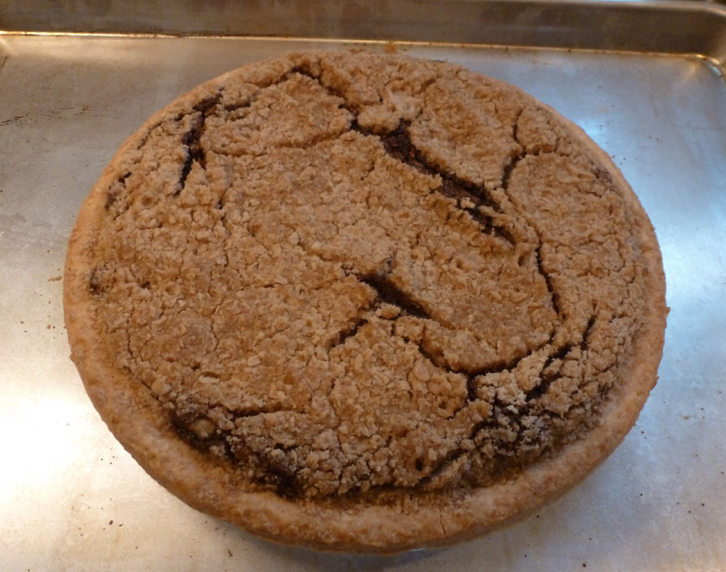
Shoofly Pie

Slice of Shoofly pie.


So, a recent Zoom meeting of friends tangented (is that a word?) into a discussion of Shoofly Pie, a staple of American country cooking, particularly among Amish and Mennonite farm families.

A little googling led to this recipe in the New York Times.  Another recipe, from the Wikipedia entry for Shoofly Pie, can be found here: https://www.ourheritageofhealth.com/traditional-shoo-fly-pie-recipe/

I always peruse the reader notes in every NYT recipe; these notes are often quite helpful and one note mentioned the molasses product shown below. 


https://www.goldenbarrel.com/product/golden-barrel-supreme-baking-molasses/

So, here is my process for baking Shoofly Pie - the directions are an amalgamation of the two recipes referenced above.

1) First, defrost one 9" frozen pie shell. While it's defrosting, make the crumb mixture: Mix 1 1/2 cups flour, 1/2 cup brown sugar, 1 teaspoon cinnamon, 1/2 teaspoon nutmeg and 1/8 teaspoon salt.

2) Cube 1 stick cold unsalted butter and cut into flour mixture, using a pastry cutter, until mixture forms fine clumps.

3) At this point preheat the oven to 425 degrees.

Have the defrosted pie crust and crumb mixture ready to hand. Put your pie crust on a baking sheet. UNDER NO CIRCUMSTANCES should you try to maneuver this liquid-y pie onto an oven rack. It will spill and slosh and there will be burnt molasses all over the bottom of the oven.

4) Now, here's where my directions are a bit different. I put half the crumb mixture into the pie shell. (Sorry no image - soon.)  Then I measured 3/4 cup of baking molasses (see above) in a 2-cup liquid measuring cup. Using another measuring cup, I poured 3/4 boiling water into the molasses. Then I added 1/2 teaspoon baking soda. I stirred this well, it started to foam, and I immediately poured the molasses mixture onto the crumbs in the pie crust. 
 
5) Finally, I mounded up the remaining crumbs over the top of the pie.

Filled pie, ready to bake.


6) I put the pie, on its baking sheet, into the oven and set the timer for 15 minutes. After 15 minutes, the oven temp was lowered to 350 degrees. I gave the pie another 35 minutes; 30 would probably have been enough.


Puffed up while in the oven.


All baked - crumb crust nicely browned.


7) When removed from the oven, the pie rested on a rack until cool, and then was popped into the fridge.  

My husband then cut the pie and, much to my surprise and relief, the pie held its shape nicely.   Thank you, St. Honore, patron saint of bakers.  We let our slices come to room temperature before enjoying, washed down with some decaf.


One quarter wedge removed, then sliced into 2 pieces.


The pie forms three layers - a molasses layer just above the crust, a kind of cakey layer of molasses-soaked filling in the middle, and then the slightly crunchy crumb layer on top. Surprisingly good.

17 January 2021

Pandemic stitchery, or a child entertains herself


Flora the Shy Daisy.


A new company in Colorado makes delightful little kits to create your own stuffed toys,  Heron Hill Stitch Co. 

My granddaughter loves these,  cutting out the pieces and stitching her new felt friends all by herself.  Pretty impressive for a five-year-old.  It's all about the process and we don't worry too much about perfection in needlework at this time.  She's having fun, while not staring at a screen.


Newly stitched friends.

Fran, the optimistic frog.


Sam, the wide-awake strawberry.
 
 
These endeavors prompted me to unearth something from a storage trunk - Hootie, an owl I glued and stitched, using a kit, when I was about ten or eleven.  Hootie has somehow survived through many house moves and life cycle events, a little faded, but still beloved.
 
 
Hootie.


25 December 2020

Best Wishes for 2021

Snowy morning in Koishikawa, Hokusai, 1830-35.
 

Happy holidays to all my friends and followers.

May 2021 bring health, contentment and companionship.