09 April 2022

Art by Taiko Chandler at the Denver Botanic Garden

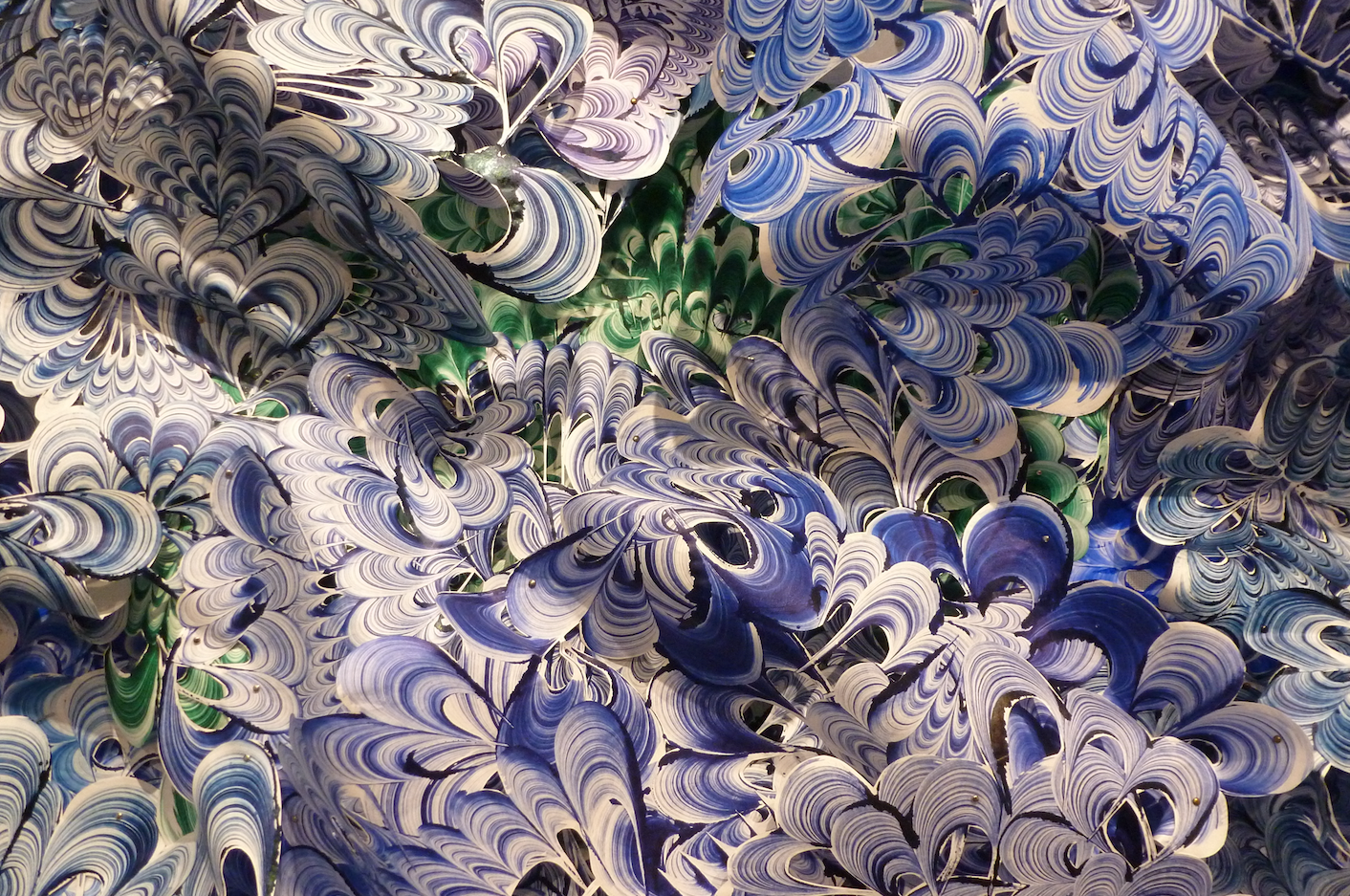
Blue Surge, detail.

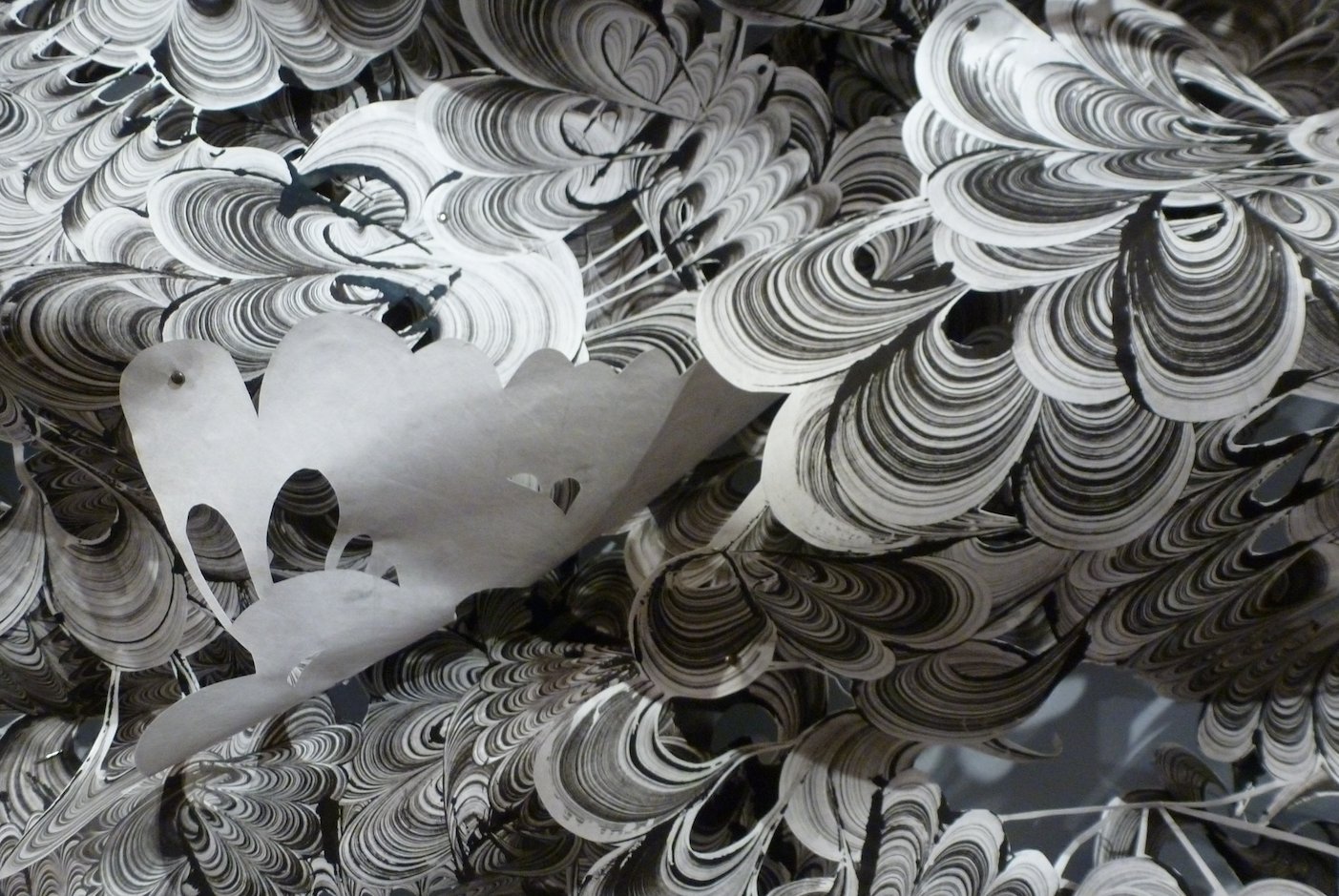
During a recent trip to Denver, we enjoyed an art exhibit at the Freyer-Newman Center, the research and exhibtion space wing of the Denver Botanic Garden.  The Indelible Garden: Prints by Taiko Chandler was on view from December 11, 2021 through April 3, 2022. The exhibit featured colorful monoprints and striking, large-scale undulating sculptures created from elements printed on Tyvek. Tyvek is the trade name of a non-woven polyethylene fabric commonly used as a house wrap and for rip-proof envelopes.

Gallery installation.


Contested Void, 2021.

Contested Void is made with organza (a sheer fabric), wire, thread and monoprinted Tyvek.  Now a Denver resident, Ms. Chandler is originally from Japan and according to the exhibit website her work is influenced by:

Recollections of the wild forests near her hometown [Nagano], her father's garden, and her mother's ikebana (traditional flower arranging) suffuse her artwork, finding form in the organic, layered shaped of her prints and installations. Chandler's plant-like forms are not intended as literal representtions of nature, but rather interpret its foundational influence on family and memory.


Contested Void, detail.

Frozen, 2017.


Frozen, detail.


Blue Surge, 2021.


Blue Surge, detail.

 
Turkeytail fungus on a rotting log.

Shortly after returning home, I found this turkeytail fungus while walking near my home.  Life imitating art?

12 March 2022

A Bouquet from far away

Summer is on its way.

I received an email newsletter from Cheshire Garden, an organic farm in New Hampshire whose proprietors Patti and Ralph used to sell their wonderful preserves and mustards at our local farmer's market.

They no longer visit our market but I still do mail order. Anyway, the newsletter concluded with this wonderful image of zinnias and cosmos, a real pick-me-up on the this gray, wet New England day. I thought I would share.

28 February 2022

Sophia Crownfield, textile designer, at the Cooper Hewitt

Study of Squash or Pumpkin Plants, early 20th century. Photo: Matt Flynn, Smithsonian Institution.

This month we visited the Cooper-Hewitt Museum in New York City to view a small but impressive exhibit highlighting the work of designer Sophia Crownfield, a professional American artist who developed precise nature studies into prints for textiles and wallpapers.  The exhibit is on view through July 31, 2022.  
 
From the wall text:

From the 1890s to the 1920s, Sophia Crownfield (American, 1862-1929) designed prints for some of the most prominent silk and wallpaper manufacturers in the United States.  Crownfield's interest in design was not a casual one; she was a middle-class working woman who supported herself and her youngest sister Eva through her design career.  Her story shows the hard reality that confronted American designers in a largely freelance system that offered little professional support or recognition.  To record and protect their unique designs, Crownfield and the many others who worked for some of the largest textile firms turned to the United States patent system.

Patent submission.

Wall text continues:

Crownfield first worked in Baltimore as a china decorator, and in 1889, she moved to New York City where she established herself as a professional freelance designer.  Her drawings of flowers range from delicate graphite sketches to vivid color studies, revealing her obvious ease with different types of specimens.  She had a surehanded approach that started with her sketching from stems of live flowers.  Through progressive stages of rework, she developed designs for patterns and polished drawings for specific uses.  Examples of Cheney Brothers' printed silks, show alongside these richly detailed drawings, reveal how Crownfield's process transformed floral stems into the fashionable patterns of the period.

Drawing, Study of Irises, on trace paper, early 20th-century.


Drawing, Study of Irises, gray paper, early 20th-century


Cheney Brother silk print, designed by S. Crownfield.

Wall text, conclusion:
 
Generation of female designers, both before and after Crownfield, experienced the same invisibility; the notable exceptions were those that were wealthy or well connected.  Recognizing how easily her sister's contributions to American design could be lost, Crownfield's younger sister, the author Gertrude Crownfield, took great care to place her work in institutions such as Cooper Hewitt to preserve her legacy.
Crownfield in her studio, c. 1900, photo courtesy Crownfield family.

Crownfield's design career coincided with the heyday of the Cheney Brothers manufacturing of silk fabrics.  You can read a contemporary promotional history of the company here: https://digital.library.cornell.edu/catalog/hearth4614873
 
Drawing, floral study (detail)  early 20th-century

Silk fabric designed by Crownfield, produced by Cheney Brothers.


Silk fabric designed by Crownfield, produced by Cheney Brothers.


Silk fabric designed by Crownfield, produced by Cheney Brothers (glare from lighting).


Design for cushion cover, early 20th-century.

21 February 2022

A book about the shirt on your back - Worn

ISBN 978 152 474 483 95

I'm just finishing up this well-received book by Sofi Thanhauser, organized into chapters by fiber families - Linen, Cotton, Silk, Synthetics, and Wool. Thanhauser delves into the history and usage of these fibers in clothing, including a welcome exploration of the impact of manufacturing practices on workers and the environment.  Moreover, as she writes,  “There is scarcely a part of the human experience, historic or current, that the story of clothes does not touch.”
 
It's an excellent book, despite the lack of images, and is available as an ebook as well.
 
I hope a paperback will be forthcoming. It's an important and engaging work.


31 January 2022

LLama wool mitts


Fingerless mitts.
 

So, a friend cleaned out her yarn stash and gave me two 99-yard skeins of "Maya" yarn produced a while back by the bygone company Classic Elite Yarns.  Ravelry came through again with a pattern by Leslie Friend for fingerless mitts. As I find touch-screen gloves don't work well for me, I thought I'd try these. On the advice of another Ravelry user, I knit with size 5 needles, although the pattern called for size 6.  The result is a nice, dense fabric, and a good fit on my small hands. (DH is modeling in the image.)

The worsted-weight yarn, made in Peru, is 50% llama, a fiber I don't often encounter in yarn, and 50% wool,  and is very, very warm. The mitts used up about 2/3 of the two skeins.
24 January 2022

New Tammis Keefe items on website

Courage, pink colorway.

 
I began collection Keefe items in 1999, when a friend introduced me to this artist.  Although the pace of acquisition has slowed considerably in the last few years, I've been able to find some new items and, thanks to my patient DH, there are now 22 new images on the www.tammiskeefe.com website.  These include designs already listed but in additional colorways, and also a few new designs.  I continue to be impressed by Keefe's output, given the relatively short span of her career.  She began designing print textiles around 1947 and died in 1960.  The linen towels were produced by home textiles manufacturer Fallani & Cohn.

Grocery List.


Reef.

 
Thanks to the kindness of fellow textile aficionado Merle, who has a wonderful website dedicated to Vera Neumann,  I've recently added dozens of Keefe hankies to the treasure trove; it will take us a while to process them, but stay tuned. Before being posted to the site, the items must be photographed, the images water-marked, and then I have to think of a title for each design, which is more difficult than you might think when dealing with about 400 individual designs. Cataloging takes time but I love sharing the work of this talented woman artist.


Pond Lily.


Ringmaster, red colorway.


Mermaids, indigo colorway.

31 December 2021

Lotus Lantern.
 

I made this lantern from a kit, in a Zoom workshop sponsored by our local public library.  The Korean-American activity leader shared a bit about the symbolism of the lotus. Among other attributes, the flower is a symbol of rebirth, which seems appropriate as we enter a new year in our Western calendar.
 
Thanks to everyone who visited my blog this year, and best wishes for 2022! - Ellen