10 November 2022

Weavers' Guild of Boston Show and Sale

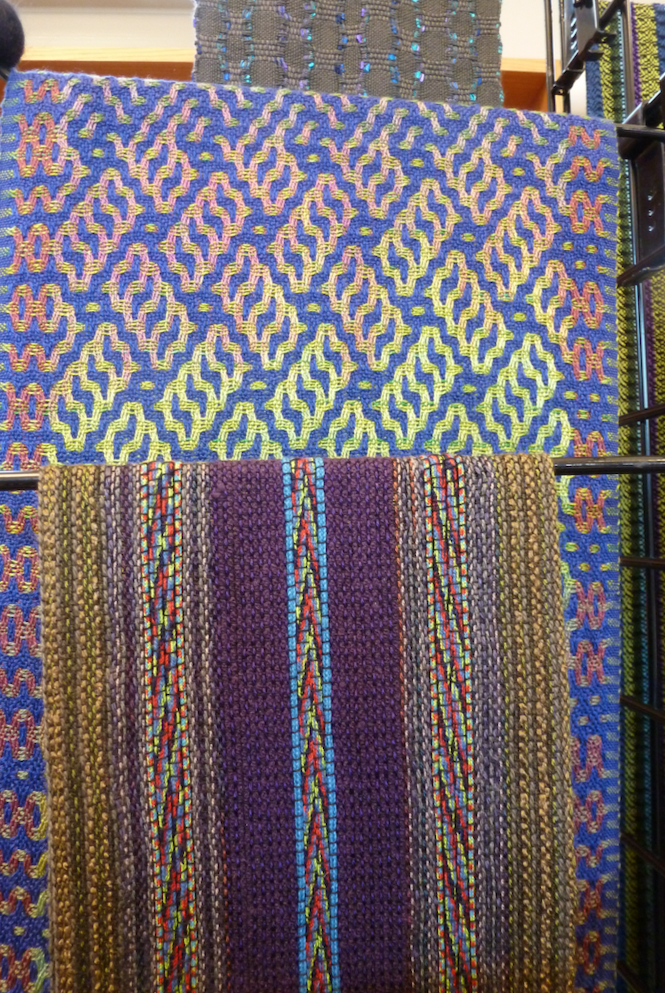
Beautiful rug, Johanna Erickson.


A friend clued me into a wonderful sale of woven items by the Weavers Guild of Boston, whose annual sale took place November 4 and 5, at the Weston Art and Innovation Center, the "maker space" of the Weston public library system. Lots of wonderful items for sale - accessories such as scarves, wraps and jewelry, and textiles for the home too.  And we were allowed to touch!  I purchased a scarf for my daughter-in-law - hope she likes it.

I wasn't able to record every weaver's name for every item, but there was a lot of skill on display and exciting use of color.

Scarves in glowing hues.


Scarves in shades of white, black and gray.


Scarf - reminds me of the Drunkard's Path quilt pattern.

This year, 2022, is the 100th anniversary of the Guild. An interesting display board gave a bit of history of weaving and a bit about the craft today. From this display:

Weaving is the action of making fabric by interlacing threads.  This ancient process involves intertwining two distinct set of yarns or threads -the warp and the weft - at right angles to form cloth.  Warp threads are the length wise fibers that are stretched tight on a loom, and weft threads are laced horizontally through the warp threads.  (Weft is an old English word meaning "that which is woven.")  By crisscrossing the fiber strands in this way, a weaver can create textiles, such as cloth, carpets, tapestries, and more.

The display also included the graphic below, just about the best illustration I've seen of warp and weft.


Clear and concise explanatory image.


One room of the sale, with items for kitchen and dining table.

One room featured domestic textiles: dishtowels, runners, place mats, hot mitts, etc. Designs were both traditional and contemporary.

Dishtowels for sale.

Another area with wraps, jackets and scarves.

More from the display board on weaving:

Before the textile weaving process emerged, its underlying principles were applied in the creation of everyday necessities like fences, shelters, and baskets.  These construction relied upon the interlacing of small materials, such as twigs and leaves, to form stable objects.  Once ancient humans discovered how to spin plant fibers to create thread (some 20 or 30 thousand years ago), basic weaving principles were put to expansive use, providing woven textiles for both utility and expressions.
A towel by Marjie Thompson, based on a very old draft, or weaving pattern.

The weavers had to suspend their monthly meetings due to the pandemic.  Twenty-four members determined to make a community quilt, using small woven bits and pieces. From the project description:

Home Sweet Home 
The COVID-19 Closet Cleanup Collaboration 
by members of the Weavers' Guild of Boston
What does home and security mean to you in the time of Covid 19 pandemic? 
This theme brought our guild members together as we faced national quarantine in March 2020.  Zoom meetings began with small talk, and we laughed about the frenzy of cleaning closets. It was a time when going to the store was not possible.  By using pieces from previous projects, and reimagining them in a small format, our community quilt project came alive with joy and colorful expression. 
 
The individual blocks represent views from our own window to the world.  Featuring familiar snapshots, like a house, a partner, a pet, a good book, a windowsill with flowers, a fantasy portrait with a bag of craft supplies, are all rendered with handwoven fabrics.  As each block found its place in the panel, it was clear that the answer to our theme question revolved around love.

Home Sweet Home quilt created with hand-woven fabrics.


Block detail - the house wears a mask.


Detail of one block - wash on the line.


Weaving and embroidery combined.


My favorite block, simple but evocative.

29 October 2022

Paper Bag Hats by moses at the Mingei International Museum

 
Hats on heads.


Hats on display.

Remember "paper or plastic?" at the grocery check-out? Making puppets out of paper lunch bags? The all-time maestro of paper bag upcycling may be moses (born Murray Odessky, 1931-2015) and his moniker is indeed all lowercase.

We viewed this wonderful display of his work in the exhibit "Fold-Twist-Tie" at the Mingei International Museum, part of the art complex in Balboa Park the cultural center and garden in San Diego.

 moses moved to Hawaii and according to the exhibit wall text:

According to moses, his journey making hats began serendipitously on a New Year's Eve in 1979 when he brought some things to a party in a paper bag.  When he went home, he emptied a size 12 bag and turned it over his head.  It fit, and he formed it into a hat. The original concept for the hats was to create protection from the strong Hawaiian sun, but ideas kept coming, each hat inspired by a person, thing or idea over roughly a decade. moses created over 250 hats in total, ranging from relatively simple designs each made from a single bag to elaborate examples that transformed a hundred or more bags each into fanciful headdresses.  His past career experience as an package and graphic designer for Mattel and other firms informed his work, as did his love of literature, poetry and travel.  He was clearly influenced by the brilliance of other cultures just as he was inspired by the mundane.  He worked daily and diligently, either from a "studio" at the public library in Waimea or with a borrowed camera on the beach, photographing willing participants who somehow served as the perfect characters to model each hat.  He also visited schools all over the Big Island, teaching workshops to hundreds of children.  He also hosted countless workshops for adults.  Today, over 20 years since his first exhibition at Mingei, moses' hats continue to radiated prodigious talent, perceptive humor, his love of humble materials - and unexpected beauty.

The Mingei museum, which collects and displays what we commonly call "folk art," holds a collection of over 200 of moses' hats. In addition to the displays, a continuous video loop featured portraits of willing volunteers modelling the hats.  moses took snapshots of his hat models - some are shown in the first image in this post and more images can be admired at the website of his daughter, artist Kira Od.

Imaginative hat designs.


Shangri-la hat.


Image of Shangri-la on model.


Off to the races hat. Shades of Royal Ascot!


Off to the races hat on enthusiastic model.


Wall of hats.


Exhibit title on wall.
 
As the exhibit title indicates, many of the hats were made by simply folding, twisting and tying bags, but more elaborate  creations involved scissors, twine and white glue.

There was wall text with moses' instructions for making a paper bag hat; I would have loved a hand-out of this to learn more about his methods but will just experiment on my own, if I can find the bags in this era of reusable grocery totes.

 
More hats.


Artichoke hat.

As Halloween is Monday, I'll share a Halloween craft, made with a paper bag and tempera paint by my son some time ago in kindergarten. Believe it or not, this item is in mint condition.
 
Happy Halloween!

22 October 2022

Quinobequin Quilters Show


Fractured, Linda Evans.
 
On October 21 and 22, Quinobequin Quilters held its biennial show, the first since the beginning of the pandemic, I believe.  (By the way, if you're wondering whatever "Quinobequin" means, I'll tell you at the end of the post.)
 
Over 130 quilts were displayed in the Needham Masonic Hall. It was nourishment for the eyes and the soul, to see quilts and people again.


Fractured, detail.

 This blog just features a few of the many lovely quilts, with some of their stories.

 
Quilts on exhibit.


Chocolate Layer Cake, Nancy Weinreich.
 
The quilt above was made from a "layer cake" packet -  a selection of precut pieces, stacked and bundled to form a "cake",  from a distributor's fabric range. Color choices will always be pleasing, as the textile designer has done the work of selecting for hue and value already. Love the warm neutrals with accents of toned blue and red.

Wild One Block Wonder, Jane Evans.

Next, a quilt of an entirely different color.  Ms. Evans made this quilt from fabric given to her by her mother. Unusual colors but I love it.  The fussy cutting and assembly for each hexagon displays a high degree of skill.

Wild One Block Wonder, detail.
 
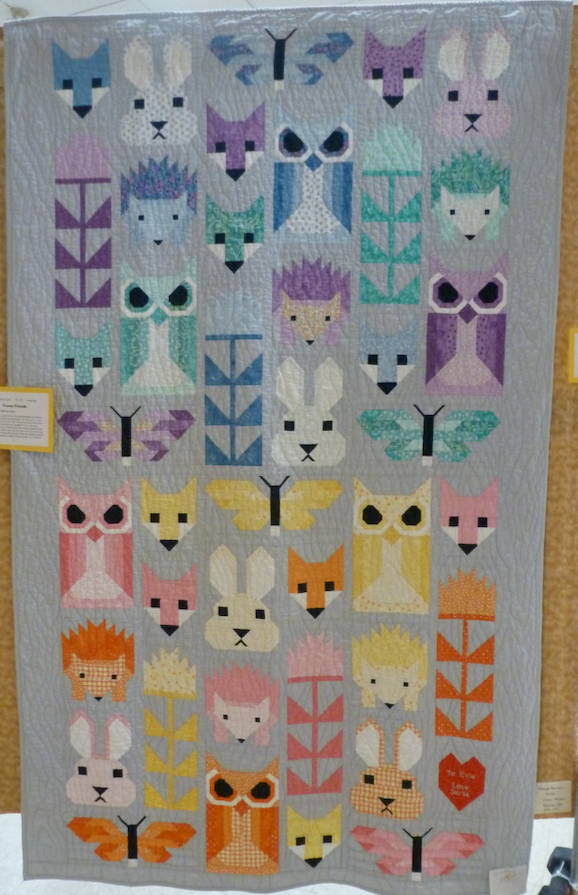
Excellent piecing is demonstrated in the quilt below too, made by the artist for her granddaughter's "big girl" bed. The pattern was designed by Elizabeth Hartman.
 
Forest Friends, Beth Green.

Forest Friends, detail.
 
Hexies for All, Penelope Kulko.
 
We see hexagons again in the blue and white quilt, inspired by Katja Marek's book "The New Hexagon."  Blue and white is a traditional color scheme but works well in modern quilts too.
 
Hexies for All, detail.

 
Time to Smell the Flowers, Maxine Rosenberg.
 
Still more hexagons!  According  Ms. Rosenberg:
 
I constructed this English Paper Pieced Quilt during Covid from a picture on the Paper Pieces Website.  Unable to buy plants for my outside garden the basket and butterfly reminded me of the pleasure we got from winged visitors to our garden.
 

Block of the Month designed by Linda Evans.

Guild member Linda Evans designed the Block of the Month activity above - each month a pattern was sent out to participants featuring one of the quilt blocks. Choice of fabric, sashing and assembly are individual decisions. This is master class is variations on a theme and a revelatory look at the impact of color and contrast in pattern interpretation. Well done all!

Resilience, Robin Jaeger.

Flowers and gardens and other aspects of nature inspired more quilts.  The Resilince quilt above was based on "Whimsical Garden" by Tina Curran. This quilt is displayed in the Town of Needham's New Public Safety Building and was a "thank-you" present to Needham's essential safety workers.

Resilience, detail.


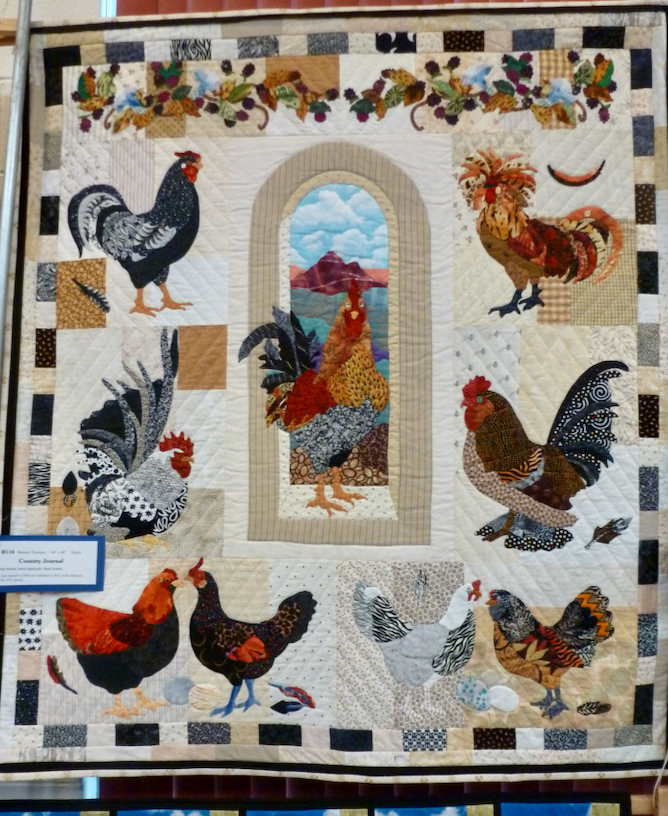
Country Journal, Marlene Thurston.

Can you hear the clucking? The nature theme continues with a flock of fowl, in the applique quilt. This quilt was begun in 2002 and finished last year.  I'm a firm believer in the Slow Fiber movement myself.

Country Journal, detail.


The Spirit of Aloha: A Hawaiian Quilt, Evy Megerman.

Ms. Megerman's daughter and son-in-law met in Hawaii and it is a special place for them.  I hope they appreciate the quilt.  The quilt below was also made for a family member. According to artist Kulko:

A few years ago my son opened a skateboard shop in his Brooklyn [neighbor]'hood.  I helped him get the store ready for opening by matting and framing way cool, totally hip skateboarding photographs and other skater paraphernalia.  Along the way I had the idea for this quilt, marrying motion, the boarder and graffiti.  In the end, my son gave me a sweet, sad look, saying, "Mom, it's great, and we will NEVER hang a quilt in the skate shop."  It was a long shot, apparently too long a shot.


Skater, Penelope Kulko.

Wheels are celebrated in the bicycle quilt below, an original design by maker Gotlib; a gift for her husband. This quilt evidently did make it onto a wall.


The Bicycle, Lorraine Gotlib.

For every show the guild makes a raffle quilt, seen below. Sadly I didn't win this wondeful quilt, as it's one of the best raffle quilts I've ever seen.


Snowdrops, the raffle quilt.

Finally, a cheerful little applique quilt with a little house and tree motif which just made me smile. 

What a great quilt show!

Temecula Sampler, Bryn Macy Wood.

So, the word "Quinobequin" - it's the Native American name for the Charles River, and it means "meandering river".  Needham is bordered to the east and south by the River.


19 September 2022

Queen Elizabeth II: Tributes in textiles

Tammis Keefe handkerchief, 1950's.

Like many folks around the world, I respected and admired Queen Elizabeth II (1926-2022) and awoke a bit early to watch her funeral this morning.  There were tears.


The lifecycle event at the beginning of her reign, her coronation, was also televised, and celebrated with pomp, ceremony, and souvenirs.  Commemorative textiles were very popular, including scarves and handkerchiefs. Although I haven't been able yet to find documentation, I believe these two handkerchiefs, from my collection, were produced as souvenirs of the coronation of the young queen. The central image of the hankie above certainly resembles the Gold State Coach and the crowns in the corners evoke the silhouette of St. Edward's Crown, worn during the coronation.

Below, a silk pocket square again depicts the crown and the golden coach, in addition to London Bridge, yeoman of the guard, and The Tower.

Tammis Keefe, silk pocket handkerchief, 1950's.


I'll miss the Queen's colorful outfits and matching hats - designer Angela Kelly did wonderful work.  The Queen's self-presentation and style did much to make every event special.

The person who most closely approximately the Queen's role here in America might have been Mrs. Brook Astor, who once said:
If I go up to Harlem or down to Sixth Street, and I'm not dressed up or I'm not wearing my jewelry, then the people feel I'm talking down to them. People expect to see Mrs. Astor, not some dowdy old lady, and I don't intend to disappoint.

The Queen never disappointed us.

16 September 2022

Fabric: The Hidden History of the Material World


Cover image.

I've just finished Fabric: The Hidden History of the Material World, by British writer Victoria Finlay. The book, published this year, was a gift from a dear friend, and was well-reviewed in the New York Times.

Finlay divides the book into chapters by fiber or fabric type, including wool, tweed (a type of woolen fabric), silk, etc. A chapter entitled "Imagined Fabrics" covers fibers, such as polyester, made from hydrocarbons. I love maps and the book includes several so the reader can follow the geography of fiber sources.  There is also a short, informal glossary right at the front of the book, in case terms such as heddle and selvedge are unfamiliar, and eight pages of color images.
 
Finlay is quite adventurous and through a combination of perseverance, connections, and just plain luck manages to get to remote areas of Papua New Guinea to observe and document the  making of barkcloth, a traditional material crafted from the inner bark of young Broussonetia papyrifera trees.   In other chapters Finlay tries her hand at backstrap weaving in Guatemala and quilting in Gee's Bend, Alabama. Accompanying her on her travels is part of the fun.

The book  interlaces cultural history, science and technology, and politics, and Finlay refers to her book as a kind of patchwork - she and her mother had planned to create a patchwork quilt together but this project was never realized due to her mother's death.  So, the book is also a kind of memoir of grieving, but is never morbid.  Overall, a very informative, entertaining volume on cloth in our world.
 
A note on the cover image - it's a detail from a painting by neo-classicist John William Waterhouse (1849-1917) entitled Penelope and the Suitors, in the Aberdeen Art Gallery.  Penelope, wife of Odysseus, works at her loom, supposedly making a burial shroud for her father-in-law, while secretly picking out the work at night. The suitors, at right, try to woo her with flowers and music, but she held fast. I've always read The Odyssey as a kind of celebration of monogamy; both Penelope and Odysseus had plenty of opportunities to make new alliances but remained loyal to one another.

Penelope and Her Suitors, 1912.


13 September 2022

Soft toys to stitch

Finished stuffed personalities, made by a seven-year-old.

Our grandchildren and their parents visited this summer and my granddaughter loves projects so I found this kit. My aging brain has forgotten where I found it, but it's available through Amazon and other vendors.
 
Kit comes with everything, including polyfil stuffing and a needle, and makes three stuffed toys: a unicorn, phoenix bird and yeti.  I explained the legend of the phoenix, and we found Nepal and Tibet on a world map to discuss the yeti. 
 
The well-illustrated instruction booklet is very clear. I helped start, and tie off, each seam of stitching, but otherwise grandchild worked independently. Most of the eyes and ears, etc., are adhesive, but there is a bit of additional stitching. 
 
Also extra adhesive bits allow for some personalization, as seen in the yeti in the top image, which differs from the image on the package.


Several mornings of fun.


07 June 2022

Tammis Keefe tablecloth

Air Ships, 64" x 48", linen.

I recently added another tablecloth to the online Keefe exhibit; it will be added to the Tammis Keefe website soon. To recap, Tammis Keefe was a textile designer active from about 1947 to her death in 1960.  She designed hundreds of domestic linens - towels, placemats, tablecloths - but is probably best known for her handkerchief designs. Air Ships is my name for this design; I don't know what manufacturer Fallani and Cohn called it.

Air Ships, detail.

I receive the newsletter of a fun museum in Michigan - the International Museum of Dinnerware Design, or IMODD. The museum is having a lecture series on aspects of mid-century modern tabletop designs for the home, including an online talk tomorrow at 6:30 pm (Eastern time)  entitled Setting the Standard for Setting the Table: Modern Women Textile Designers.

Learn more and register for the lecture at the museum's website: http://dinnerwaremuseum.org/main/