26 June 2023

What That Quilt Knows About Me - American Folk Art Museum

 
Whole cloth quilt, detail.

In May DH and I joined a docent-led tour of the exhibit What That Quilt Knows About Me at the American Folk Art Museum in Manhattan. The title of the exhibit is from a quote attributed to an anonymous needleworker:
"My whole life is in that quilt...my hopes and fears, my joys and sorrows, my loves and hates.  I tremble sometimes when I remember what that quilt know about me."


My own sub-title for the exhibit might might be "if this quilt could talk..." People have long imbued inanimate objects with special meaning, especially objects made with precious materials or involving skilled artisanship.  From the wall text:
 
The notion that these objects [quilts] have the capacity for "knowing" - containing information or narratives about the human experience - expands the scope of the textile beyond its maker, exploring how material things can gather, retain, and pass down histories of the individual, family and community.

So, although remarkable, some of the quilts may not feature refined technique or look like the color-coordinated and sophisticated award-winning quilts seen at contemporary quilt shows. However, the works present insights into the life and stories of the women (and the occasional man) who made them.

Bird of Paradise quilt top, maker unknown, 1858-1863.

This quilt top, made in the Albany region of New York state, was never made into a finished quilt but was preserved and found its way into the museum's collection.  Not only did this quilt top survive but so did some of the paper templates used to make the appliques motifs; see the templates in the image below.

Paper templates for Bird of Paradise quilt top.

Mysteriously, the templates include designs for the the male and female figures but the finished quilt top omits the male figure.  We'll never know the reason for the omission - did the man die in the Civil War? Did a planned marriage not take place for some other reason? 

The quilt top features images of contemporaneous popular culture, including famed race horses and a circus elephant named Hannibal, who performed in the region.

Bird of Paradise quilt top, detail.

Another applique quilt is below, and conveys the maker's love of color and of chickens. This quilt was made by Mississippi life-long quilter Pearlie Posey (1894-1984) shortly before she died. Ms Posey's mother died young, so she learned techniques from her grandmother.  From the wall text:
Posey saw quilting as part of her legacy to her family.  Perhaps remembering her mother, she said, "...if the Lord take me and I leave you...I say you'll have some covers."

Hens Quilt, 1981.


Sacret Bibel [sic] quilt top, Susan Arrowood, 1875-1895.


In this quilt the maker depicts stories from the Old and New Testaments and lively scenes possibly from her place of worship. She's labelled some of the vignettes with earnest, if not scholarly, hand-writing and spelling. The detail below show John the Baptist immersing Jesus in the River Jordan.

Detail, Sacret Bibel quilt top.


The exhibit also includes applique quilts from the tradition of Baltimore Album quilts (image below), made by women with the resources to use purpose-bought materials and the time to construct elaborate blocks and border designs.  From the wall text:

Although many Baltimore quilts are associated with Christian communities, this spectacular example is part of a group possibly linked with the Baltimore Hebrew Congregation.  Founded in 1830, by the time this quilt was made the congregation was meeting at the Lloyd Street synagogue, one of the oldest in the United States.
 
Baltimore album quilts are known as an exceptionally colorful and playful regional tradition, springing in part from the accessibility of a wide range of textiles imported into the city's bustling port.  At the height of popularity in the mid-19th century, they are recognizable for their use of pictorial applique - free-form fabric cut-outs applied to the larger background of the quilt.  Each block consists of an individual vignette, highlighting the creativity of the quilter(s) and coming together to form an "album," from which this style takes its name.

Reiter Family Album Quilt, 1848-1850.

Some quilts include both piecing and appliqué techniques, such as the quilt below, one of the oldest in the exhibit.  This quilt includes fabulous antique printed fabrics, including a central block printed by printer John Hewson (1744-1821).  The dating of the quilt itself is given as a range from 1790-1810. It's important to remember that women would have collected fabrics -  remnants from dress-making, home decoration etc. - for some time before these pieces would have been combined into a quilt, along with special fabrics such as the central panel and the lengths for the exuberant borders. I have a quilt made in the 1920's for my mother by my great-grandmother using fabrics from the 19th century.
 
Hewson-Center Quilt, maker unknown.

This quilt has interesting connections to early American history. From the wall text:

The textiles of British-born American patrior John Hewson demonstrate the trans-Atlantic popularity of natural motifs, such as the lively birds, butterflies, and flowers seen in the center of this quilt.  However, this charming imagery presents a stark contrast to the histories of conflict in which textiles and other luxury products were embroiled in the 18th century.

Block-printer John Hewson immigrated to Philadelphia from London in 1773, a time when the trans-Atlantic exchange of textiles and other trade goods, like tea, were a great point of contention in the growing Revolutionary clash.  Although British regulations hampered domestic textiles production, Hewson set up his own printworks in his adopted city, bringing his London-honed skills to the American market.

Later in his career, he would further advocate for the American textile industry by sending yards of his fabric to Martha Washington, encouraging the President's wife to sport locally-made chintz with pride.  During the Revolution, Hewson also supported the American cause by joining the Philadelphia militia. He was captured by the British but returned to his business after his release.

 
Hewson panel quilt, detail.

Hewson panel quilt, detail.

Another 19th century is shown below, and it's interesting not only because of its stellar workmanship but because an old note attached to the back indicated it was made by Black needlewomen who were enslaved and worked in the household of the Kentucky plantation called the The Knob. Based on stylist similarities to another masterpiece quilt in the collection of the Metropolitan Museum of Art, this quilt has been attributed to sisters Ellen Morton Littlejohn (c. 1826-n.d.) and Margaret Morton (c. 1833-1880). Both quilts feature blocks enhanced by trapunto technique; that is stuffing the motif with additional batting or other fill, embellishing the design in low relief.

Whig Rose and Swag Border Quilt, 1850

Whig Rose and Swag Border Quilt, detail of trapunto.

Another quilt from this time period helps demonstrate the breadth of quilt designs and traditions.  I love the deep orange referred to in quilt studies as "cheddar" and the quilt top below glows with it.  The quilt top was made by Sarah "Sallie" Ann Garges (c.1833 -c.1901.)

Applique Bedcover, Sallie Ann Garges, 1853.

 From the wall text:

This quilt top conceals a mystery: at center right, beside the two white cow, an amorphous yellow patch obscures a male figure. Why was he cover up?  We will probably never know the quilter's reasons for removing him from the scene.  Garges' determination to conceal him suggests the specific and personal nature of her work.  Rather than generalized figures, the characters populating her quilt may well have been intended to represent people from her life.

According to family tradition, the bedcover was made to celebrate the engagement of Sarah "Sallie" Ann Garges to her groom Oliver Shutt.  Scenes from agricultural life enliven the geometric composition, likely draw from everyday experiences on the family farm in Doylestown, Pennsylvania.  Grounding the design with a house and a barn at either end of the central diamond, Garges depicts men at work, hunting, plowing, and chopping.  Distinctive motifs such as a beehive, squirrels, and bugs further personalize the scene.  The quilter intialed and dated her work in the center with the year of her engagement, 1853, and signed her initials "SAG." Garges had three brothers, but one died young, suggesting a possible candidate for the covered figure.

Of course, another mystery is why the top was never quilted - was it meant to be more of an informal throw?   

Applique bedcover, detail.
 

The exhibit is not only wide-reaching with regard to time period, but also geography. The quilt below is attributed to Mary Sherman Thompson and is thought to be a wedding gift. 

American missionaries introduced Anglo-style quilting to the islands in the 19th century but the native Hawaiians transformed this imported craft into a style all their own.  Moreover, quilts often featured symbols of heritage and culture from many sources and polities. According to the curators:

Also referred to by the title Ku'u Hae Aloha or "My Beloved Flag," this rare 19th-century quilt carries powerful political meaning.  Consisting of four flags centered on the royal crest, the work follows a 19th-century pattern expressing pride in Hawaiian sovereignty.  In a complex entanglement of ideals, these flags are based on WEstern symbols, includ the Union Jack of Great Britain, who royal government provided a model for the Kingdom of Hawaii when it was founded in the late 18th century.
Hawaiian flag quilts gained further symbolic potency when the monarchy was later deposed.  In 1893, a coup was staged against Queen Lili'uokalani - carried out primarily by Americans or Hawaiians of American descent - leading to the eventual annexation of Hawaii to the United States.  Flag quilts took on the additional poignancy of stolen independence.  Quilting practice also inserted itself into Hawaiian political history when, while imprisoned during this era, the queen herself turned to the craft.  Her work can now be seen at Hawaii's Iolani Palace.

Hawaiian Flag Quilt, attributed to Mary Thompson, late 19th c.

Another quilt which features a melding of traditions is the pieced quilt below, made by a woman born in Japan who learned to quilt in the United States.  The many small, expertly pieced blocks in this work utilized antique Japanese kimono fabrics.

Yuen no Akari: Light from Far-Away Space. Setsuko Obi, 2001.

Light from Far-Away Space, detail.

Finally, more about the quilt which opened this blog post. That first image is a detail of the quilt below, in the detail image that is the first picture of this post.  I've considerably lightened the image to show the texture of the quilting, which the wall text notes as "...lavish ornamental stitching across the entire surface of the bedcovering." More from the wall text:

Referred to as "whole-cloth" quilts, such works are made of large pieces of fabric in solid colors.  The tradition of pieced quilts, which join together many small patches of fabric, developed later in the 19th century.

Whole-cloth quilts were also made in England, and immigrant women brought the practice to the American Northeast.  18th-century petticoats could also be intricately quilted.  Women covered themselves with the skilled work of the needleworker's hand - perhaps their own, that of a family member, or a professional seamstress - throughout the day and into the night.
Whole Cloth Quilt, maker unknown, New England, early 18th c.

31 May 2023

The Beauty of Chiso: Kimono Couture

Book about the Kyoto-based kimono maker Chiso.
 

The Worcester Art Museum had a significant exhibit of kimono history in 2021, entitled The Kimono in Print: 300 Years of Japanese Design.  I didn't make it to that show, celebrating Japan's national costume, but am grateful for the internet's ability to give me a fair substitute for in-person attendance.
 
An interactive online exhibit, The Beauty of Chiso: Kimono Couture, features the almost 500-year-old Chiso textile firm, based in Kyoto.   Chiso developed a unique kimono for the Worcester Art Museum exhibit - the fabric design is featured on the cover of the book, above. The publication accompanying the exhibit, in the image above, includes chapters on the long history of Chiso, sources of inspiration, innovations in surface design, and the kimono development process.  In addition to two dozen color plates and additional illustrations, the book also has a useful glossary and a graphic explaining the components of a kimono.  I love the fabric design in the image below, Plate 17 in the book.
 
Tatsuta River Design, silk crepe, 1890, designer Imao Keinen.


 Catalog ISBN: 978-1-911282-66-2

29 May 2023

Death and the Maid - Cecily Brown at The Met


Viewers enjoy the exhibit.


In April we visited family in New York and viewed Death and the Maid, an retrospective exhibit of work by New York City-based artist Cecily Brown.  The exhibit, including about 20 paintings as well as monotypes and sketches, was favorably reviewed in the New York Times and the Wall Street Journal.  It helps to have some knowledge of art history to appreciate the imagery of the paintings, as many of the works connect to earlier artists' work, such as the monotype below.  In this work Brown riffs on the genre of vanitas paintings, typically featuring young women fixated, Narcissus-like, on their image in a mirror while the composition forms a skull, a memento mori.  

All is Vanity (after Gilbert), monotype, 2006.
 
"Gilbert" refers to Charles Allen Gilbert, (1873-1929), a popular American illustrator who created the image below.  Brown updates this timeless theme for this era of social media and influencers.


All is Vanity, Gilbert, 1892. https://en.wikipedia.org/wiki/Charles_Allan_Gilbert

The painting which gives the exhibit its title is below and echoes a work by Edvard Munch (1863-1944), which in turn continues the long tradition of juxtaposing young women with a skeletal angel of death, a reminder that youth and beauty are fragile and fleeting.  Below, two barely discernible vertical figures merge in a frenzied landscape.


Death and the Maid, 2022.


Death and Life (Death and the Maiden), Edvard Munch, 1894. https://artsandculture.google.com/asset/death-and-life/GgGrhNSsviphYA?hl=en

One of my favorites in the show is below, entitled "Selfie" and was painted early in the Covid-19 pandemic.  There's a reclining figure in the right foreground, and a mirror and vanity in the right background (with a suggestion of a face). The room is crowded with pictures, shelving, a wall clock; the sense of confinement and containment is palpable.  I really enjoy Brown's use of color.
 
Selfie, 2020.


Selfie, detail.


At the exhibit.


Another genre which Brown explores is the still life celebrating luscious displays of luxurious foodstuffs, such as lobster, table grapes, cherries. Animals often invade, or lurk in, the scene.  We think of this genre with regard to 17th-century  Dutch painters but modern painters such as Picasso painted still lifes too, even with a cat.
 

Lobsters, Oysters, Cherries and Pearls, 2020.


Still life with cat and lobster, Pablo Picasso, 1962. https://www.wikiart.org/en/pablo-picasso/still-life-with-cat-and-lobster-1962


Lobster, Oysters, Cherries and Pearls, detail.


The  tablecloth,  cherries and lobster all merge in a swelter of red, relieved by white and cream suggesting a compote dish, the titular oysters and pearls. A black cat crouches, concealed beneath this swirl of luxury - a reminder of fickle fortune, perhaps.

There is an exhibition catalog, ISBN: 9781588397614.

30 April 2023

Shaped by the Loom - Navajo weaving at the Bard Graduate Center


Germantown blanket, ca. 1900, Diné artist.

In April we went to the Bard Graduate Center in New York City to see a small but powerful exhibit on the artistry of Navajo weaving, Shaped by the Loom.  "Navajo" is a term of Spanish colonial origin; the people refer to themselves as Diné, but I will use the term interchangeably in this post. 

 Info and samples of wool raised by Navajo.
From the wall text:
Each element of a Navajo weavng is carefully planned and executed.  To create a balanced composition, a weaver considers the formation of motifs, the placement and scale of design elements, and the combination of colors.  Symmetry is important, but fifth-generation Diné textile artist Lynda Teller Pete encourage flexibility.  As she explains, "your rug or textile is at the mercy of its environment," which often causes the warps to stretch and shrink, altering a weaving's dimensions and the proportions of the design.
Historically, the weavers worked with the natural colors of the sheep's wool. The color palette is more expansive than one might guess, ranging from pale cream to very dark gray and brown. The colors can be seen in the textile below, which features undyed yarn sourced from the artist's own flock.
 
Burnham Area Geometric Weaving, Marie Begay, ca. 2021

Burnham Area Geometric Weaving, detail.

From the wall text section 'Dyeing and Coloring':
Adinidiin - light - is magic.  It is prayer, projection, and perspective.  it is an all-seeing element that permeates all aspects of life and is found in land, air, water, and sky.  Moreover, light exists withing and radiates from each one of us as we are the connections between and within the elements. - Rapheal Begay, (Diné ), photographer
Initially the Navajo worked with the natural colors of their sheep's wool as well as mineral- and plant-derived colorants, including indigo and cochineal.  In the later part of the 19th century, with a growing tourist market, trade cloth made from synthetically-dyed  Germantown yarn was unwoven and re-spun for use in weavings.
 
Dye chart, Roselyn Washburn, 2019.
 
Dye chart, detail.

Untitled (Tourists), Gerald Nailor (Toh-Yah, Diné ), 1937.
 
In addition to new materials, new subjects were assimilated into the designs.  Trains brought settlers, trading posts and tourism, encouraging both exploitation of,  and new economic opportunities for, indigenous populations. The motifs along the trains are thunderbirds, a symbol of strength and protection.
 
Train pictorial weaving, Diné artist, 1880s.

The exhibit also featured tools and educational material, explaining the parts of the loom and the weaving process. The image below is from a book by Lynda Teller Pete and Barbara Teller Ornelas, How to Weave a Navajo Rug and Other Lessons from Spider Woman (Loveland, CO: Thrums Books, 2020).

Book illustration, Mychal Yellowman, 2020.


Contemporary Navajo weaving tools, Belvin Pete, Lynda Teller Pete and Barbara Teller Ornelas.

Navajo loom with unfinished weaving (sash belt), before 1910.

Weaver at Her Loom, Geanita John, ca. 2007.

Carrizo Summer, Kevin Aspaas, 2023.

The tradition is in good hands with weavers such as Kevin Aspaas (born 1995), whose weaving, above, is dyed with sagebrush and rabbitbrush.  
 
More historical images can be see here:  https://exhibitions.bgc.bard.edu/shapedbytheloom/collection/

01 April 2023

Beaverland, book by Leila Philip


No April's Fool today, just a sincere plug for a book I very much enjoyed, Beaverland, by Leila Philip.  It's a well-written volume of natural history, made engaging with a bit of humor too as well as some fascinating illustrations.  I've seen a beaver while paddling in the Charles River and at least one beaver has made a watery home in my city, a suburb of Boston. 

While on a family vacation in Montreal long ago, we bicycled to the Lachine Museum of the Fur Trade.  French voyageurs - early explorer/traders - bought or bartered beaver pelts from Native Americans.  At the museum we learned that the European hat making process did not utilize  the intact pelts for hat making but separated the soft underfur of the beaver pelts from the longer, coarser guard hairs.  The soft underfur was felted and this material was then molded into hats

Although silk became the preferred material for top hats, beaver pelts are still used today for the international fashion industry.  California recently outlawed the trade in new animal fur products; perhaps other states will follow suit.

20 March 2023

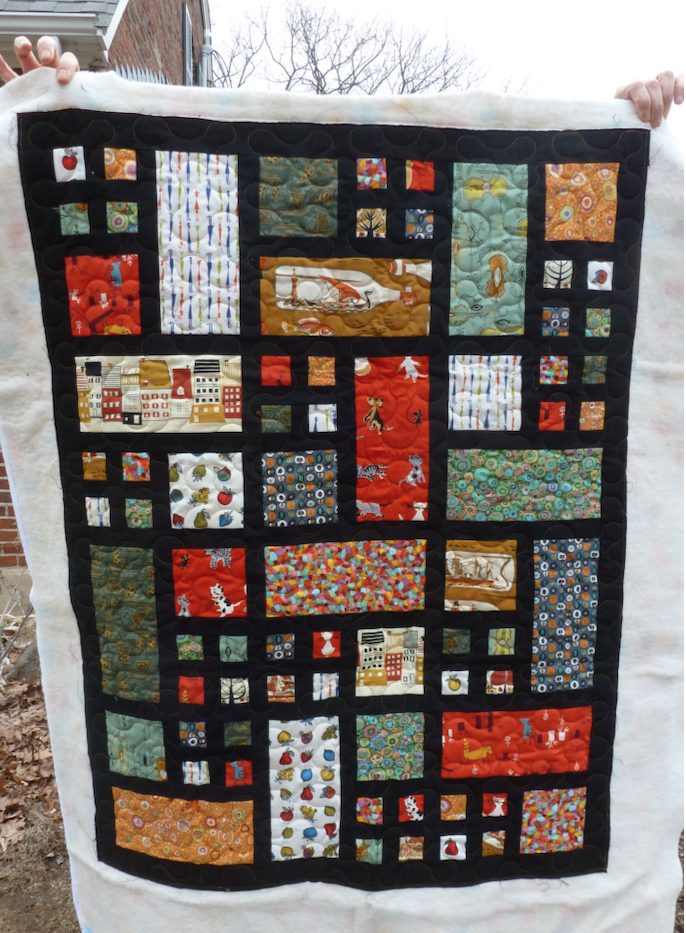
Patio pattern baby quilt

Next step - binding.

A new baby will arrive soon, so of course I made a quilt. Not for use in the crib until baby can safely roll over, but useful as a clean surface for "tummy time," a layer in the stroller, etc.

The pattern is one of my favorites, Patio, designed by Happy Zombie

Reminds me of the graphics of Alexander Girard.

I used fabric from my extensive stash and only had to buy the backing fabric. Many of the fabrics are vintage prints (pre-1960 or so) - we can date these fabrics as they are 36" wide, not the current standard of 45."  Most of the prints are "conversational" - this is the textile world's term for fabrics with figurative images.  One of my favorites is a variation on Little Red Riding Hood (above.)

Attenuated people.


Ships in a bottle.

 
A fun music-themed fabric.
 
Mid-century modern colors.

Save those shards of china.

The fabric below was produced by Rose and Hubble and is based on mosaics by Kaffe Fassett.  It's a useful print because of all the colors; I employed it as the binding for this quilt.
 
Based on a mosaic installation for the Chelsea Flower Show.

 The backing is a cute owl fabric by Robert Kaufman designer Ann Kelle.  Machine quilted for durability - just an edge-to-edge pattern called Meander, expertly done by Burlington Electric Quilters.

Who-whoo!