Showing posts with label Books to enjoy. Show all posts

31 May 2023

The Beauty of Chiso: Kimono Couture

Book about the Kyoto-based kimono maker Chiso.
 

The Worcester Art Museum had a significant exhibit of kimono history in 2021, entitled The Kimono in Print: 300 Years of Japanese Design.  I didn't make it to that show, celebrating Japan's national costume, but am grateful for the internet's ability to give me a fair substitute for in-person attendance.
 
An interactive online exhibit, The Beauty of Chiso: Kimono Couture, features the almost 500-year-old Chiso textile firm, based in Kyoto.   Chiso developed a unique kimono for the Worcester Art Museum exhibit - the fabric design is featured on the cover of the book, above. The publication accompanying the exhibit, in the image above, includes chapters on the long history of Chiso, sources of inspiration, innovations in surface design, and the kimono development process.  In addition to two dozen color plates and additional illustrations, the book also has a useful glossary and a graphic explaining the components of a kimono.  I love the fabric design in the image below, Plate 17 in the book.
 
Tatsuta River Design, silk crepe, 1890, designer Imao Keinen.


 Catalog ISBN: 978-1-911282-66-2

01 April 2023

Beaverland, book by Leila Philip


No April's Fool today, just a sincere plug for a book I very much enjoyed, Beaverland, by Leila Philip.  It's a well-written volume of natural history, made engaging with a bit of humor too as well as some fascinating illustrations.  I've seen a beaver while paddling in the Charles River and at least one beaver has made a watery home in my city, a suburb of Boston. 

While on a family vacation in Montreal long ago, we bicycled to the Lachine Museum of the Fur Trade.  French voyageurs - early explorer/traders - bought or bartered beaver pelts from Native Americans.  At the museum we learned that the European hat making process did not utilize  the intact pelts for hat making but separated the soft underfur of the beaver pelts from the longer, coarser guard hairs.  The soft underfur was felted and this material was then molded into hats. 

Although silk became the preferred material for top hats, beaver pelts are still used today for the international fashion industry.  California recently outlawed the trade in new animal fur products; perhaps other states will follow suit.

26 February 2023

Threads of LIfe - Stories told with stitching

 
ISBN 978-1-4197-3953-8
 
Just finished Scottish author Clare Hunter's book, Threads of Life, subtitled A History of the World Through the Eye of a Needle.  In chapters with headings such as "Protest," "Identity," "Community," and "Loss," Hunter celebrates the stitch with personal, and political, reflections on everything from the Bayeux Tapestry to the AIDS quilt.  Oddly, the book contains no images - not one - so I read it with my tablet alongside, to search for pictures. Only after finishing the book did it occur to me to visit Hunter's website, where, indeed, there are many (public domain I assume) images of some of the artifacts referenced in the book.
 

27 December 2022

Laces of Ipswich

Cover, The Laces of Ipswich, with costumed interpreter.


I recently read a fascinating book on a aspect of New England textile history new to me.  In the mid-18th century women in Ipswich, a town on the north shore of Boston, Massachusetts, established a very successful cottage industry in lace-making. At the height of production, 600 lace makers created pillow lace, making edgings for bonnets and shawls.  This wasn't a recreational hobby but rather provided much needed additional income for the lace maker's household. We are lucky in researcher and author Marta Cotterell Raffel, who dug deep and is an engaging writer too. 

In 1791 Ipswich resident Reverend Joseph Dana prepared a report for businessman and senator George Cabot on the lace industry in Ipswich. The report, with thirty-six small samples of lace, was ultimately submitted to Alexander Hamilton, eager to assess industries in the new country as imports from Britain were curtailed or halted altogether.  Eventually the samples became part of the Library of Congress collections, where they have been expertly conserved to this day. The image below is from the Library of Congress website.

The book has a valuable glossary, images of lace samples, portraits of New England women wearing the lace, and a bibliography. Modern day lace makers have reproduced some of the historic patterns. An appendix shows several of these recreated samples with their corresponding pattern, called a "pricking".  Below is a detail of an Ipswich lace with its associated "pricking". The lace maker inserted her pins into the holes of the pricking, and wove around the pins, using linen or silk thread wound onto her bobbins.
 
It's important to note the lace produced is not the highly refined lace produced by women in Irish convents or trained by lace schools in Europe.  Such imported lace was a luxury item and embellished the clothing and accessories of women of highest social status.  The lace makers of Ipswich, who learned from each other, were producing lace edgings affordable by middle-class women - the wives of merchants and other businessmen, for example. 

With the advent of machine-made lace this once-valued textile lost some of its exclusivity and allure, and the making of Ipswich lace ceased about 1840, although a few practitioners continue until the end of the century.  There was a bit of a revival in the 1920's as part of the general Colonial Revival movement, when antiquarians such as Wallace Nutting recreated a rather romantic vision of colonial life through staged photography.  One major contribution of this revival was the preservation of colonial artifacts and renewed appreciation of the skills demonstrated.
 
Recreation of Ipswich lace edging, with "pricking" pattern.

The Laces of Ipswich: The Art and Economics of an Early American Industry, 1750-1840.
ISBN 1-58465-163-6

16 September 2022

Fabric: The Hidden History of the Material World


Cover image.

I've just finished Fabric: The Hidden History of the Material World, by British writer Victoria Finlay. The book, published this year, was a gift from a dear friend, and was well-reviewed in the New York Times.

Finlay divides the book into chapters by fiber or fabric type, including wool, tweed (a type of woolen fabric), silk, etc. A chapter entitled "Imagined Fabrics" covers fibers, such as polyester, made from hydrocarbons. I love maps and the book includes several so the reader can follow the geography of fiber sources.  There is also a short, informal glossary right at the front of the book, in case terms such as heddle and selvedge are unfamiliar, and eight pages of color images.
 
Finlay is quite adventurous and through a combination of perseverance, connections, and just plain luck manages to get to remote areas of Papua New Guinea to observe and document the  making of barkcloth, a traditional material crafted from the inner bark of young Broussonetia papyrifera trees.   In other chapters Finlay tries her hand at backstrap weaving in Guatemala and quilting in Gee's Bend, Alabama. Accompanying her on her travels is part of the fun.

The book  interlaces cultural history, science and technology, and politics, and Finlay refers to her book as a kind of patchwork - she and her mother had planned to create a patchwork quilt together but this project was never realized due to her mother's death.  So, the book is also a kind of memoir of grieving, but is never morbid.  Overall, a very informative, entertaining volume on cloth in our world.
 
A note on the cover image - it's a detail from a painting by neo-classicist John William Waterhouse (1849-1917) entitled Penelope and the Suitors, in the Aberdeen Art Gallery.  Penelope, wife of Odysseus, works at her loom, supposedly making a burial shroud for her father-in-law, while secretly picking out the work at night. The suitors, at right, try to woo her with flowers and music, but she held fast. I've always read The Odyssey as a kind of celebration of monogamy; both Penelope and Odysseus had plenty of opportunities to make new alliances but remained loyal to one another.

Penelope and Her Suitors, 1912.


14 May 2022

The Ladies' Paradise - The Way We Shop Now

 
Building a temple of consumer culture.

I'm reading The Ladies Paradise, by Émile Zola, in an excellent translation by Brian Nelson.  Remember departments stores? A few survive - Macy's, Bloomingdale's, for example - but many perished even before the advent of online shopping.  
 
But how did the department store itself evolve? This story is a fictionalized - but well-researched - account of the emergence of a modern department store in the heart of Paris, during the Second Empire (1852-1870).  But you don't have to know or care anything about the politics or history of the period to enjoy this story.  Anti-hero Octave Mouret is an entrepreneur who sees the great wealth generated during this period and the aspirational consumption which that wealth enables. A born salesman, and the manager-owner of The Paradise store, Mouret understands the benefits of innovations such as buying in quantity, the use of  "loss leaders" and, enabled by the lower cost of plate glass at this time, the enticement of street-level display windows. Mouret is based on Aristide Boucicaut, the founder of the French department store chain Bon Marché.
 
Prior to the development of the grand magasins (department stores), the shopper traipsed from small shop to small shop; each retailer specializing in one item or type of goods. One bought dress material from a draper, for example, and then gave the fabric and any trimming to a dressmaker.  If you needed an umbrella, you went to the umbrella maker.  Even during my youth in Detroit, home of the J. L. Hudson department store, my grandmother would say that "one could go from store to store to buy what was needed, or just go to Hudson's."
 
Assembling different types of goods - departments - under one roof was revolutionary.  Mouret's fictional store was a success, as he added a mail order catalog and home delivery, just as Boucicaut did in the real-life department store.  As goods were sold at The Paradise, they were packaged and sent down a chute to the basement dispatch area, for transfer to the delivery trucks:
During big sales especially, the chute would discharge an endless flow into the basement, silks from Lyons, woolens from England, linens from Flanders, calicoes from Alsace, prints from Rouen...


J. L. Hudson store (now demolished) with giant flag, downtown Detroit.
 
 
The Ladies' Paradise isn't a dry history though - the story unfolds through the eyes of the protagonist Denise, a penniless young woman, orphaned and fresh from the boondocks, hoping to find employment with her uncle, a Paris shop-keeper.  However the uncle's business is slowly being squeezed by The Paradise, and instead Denise finds employment with the enemy, so to speak, becoming a saleslady at The Paradise. Something about her sparks Mouret's interest in a way he finds unsettling, and the development of their relationship will keep you reading.  The introduction to the book is excellent too.

There's also a television series, The Paradise, very loosely based on the novel and relocated to England. The series, available on Amazon Prime, is better than reviews indicate, and at any rate the costumes are wonderful.  However, while Zola's book is clearly a critique of consumer exploitation and manipulation, the television show mostly celebrates one retail triumph after another, without much insight or reflection.

21 February 2022

A book about the shirt on your back - Worn

ISBN 978 152 474 483 95

I'm just finishing up this well-received book by Sofi Thanhauser, organized into chapters by fiber families - Linen, Cotton, Silk, Synthetics, and Wool. Thanhauser delves into the history and usage of these fibers in clothing, including a welcome exploration of the impact of manufacturing practices on workers and the environment.  Moreover, as she writes,  “There is scarcely a part of the human experience, historic or current, that the story of clothes does not touch.”
 
It's an excellent book, despite the lack of images, and is available as an ebook as well.
 
I hope a paperback will be forthcoming. It's an important and engaging work.


20 April 2021

Finishing a very good book by Virginia Postrel, which received a deservedly glowing review in the Wall Street Journal and a somewhat nit-picky notice in the New York Times.

Love the glossary of textile terms but wish the budget had stretched to more images and to color plates upon occasion.

The Fabric of Civilization: How Textiles Made the World. Virgina Postrel. ISBN 9781541617605.
 

25 August 2014

Anne Hollander and Tom Tierney and costume history


Woman in Blue, Henri Matisse, 1937, from Fabric of Vision.

Two leading lights in the world of textile history died last month.  Anne Hollander, an independent scholar and curator, studied the role of costume (the art world's  portmanteau for apparel) in art throughout history.  Ms. Hollander, in her many books, analyzed how artists, as disparate as sculptors in ancient Greece and the 20th-century British painter Lucian Freud, used clothing and drapery to convey meaning. She pioneered the serious study of fashion and clothing; prior to her work "It [fashion] had this taint of a women's-page subject" stated Judy Thurman, a New Yorker writer quoted in Ms. Hollander's New York Times obituary.

Given that clothing and accessories are freighted with immense symbolism, it seems obvious now that the depiction of apparel - clothing which can signal status, wealth and power, among other characteristics - would seem an obvious focus of study, but this was not always so. A major corrective to this oversight arrived with the 2002 exhibit Fabric of Vision: Dress and Drapery in Painting, curated by Ms. Hollander for Britain's National Gallery.


Exhibition catalog.

Ms. Hollander wrote about robes, tailcoats, veils and dresses; Tom Tierney drew them.  Dover books have sold over 4 million copies of his paper doll books, reason enough to sit up and take notice even if the books themselves weren't so charming and, due to his meticulous research, so informative. If you can't get to the Costume Institute at the Metropolitan Museum of Art, Mr. Tierney's books will help scratch the fashion itch. You can even see Kate Middleton in her unmentionables - evidently things have loosened up at Buck House - in the officially sanctioned William & Kate paper doll book.


Selection of Dover paper doll books by Tom Tierney.

The phrase "making history come alive" is over-used but nevertheless genuinely describes the utility of Mr. Tierney's books, which can flesh out the opulence  of Tudor England - Henry VIII and his wives - or demonstrate just what Jane Austen meant when she wrote about pelisses and spencer jackets.

Finally, a book about someone very much still with us, Queen Elizabeth II - Dressing the Queen: the Jubilee Wardrobe. As a public figure the Queen must dress the part and has a dedicated and talented wardrobe staff, marshaled by Head Dresser Angela Kelly. This book gives a glimpse of the process for preparing the Queen's wardrobe for the Jubilee Year. Yes, the volume celebrates hereditary rank and privilege, like any reporting on the royal family, although I happen to think the Queen gives good value for money. One tidbit is that, to avoid any unfortunate accidents, small weights are sewn into the hems of some garments.  The images below are taken from the book.

Blue outfit with sleeve detail, worn to Armed Forces Muster, 2012.

Service of Thanksgiving, St. Paul's Cathedral. 

The planning and craftsmanship involved is impressive; protocol plays a role too; during a trip to Ireland, the Queen wore a green suit and hat for an open-car procession. For the opening of the Olympics, two identical peach dresses were made in secret; one worn by a stunt double parachuting into Olympic stadium and one for the Queen, who appeared on the podium with hardly a feather out of place after her apparent sky-dive.  As I said, good value for money.

Dressing the Queen: The Jubilee Wardrobe. ISBN 978 1 905686 74 2

Anne Hollander wrote many books, among them:
Fabric of Vision: Dress and Drapery in Painting. ISBN  1 85709 907 9
Moving Pictures. ISBN 0 394 57400 1
Feeding the Eye. ISBN 0 374 28201 3

Tom Tierney's books are available at the Dover site and many bookstores.


10 November 2011

Streamlined Irons

Image from http://www.arthursclipart.org/
I call this image "The Indoctrination."

Unless the family wardrobe consists solely of knitwear, sooner or later someone has to break out the iron and companion board. Ironing is one of those tasks that does give immediate gratification, as shirts are transformed from rumply and wrinkled to smooth and crisp. Mostly I use my iron these days for patchwork, as the iron is an essential tool in quilt-making. I still iron a few shirts too.

After electricity arrived in American homes the electric iron wasn't far behind. In this day and age, when everything is Made in China, it's good to have a reminder that our shores used be home to hundreds of appliance manufacturers, from national behemoths like General Electric to now-defunct regional firms, including several in my hometown of Detroit.

On October 31, DH and I attended a fascinating lecture at the Newton Free Library. Presenter Jay Raymond gave an illustrated talk on streamlined irons, appliances manufactured from about 1934 to the mid 1950's. Many examples from his collection were on display in hallway cases for the month of October. (Most of the irons have lost their original electric cords.)

Ultramatic, made in France by Novex-Siebert.
The invention of bakelite, an early plastic,
made curvaceous styling easier.

Streamlined design was in part an effort to entice consumers to buy newer, more modern models, even when their old cars or irons were perfectly functional. It was also a response to the embrace of progress, and the idea that faster and sleeker meant better. No iron was going to race in a Grand Prix, but the aesthetic was almost universal and hence applied to objects like irons, which did at least move during use, as well as to completely stationary appliances such as toasters.

In this early attempt at a practical home steam iron
the water reservoir also functions as the stanchion for the handle.


As steam irons became more popular, the need for a larger water reservoir increased the bulk of the appliance, but designers were still able to create reasonably streamlined profiles.

The Feather Way #130 steam iron.
(From the book.)

Irons on display at the library.

The Knapp-Monarch company produced many intriguing designs,
with great appeal for iron collectors,
of whom there are more than you might guess.

Mr. Raymond, speaking at the library.

Mr. Raymond, an enthusiastic collector and meticulous researcher, has produced an excellent book, Streamlined Irons, ISBN 978-0-615-25656-6. The book features gorgeous photography, by James B. Abbott and Jay Texter, of almost 200 irons, an excellent essay on the streamlined aesthetic and even a section on early electric irons, for comparison. It's a must read for anyone interested in the history of American design and manufacturing, or in object-centered material culture, or just curious about those everyday items we use in our homes.

Streamlined Irons, by Jay Raymond.

Mr. Raymond also has an informative website at: http://www.streamlinedirons.com/

11 May 2011

From alizarine to vermilion: color history

The book cover features a box of Foinet artist's pastels, c. 1930.

The production of dyes and pigments for use on textiles has had a huge influence on human events, yet conventional histories largely ignore this thread (pun intended.) "Colors: The Story of Dyes and Pigments" is a profusely-illustrated book that travels from 40,000-year-old painted caves in France to the chemistry cartels of Germany, weaving a fascinating tale conflating commerce, industry and art.

There are many examples of the impact of consumer demand for better textile colorants on world history. For instance, while it was a British chemist who invented the first commercially exploitable synthetic dye, cheap labor in the British colonies continued to prop up the use of natural dyes for textiles. Germany, which had come late to the table as a colonial power, sought solutions in industry, and in their search for domestically-produced pigments German chemists helped invent the field of organic chemistry. By 1904, Germany was exporting massive amounts of synthetic indigo, to the detriment of colonial India and the ports of France; as the books states, "many markets were lost to German chemistry".

Indigo dyer at work.
The British established an agricultural
monoculture of indigo in India.


British chemist William Perkin with shawl featuring yarn
tinted with his synthetic mauveine.

There are also particularly fascinating sections on color in medieval iconography, the toxicity of some early pigments, and the emergence of chromatics, the science of color and perception.

This book is the nearest approximation of an economic and cultural history of textile pigments and dyes that I've found to date, and has excellent production values, a good index and appendices of primary documents and further reading.

Nuts and bolts info: authors Francois Delamare and Bernard Gu
ineau; ISBN 0-8109-2872-8.


21 January 2011

Read about Red

Cover of A Perfect Red

I finished a very good book this month: A Perfect Red: Empire, Espionage, and the Quest for the Color of Desire, by Boston-area writer/researcher Amy Butler Greenfield. Status and power, consumerism, alchemical mysteries and a host of personalities from Cortez to botanist Joseph Banks - it's all in here, as Ms. Greenfield spins her yarn. (Pun intended.) We take color for granted and forget that for much of history humans dressed in garments with hues ranging from light mud to dark mud, emphasis on the mud. The bright plumage of birds and the pigments of flowers must have seemed magical. In search of color, pre-historic people utilized the mineral ochre, found in southern France near Rousillon, among other mineral sources. And, as Ms. Greenfield asserts, an affinity for red seems hard-wired in the human brain.

Her focus is largely on the dye cochineal, derived from a scale insect which grows on an
opuntia cactus in Central America. The bodies of the tiny insects are harvested and dried, and the prepared dye, vastly superior to the pigments native to Europe, became the most important monopoly export from New Spain. Tricky to cultivate, cochineal never became one of the plantation crops, such as cocoa or coffee, and perhaps that is one reason it's overlooked in many conventional histories, which tend to focus on food and spices, and the role of these monocultural crops in the development of the slave trade. Even Niall Ferguson's excellent book on Britain's global aspirations, Empire, mentions but does not index cochineal, although botanist Joseph Banks expended much energy and time trying to include cochineal in his plans for Britain's agriculture empire.

However, there is a lesson for today - Since cochineal could not benefit from economies of scale, coercive labor systems utilized for other crops proved useless. So instead of enslavement of the native peoples, or forced quota production, Spain provided incentives to the indigenous populations, including a credit system, lending money to the Indians who then repaid the loan and interest with cochineal. The system worked very well and was one of the few sources of credit available to these rural populations. The legacy of this system is one reason that the cochineal-producing areas of Mexico were able to better preserve their culture and language.


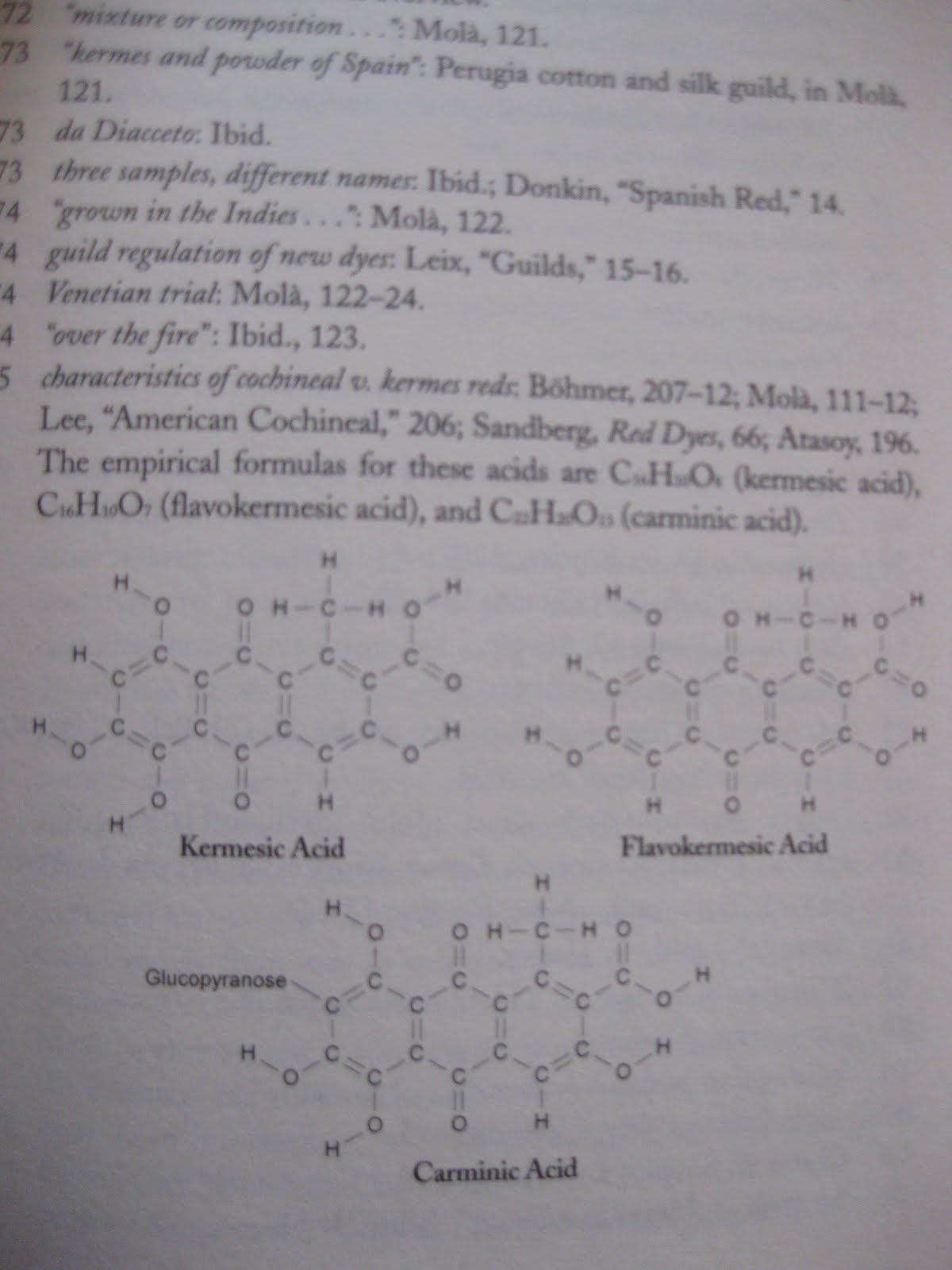
Molecular diagram of carminic acid, the actual pigment in cochineal.

The market for cochineal hit the basement, of course, when aniline dyes were invented in the mid-19th century. Ms. Greenfield covers the demise of cochineal, and its partial revival with the renewed interest in natural dyes; she wraps up her book with the "power red" suit worn by Nancy Reagan, neatly book-ending her opening discussion of our desire for red by the yard.

The book is a fascinating inter-disciplinary study of commerce and colonialism, science and fashion.
Ms. Greenfield's work is well-researched and the notes are excellent. My only quibble is a middle chapter on French espionage - a plot to smuggle insect-covered cactus pads out of Mexico - dragged on a bit. And of course, I would like to see many more pictures of people wearing wonderful red!

The images of Renaissance luminaries in their red finery are wonderful.


12 June 2010

Recommended reading

Indian Textiles in the East, by John Guy.

I recently finished two enjoyable books, Indian Textiles in the East: From Southeast Asia to Japan and Behind Closed Doors: At Home in Georgian England.

The Indian Textiles book is a profusely-illustrated scholarly cultural study. Before the European East India Companies muscled their way into Asian commerce, colorfast Indian cloth was traded in a regional exchange system, with merchants also sailing from Muslim Arabia. This engagingly-written book documents this trade of textiles for spices from the time period, roughly, of 1600 - 1858. Maps, primary documents, contemporary images and, of course, color photos of stunning historic textiles all serve to explain the fabrication and origin of regional textiles, how the printed cottons and silk ikats were made, and the degree to which products were adapted to the requirements of each market, whether in Malaysia, Sulawesi (Indonesia) or Japan.

The author, John Guy, was formerly Senior Curator of the Asian Department at the Victoria and Albert Museum and is now Curator of South and Southeast Asian Art in the Department of Asian Art at the Met.

Process of creating a mordanted cotton print.

Illustration from the book of a Palampore
(large bedcover or curtain panel).


An engaging cultural study by Amanda Vickery.

The other book is Behind Closed Doors: at Home in Georgian England, by British history professor Amanda Vickery. The cover image and book title suggests a focus on salacious behavior or outlandish dress; there is neither, although one discussion of an aristocratic divorce begins to read like a People magazine of the 18th century. A good review can be accessed at this link:

http://www.nytimes.com/2009/12/20/books/review/Wulf-t.html

For me, the most important chapter was entitled "What Women Made," a discussion of "amateur" crafting and female accomplishments. Art history hasn't known what to do with regard to the production of embroidery, cut paper work, shellwork, decorated boxes, fire screens, etc. Is it art, occupational therapy or make-work? Were women just decorating their own cages? As Ms. Vickery states, "The domestic context of female decorative work has guaranteed its low prestige. A founding legend of women's history narrates the withdrawal of middling and privileged women from productive work and relegation to a separate sphere of home as a consequence of industrial capitalism." Somehow, objects made in one's "leisure time", i.e. by women not in the work force, became ripe for parody and disparagement.

Although the two books feature very different subject matter, what is clear in the Guy book is that in historical Asian cultures textiles represented status and wealth in the way that precious metal jewelry and objects function in other societies. Traditional Asian culture, as I understand it, did not establish a dichotomy between "high" and "low" arts; textiles were not relegated to "decorative art" status, as opposed to "fine art" status. Indeed, textile designs even influenced architectural detail and decoration.

Guy's research and analysis has reinforced the status of these textiles as art. Those of us who value needle arts can only hope that more research on objects made by women in past centuries will undoubtedly lead to a reassessment of these products as well.