Showing posts with label The Met Museum New York. Show all posts

18 October 2024

Flapper Fashion: Stehli Silks at the Metropolitan Museum, New York

 
Debutantes wearing Americana Prints, rehearsing for a fund raiser. 


The above image of a newspaper clipping, attributed to the New York Times, 1925, show several young ladies wearing dresses sewn from a line of apparel fabrics, "Americana Silks",  developed by the Stehli Silk Company and designed by American artists.
 
In October, DH and I ventured to the Met, and down a flight of stairs to a small gallery, a sort of anteroom just outside the Antonio Ratti Textile Center. There's usually a very interesting exhibit relating to textiles in this somewhat hidden away space.  Through April 8, 2025 a collection of delightful "jazz-age" silks, and contemporary ephemera, is on display.

The gallery outside the Ratti Center.

From the wall text:

The Stehli Silks Corporation was founded in 1840 as a small family-owned silk weaving firm in Obfelden, Switzerland.  At first, the company operated about thirty power looms, producing all-silk fabrics for clothing.  As the company in Switzerland expanded throughout the 1880s and 1890s (by 1895 they were running five hundred looms), they established a New York office to sell their textiles to the U. S. market.  But American tariffs on foreign goods enacted in the late 1890s made the Stehli family decide to take a radical new approach by also setting up a factory in the United States.  In November 1897, land for a large mill was purchased in Lancaster, Pennsylvania, and a year later, with the first mill building finished, two hundred fifty looms were producing yardage.  Other buildings followed; by 1914, more than one thousand looms were in use, and the business was making $3 million per year (about $90 million in today's money).

"Americana Silks"  on display.

Wall text continues:
In the early 1920s, the Stehli Silks management realized that the market was changing.  Following World War 1, consumers adopted a generally more informal lifestyle, favoring soft crepes and chiffons (like those used for the Americana Prints) over stiff dress fabrics like the taffetas and satins Stehli had traditionally produced.  The garment business was booming in New York City, and Stehli organized a special sales force to market their goods directly to the trade.  The groundwork for the creation of the Americana Prints line was in place.
Detail, Falling Leaves dress fabric, by Ralph Barton.

Booklet  of dress ideas, illustration by Ralph Barton, 1926.

More wall text:
In 1925, the International Exposition of Modern Decorative and Industrial Arts was held in Paris.  While the United States declined to send examples of current American design, representatives from various industries visited.  Among these was a delegation from the silk industry, including Kneeland L. (Ruzzie) Green, the newly hired art director for the Stehli Silks Corporation.  The trip inspired him to create the Americana Prints line, in direct reaction against American fashion's heavy dependence on French design.  He quickly gathered a group of American men and women illustrators, graphic designers, cartoonists, and eventually photographer, to create fabric designs for the Spring season 1926.  The saturated colors and lighthearted patterns were meant to reflect the innovative and optimistic American spirit of the 1920s.
Silk crepe dress featuring Manhattan fabric design.

Samples of colorways of Manhattan design, Clayton Knight, 1925.

An article in the New York Times, November 1, 1925, introduced the first series (of three) of Americana Prints and predicted that "possibly the biggest hit of the entire threes dozen designs will be 'Manhattan', which is so modern that it suggests a view of all of our skyscrapers piled up together, seen from an elevated train rounding a sharp curve." It was indeed one of the most successful designs. 

Clipping from the New York Times.


Concluding wall text:
The Americana Prints line, available in high-end department stores around the country both as yardage and ready-made dresses, was heavily promoted by Stehli in the general and fashion press.  It was not inexpensive when first introduced, the silk yardage sold for $4.50 per yard (about $75 today) and dresses were $39.50 (about $675 today).  The line continued for three years, in three different series.  Ultimately, there were about ninety-five designs by fifteen artists, and in 1927, the Stehli Silks Corporation had its most successful year ever.  However, by late 1928, overproduction and falling demand saw an end to this groundbreaking design line.
Unless otherwise note, all fabrics pictured are silk crepe. 

Gentlemen Prefer Blondes, Ralph Barton, 1925.

Hollywood, Neysa McMein, 1925.

Ticker Tape, Charles Buckles Falls, 1925.

April, Clayton Knight, 1927.

Plum Blossoms, Katharine Sturges.

Dress made with Plum Blossoms fabric.

Inca, Charles Buckles Falls, 1925.

Model wearing dress stitched from Inca fabric.
 
The images of models in dresses were produced by the Kadel and Herbert Commercial Department, in New York City, 1925.  I love seeing the hair styles and shoes of the era.  Below is one of my favorite patterns, created after the artist made a trip to Paris. You can see the Ile de la Cité and the Cathedral of Notre Dame. 
 
My Trip Abroad, Ralph Barton, 1925.

My Trip Abroad detail with Eiffel Tower.


Model in My Trip Abroad dress.
 
Many of the fabrics and other items in the exhibit were donated to the museum by Hilary Knight, the son of featured artists Clayton Knight and Katharine Sturges. Hilary Knight is still alive (at the time of this post) and may be best known as the illustrator/co-author of the Eloise books.

29 May 2023

Death and the Maid - Cecily Brown at The Met


Viewers enjoy the exhibit.


In April we visited family in New York and viewed Death and the Maid, an retrospective exhibit of work by New York City-based artist Cecily Brown.  The exhibit, including about 20 paintings as well as monotypes and sketches, was favorably reviewed in the New York Times and the Wall Street Journal.  It helps to have some knowledge of art history to appreciate the imagery of the paintings, as many of the works connect to earlier artists' work, such as the monotype below.  In this work Brown riffs on the genre of vanitas paintings, typically featuring young women fixated, Narcissus-like, on their image in a mirror while the composition forms a skull, a memento mori.  

All is Vanity (after Gilbert), monotype, 2006.
 
"Gilbert" refers to Charles Allen Gilbert, (1873-1929), a popular American illustrator who created the image below.  Brown updates this timeless theme for this era of social media and influencers.


All is Vanity, Gilbert, 1892. https://en.wikipedia.org/wiki/Charles_Allan_Gilbert

The painting which gives the exhibit its title is below and echoes a work by Edvard Munch (1863-1944), which in turn continues the long tradition of juxtaposing young women with a skeletal angel of death, a reminder that youth and beauty are fragile and fleeting.  Below, two barely discernible vertical figures merge in a frenzied landscape.


Death and the Maid, 2022.


Death and Life (Death and the Maiden), Edvard Munch, 1894. https://artsandculture.google.com/asset/death-and-life/GgGrhNSsviphYA?hl=en

One of my favorites in the show is below, entitled "Selfie" and was painted early in the Covid-19 pandemic.  There's a reclining figure in the right foreground, and a mirror and vanity in the right background (with a suggestion of a face). The room is crowded with pictures, shelving, a wall clock; the sense of confinement and containment is palpable.  I really enjoy Brown's use of color.
 
Selfie, 2020.


Selfie, detail.


At the exhibit.


Another genre which Brown explores is the still life celebrating luscious displays of luxurious foodstuffs, such as lobster, table grapes, cherries. Animals often invade, or lurk in, the scene.  We think of this genre with regard to 17th-century  Dutch painters but modern painters such as Picasso painted still lifes too, even with a cat.
 

Lobsters, Oysters, Cherries and Pearls, 2020.


Still life with cat and lobster, Pablo Picasso, 1962. https://www.wikiart.org/en/pablo-picasso/still-life-with-cat-and-lobster-1962


Lobster, Oysters, Cherries and Pearls, detail.


The  tablecloth,  cherries and lobster all merge in a swelter of red, relieved by white and cream suggesting a compote dish, the titular oysters and pearls. A black cat crouches, concealed beneath this swirl of luxury - a reminder of fickle fortune, perhaps.

There is an exhibition catalog, ISBN: 9781588397614.

13 November 2022

The John C. Weber kimono collection at The Met, part 1


Bridal kimono, 19th c., detail.
 
 
In October we went to New York City to visit family and see this amazing exhibit of historic Japanese garments.  Below are some images, more or less in chronological order, of items which appealed to me.  The exhibit was big, so I'll do more than one post about it.  This post focuses primarily on garments from the Edo period (1615-1868).  Most of the images reference uchikake, which is actually a heavily embellished over robe which would have been the top layer of an ensemble, but I will just use the term kimono for simplicity.
 
My husband's newer iPhone did a very good job of capturing the images in the low light of the galleries, but for better images and more information the catalog accompanying the exhibit, Kimono Style: Edo Traditions to Modern Design, is excellent.
 
Kyogen suit, detail, mid-19th c.

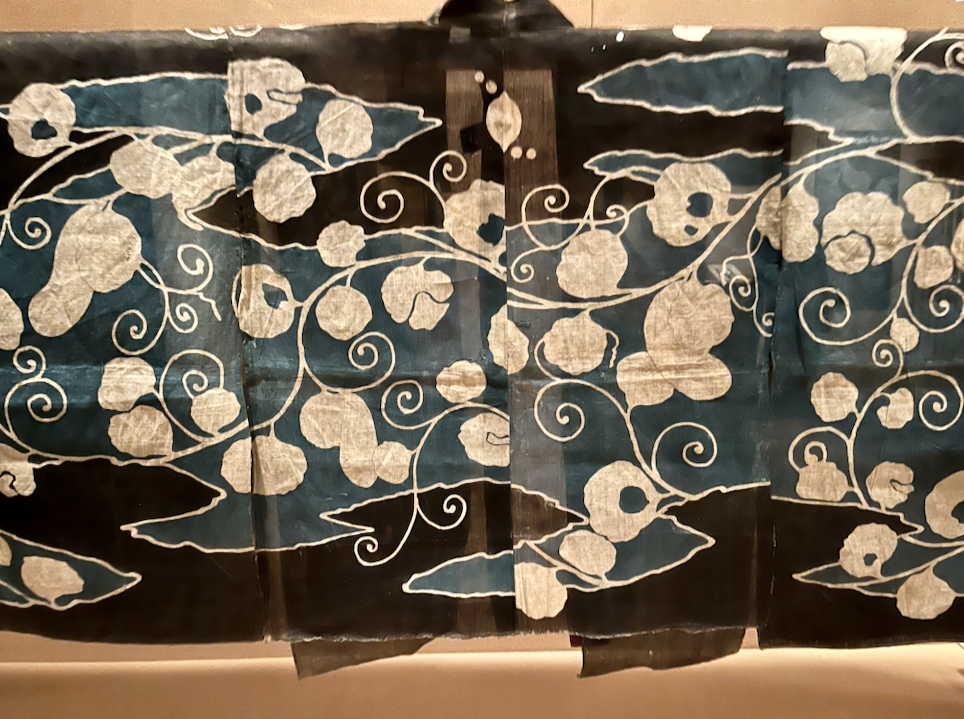
The kimono and related garments in the exhibit were worn by a variety of folks: actors, brides, wealthy women, fisherman and firefighters. The jacket above was part of a comic theater (Kyogen) costume and is made of hemp, as is the jacket below.  The rabbit motif references a Shinto tale of a clever rabbit who outwits some crocodiles to get across the sea.  Many kimono reference literature.

Kyogen jacket, early 19th c.
 
 
Of course, many are familiar with Noh costumes, elaborately decorated silk kimono worn by performers in these highly stylized plays. Many of these costumes featured gold embroidery, eye-catching and glittering on stage.
 
 
Noh costume, 19th c.
 

Noh costume, detail with shippo motif.

Kimono often feature traditional motifs commonly understood by the audience, such as the interlaced circles shippo pattern, symbolizing harmony and prosperity.

Designs for kimono were published in woodblock-printed pattern books, from which women, or their representatives such as a family steward, could select  suitable decoration.  Use of materials and decoration was closely circumscribed by sumptuary laws during the Edo period, as the military dictatorship of the shogunate kept control over society. Politics and social status were intertwined with clothing. 


Hishikawa Moronabu, book of designs, 1677.

Imura Katsukichi, order book of kosode patterns, 1716.

The kimono shape we know today evolved from an earlier type of garment called a kosode; the salient differences being the sleeve proportions and the sash - thinner than kimono obi and worn lower on the body, as seen in the figurine below, made for export to the West.


Porcelain figurine, c. 1670-90.
 
The kimono shape became codified by the end of the Edo period but colors, patterns and forms of decoration changed with the times and woe betide to the high-status lady who wore an out-of-date kimono.  Old, no-longer-chic kimono were not discarded, however, but often donated to Buddhist temples to be recycled as garments or liturgical textiles.
 
 
Buddhist monk's vestment, detail, 18th c.

 
Wealthy brides wore astonishingly decorated kimono, featuring all the skills of Japan's textile artisans, including: brocade weaving, embroidery, dyeing, and painting.  Symbolic motifs demonstrated that the wearer aspired to the attributes of the images.
 
For example, the kimono below features bamboo stalks, symbols of resilience and vitality. The folded paper decorations, in the shape of butterflies, symbolize a long marriage.  Other motifs in the kimono, including pine trees, turtles, plum blossoms and cranes, reference longevity (see first image of this post.)

 
Bridal kimono, 19th c.

 
Bridal kimono, detail.


Bridal kimono, mid-19th c.
 
 
The reddish-orange kimono above was worn by a samurai bride. She would have worn all white for the ceremony, then changed into a colorful robe for the banquet.  Auspicious images cover this kimono, including Mount Horai, near the hem, a mythical mountain associated with eternal life. We see cranes again, in the embroidery.


Bridal kimono, detail.

The turtle depicted has a "skirt" of threads attached to its rear end. These lines symbolize the seaweed that attaches to a sea turtle during its long life. The longer the trailing seaweed, the longer the life.

Detail of turtle, with seaweed trailing behind.
 
Finally, one more exquisitely embroidered kimono from this era.  This would have been worn by a high-status lady at court.  There are embroidered Chinese characters (Japanese borrows Chinese characters for part of the writing system) at the top of the body and on the sleeves which originally referenced a poem by courtier Miyako no Yoshika:
 
The weather clears, breezes comb the 
hair of the young willows;
The ice is melting, wavelets wash the whiskers
of the old bog moss.


Kimono, 18th century.


Kimono, detail.

14 June 2021

New British Galleries at the Metropolitan Museum


Japanese-inspired 19th-century Worcester ceramics.

New York City is re-opening and so are the museums. A week-end in May found me at the Metropolitan Museum of Art, viewing, among other exhibits, the newly-reinstalled British Galleries. These galleries were opened on the eve of the pandemic and are still not fully accessible; whether due to a staff shortage or other issues is a mystery.

Sadly, not able to see the embroidery.

The wall texts give a much more inclusive and honest narrative of these objects, especially with regard to that quintessentially British beverage: tea. 


The Tea Gallery.

 
There is one entire room devoted to the storing and serving of tea and the display is as exciting as the objects. One can now see the teapots from every angle, in all their shapely glory.  Ever since the King Tut exhibit, designed by the late Stuart Silver, the Met has presented its objects and artifacts in some very imaginative formats.  The design of the British Galleries hits it out of the park.

In a gravity-defying display, ceramics and small metal objects are "floated" using all-but-invisible supports affixed to transparent paneled display cases.
 

Display of ceramics and small metal objects.


Finally - we're able to see all sides of these beautiful creations.

 
Another aspect of these galleries is that there is no distinction between "fine art" and craft  but includes paintings, sculpture, furniture and even entire rooms from stately homes.  The anonymous artisan's work is celebrated as much as the work of Sir Joshua Reynolds or Christopher Dresser.
 
Iron balusters, ca. 1730-80.


Chair, ca. 1755, mahogany and needlework.


The chair above is from a design by Thomas Chippendale; the needlework design in the chair back depicts the Annunication, or "Lady Day,"which falls on March 25.   England had adopted the Gregorian calendar on March 25, 1752, only a few years before this chair was made. On this feast day contracts for tenant farmers and landowners were renegotiated. 

I look forward to returning to the galleries when they are fully open.