02 May 2013

Silk sensations - quilts that shimmer and shine

Silk cocoons, Kiryu, Japan, 2012.
On April 27, I participated in a one-day symposium, Silk: Fabric, Fashions and Quilts, co-sponsored by the American Textile History Museum (ATHM) and the New England Quilt Museum (NEQM). The series began two years ago with a seminar on textile design and production during the interregnum between the world wars, and I look forward to another session in two years.

Textile history is a topic of almost infinite breadth, encompassing the history of capitalism, manufacturing and labor regulation, consumer demand and preference, science and technology, art and design, etc. This symposium, while a wonderful learning opportunity overall, perhaps tried to cover too much of this territory, more than was realistic in one day. However, as an overview of the issues relating to the study of an historically significant fiber, the symposium did serve to underscore the ubiquity of textiles in every aspect of our lives, not just our closets.

We assembled at the NEQM, and, after a welcome and brief introduction, during which the NEQM volunteers were recognized and thanked for their efforts, the day began in earnest with the opening address, a Powerpoint gallop  through the history of American silk production - thread, yarn and yardage - led by social historian Madelyn Shaw, independent curator, textile historian and co-author of American Silk.  Ms. Shaw's impressive resume can be explored at her website.  

Highlights of this fast-paced presentation included information about the first successful American silk concern, Cheney brothers, whose gigantic factory complex can still be visited today in Manchester, Connecticut, and images of fashion-forward silk fabric from manufacturer  H R. Mallinson, whose printed silks challenged the hegemony of imported European silks in couturier clothing.

Following Ms. Shaw's address, the sixty or so attendees divided into three groups each of which headed out to one of three concurrent sessions. My group remained at the NEQM for a curator-led tour of Silk! Antique and Contemporary Art Quilts, organized by NEQM curator Pam Weeks, and on view until July 7, 2013.   Ms. Weeks, an excellent speaker, has put together a show of both variety and depth.

Sampling the Silk Road, Christine Wickert, 2011.

The award-winning quilt above was made by master quilter Chris Wickert, from applique patterns by Edyta Sitar.  My image is less than optimal, but this quilt epitomizes the qualities of silk that make it irresistible - the rich colors seem almost lit from within, and the smooth, slightly reflective surface supports Ms. Wickert's exquisite hand-quilting perfectly. 

Symposium attendee listens to gallery talk.

The quilt on the far wall in the image above was the impetus for this exhibit.  Stella Antiqua, by artist and silk historian Hanne Vibeke de Koning, is a hand-pieced and hand-quilted silk confection in feminine pinks and beige, and is in the collection of the National Quilt Museum.  Curator Weeks, a polymath who is herself an accomplished quilt artist, was quite taken with this quilt when she first viewed it and it sparked an interest in silk and silken quilt-making.

In lovely curatorial touch, one of the historic bed quilts is actually displayed on an historic bed.  In the so-called Saffron Quilt, from the Wenham Museum, the yellow silk, in marvelous condition, again highlights the exuberant hand-quilting.

Saffron Quilt, maker unknown, 18th c.

Pieced Silk Sampler, Elizabeth Crehore Johnson White, c. 1850

Silk fabric and hand-quilting are perfect partners, and in the Elizabeth White quilt, above and below, silk cooperates with a quilter's imagination run riot, particularly in the pale green silk sashing.  The sampler blocks were probably pieced with scraps left from dress-making, but the quantity of fabric needed for the sashing suggests it was purchased especially for the purpose. The pale green color works perfectly with the toned blues, corals and browns of the pieced blocks, corralling the wide variety of designs into a cohesive whole. 

Pieced Silk Sampler, detail.

One recurrent, but unheralded, theme throughout the exhibit is what we now call "upcycling" - the reuse of what would otherwise be waste or scrap material.  Silk, due to its cost and status as a luxury fiber, was particularly treasured. The quilt below, from the Pilgrim Roy Collection, is made of remnants of silk linings from a hat factory.  The pinwheel pattern is one of my favorites, and the diagonal lines of color just animate those whirligigs.

Pinwheels, maker unknown, c. 1940

Pinwheels, detail.

Happy Father's Day, Janet Elwin, 1992.

Another example of upcycling is the star quilt above, made from ties and, I believe, men's shirtings.  The careful organization of colors in the stars, as well as the contrast between dark tie material and light shirtings, make this one of the best menswear quilts I've seen, and I've requested Ms. Elwin's book from my local library.

Happy Father's Day, detail.

Straight Furrow log cabin, Amelia Jerome Perkins, c. 1880, detail.

One gallery in the exhibit is devoted to Victorian examples of the log cabin quilt; the example above has particularly compelling placement of alternating color bands within the overall light/dark sequencing of the straight furrow pattern.  This quilt really packs a graphic punch.

Silk Tobacco Premium Quilt, maker unknown, c. 1910.

In addition to dress-making offcuts and hat factory remnants, another source of silk for quilter-makers included the silk premiums enclosed with tobacco products. An skilled stitcher collected and arranged these into the small textile above. The word "baby" is embroidered on the back; consider the juxtaposition of tobacco products providing material for a baby quilt.

After the gallery tour our group continued to our second rotation, a study group session led by Lorie Chase, who briefly discussed alternatives to silk, such as synthetics, and cotton or wool treated to look more lustrous, either through heat-treatment to add shine, or through the fabric's woven construction, such as cotton used in a satin weave.  In a satin weave the horizontal threads, the weft, go under one vertical, or warp, thread but over two or more warp threads. (In plain weave each weft thread goes under one warp thread and over one warp thread.) The placement of the weft threads in the satin weave makes for an inherently smoother, more reflective fabric surface.

Satin weave - http://fm-textile.wikispaces.com/Section+3.1

I found it difficult to "change gears," from focusing on silk qua silk to a wider consideration of all the ways quilters and fiber artists add sheen and luster to their work. Ms. Chase, an independent scholar and quilt historian, had put much thought and energy into the study materials, including some wonderful handouts with actual fabric swatches. However, it almost seemed as if this segment belonged in a future seminar devoted less to one natural fiber and more to a general consideration of issues such as the artist's use of reflectivity, cultural attitudes towards sheen and texture, and the role of synthetics in the quiltmaker's toolbox.

After a delicious lunch at the ATHM and a tour of the wedding dress exhibit (see previous post) my group walked back to the NEQM, where the concluding session was a quick, illustrated tour of one of America's commercial failures - the abortive attempt to raise silkworms in mid-19th century New England. Marjorie Senechal, professor emerita at Smith College and co-author of American Silk, compared and contrasted the correct approach to silkworm husbandry, from "moth to cloth" as she put it, with the ultimately unsuccessful methods of growers in Northhampton. Silkworms are fussy little creatures! (Youtube video from my trip to Japan in 2012.)

Participants and presenters.

The final group activity was a "show and tell" by attendees, which was wonderful and too short! I wish more time had been left for this portion of the symposium.

As a sort of recessional at day's end, we were treated to an interpretative dance by The Luminaria Dance Company of Cambridge.  The dancers had energy to spare but, clutching my valued handouts, it was all I could do to slink to my car after such an intense day of learning and exploration.


29 April 2013

Down the Aisle - Bridal Dresses and Narratives

Entrance to museum, Lowell.
On April 27, 2013, about sixty or so textile enthusiasts gathered for the second bi-annual textile symposium co-sponsored by the American Textile History Museum (ATHM) and the New England Quilt Museum (NEQM).  Silk: Fabric, Fashions and Quilts, the title of the symposium, explored two concurrent exhibits at the sponsoring institutions. This blog post features the exhibit at the ATHM, Behind the Veil: Brides and Their Dresses, on view from April 6 - August 11, 2013 and organized by ATHM curator Karen Herbaugh.

Worn by Mollie Canfield, 1886, and by her great-great niece Shirley Parish, 1969.

The highlight of each dress display is the accompanying narrative, the history of the dress, often paired with a photo of the bride wearing the dress on her special day. These narratives remind us that important lifecycle events, such as weddings, provoke many responses, some traditional, some innovative.

In the 19th century, women were generally married in their "Sunday best" and did not purchase a special garment in which to be married. So, wedding dresses were not white, an impractical color, and, moreover, women wished to show off material which utilized luxurious dyestuffs.  However, according to curator Herbaugh, when Queen Victoria married Prince Albert in 1840 her white gown established the "white dress" tradition. The wedding was re-enacted in 1854, with Victoria again donning the dress, to be recorded for posterity by the then-new medium of photography.

http://en.wikipedia.org/wiki/File:Wedding_of_Queen_Victoria_and_Prince_Albert.jpgon

Wedding ensembles and their narratives.

Many of the dresses were silk, or of a synthetic material, such as acetate, which aspires to impart the luster and sheen of silk. One of my favorites, however, is the cotton dress in the collage below, worn by Mary Bodecker, a June bride in 1952. The sheer cotton has a delicate floral pattern overprinted in white ink, and a touchable sample of the fabric provides a tactile thrill.

Bodecker dress, narrative, fabric sample.

Vaillancourt gown, 1959.  

One important characteristic of the modern bridal uniform, if I may call the wedding dress a sort of uniform, is that during the all-important exchange of vows - the climax of the performance that is the wedding -  the garment is viewed from the back.  Many of the dresses had lovely details on the back, such as the oversize bow on the dress of Nyola Vaillancourt, worn in 1959, above.  Mrs. Vaillancourt liked her dress so much, she later had a doll dressed in a replica.

Judith Clarke's tiers of cotton dress, 1958.


Frances Chiungos dress, from Filene's Bridal Salon, 1945.


Curator Herbaugh recounts the tale of the train.

 One perk of a curator-led tour is that one learns more about the process of designing an exhibit and the challenges involved. As the silhouettes of wedding dresses changed over the years, these artifacts have more variation in size than do many other groups of garments. The dresses from the 1920's and the 1960's tended to have a smaller footprint than the voluminous gowns of the 1950's, for example. To plan the exhibit Ms. Herbaugh "rehearsed" the layout of mannequins and gowns using full-scale kraft paper cut-outs. 

My one minor quibble with the show is that, since the silhouettes of the dresses - bustles, tiers, oversize sleeves - are often their salient features, I think the outfits would have shown better against a contrasting background, rather than the off-white of the gallery walls. The peachy-pink of the pedestals worked well to highlight the trains and hemlines, but the white or off-white dresses in particular fade into the walls a bit. Overall, however, this is an important and rewarding show, not the least because it records and celebrates an important day in the lives of everyday women, making the stories more real than any "reality show."

Susan Pendleton dress, 1894, with "leg-of-mutton" sleeves.

01 April 2013

April Fool's Cookies


Cookies with flecks of thyme and lemon zest.

Wait a minute - thyme, black pepper and olive oil in a cookie? Yes, and it's not an April Fool's joke, just a yummy treat.

Lemon Thyme Olive Oil Cookies

2 cups all-purpose flour
1 cup sugar
½ tsp baking soda
½ teaspoon freshly ground black pepper
1 tablespoon chopped fresh thyme leaves [I just strip them off the stems and use whole leaves]
½ cup extra virgin olive oil
3 tablespoons milk
1 large lemon, zested and juiced

Preheat the oven to 350 degrees. Line 2 baking sheets with parchment paper or silicone baking sheets.

Put the flour, sugar, baking soda, pepper, and thyme into a bowl and mix together to combine. In a small bowl, mix together the olive oil, milk, lemon juice, and lemon zest.  Add the liquid ingredients to the dry ingredients, stirring with a wooden spoon until you form a nice smooth dough. [Note: I throw everything into the electric mixer with regular attachment.]

Roll heaping teaspoons of the dough into balls. Place them about 2 inches apart on the prepared baking sheets. Bake the cookies about 12 to 15 minutes, or until they are browned around the edges. [I find they need the full 15 minutes.]

Let the cookies cool for a few minutes on the baking sheets and then transfer to wire racks to cool completely.

Makes about 36 cookies

Source: George Duran on foodnetwork.com

13 March 2013

Goodbye to the Windsor Button Shop


Famous wall of buttons.
A big box craft retailer is coming to my city soon. On the heels of this news came word that the Windsor Button Shop, established 1936, is closing.  The Boston Globe reported that the store, at 35 Temple Place, will close once the inventory, including millions of buttons, is sold off.

Store with 'lost lease' signs in windows.

Store banner.

In 1998 this venerable shop was purchased by husband-and-wife Susan and Stanley Baker, who added yarn to the retail mix in 2001. Their landlord wants to renovate the interior, a space now comfortably old-fashioned.

I hopped on the Green Line for a farewall pilgrimage. My trips to this store have been far and few between recently, but I used to refer people who needed replacement buttons for blazers and other garments.

Another view of wall of buttons.

The two assistants pictured here could not have been more helpful as I selected about 90 red buttons for a future "bricks and boxes" quilt.  As I made my selection from tray after tray of buttons of all types - plastic, horn, shell, crystal - another customer was helped to select new buttons for a favorite jacket and yet another shopper received yarn advice. Will that big box store give this level of customer service? I was in Jo-Ann's Fabrics the other day, and was made to feel like an impediment rather than a customer.

Red buttons.

Cheerful assistant is amused bagging my red buttons.

Perusing yarn patterns.

Women used to sew and knit to save money, but with cheap clothes Made in China, the creative impulse has shifted to stitching and knitting for self-expression and to enjoy luxury materials, such as alpaca yarns and shell buttons, purchased in settings that not only display an inventory but entertain. Moreover, there is a need for community more than ever in this cybernetic age, and the urge to form like-minded cohorts supports crafting groups, such as quilt guilds.  Folks flock to workshops, classes and drop-in activities as well, and not just to learn or improve skills.  Successful retailers must understand and serve all of the motives which influence modern shopping.

Owner Susan neatens a display.

I must say, the tactile sensation of fingering baby alpaca worsted is delightful, and one can't do that online.  Computer screens threaten to rob us of our appreciation for texture. How do we reclaim it?

Bargain bin buttons.

One last look.


24 February 2013

Quilts by Ginny Radloff and Judy Niemeyer

Ginny Radloff speaking.
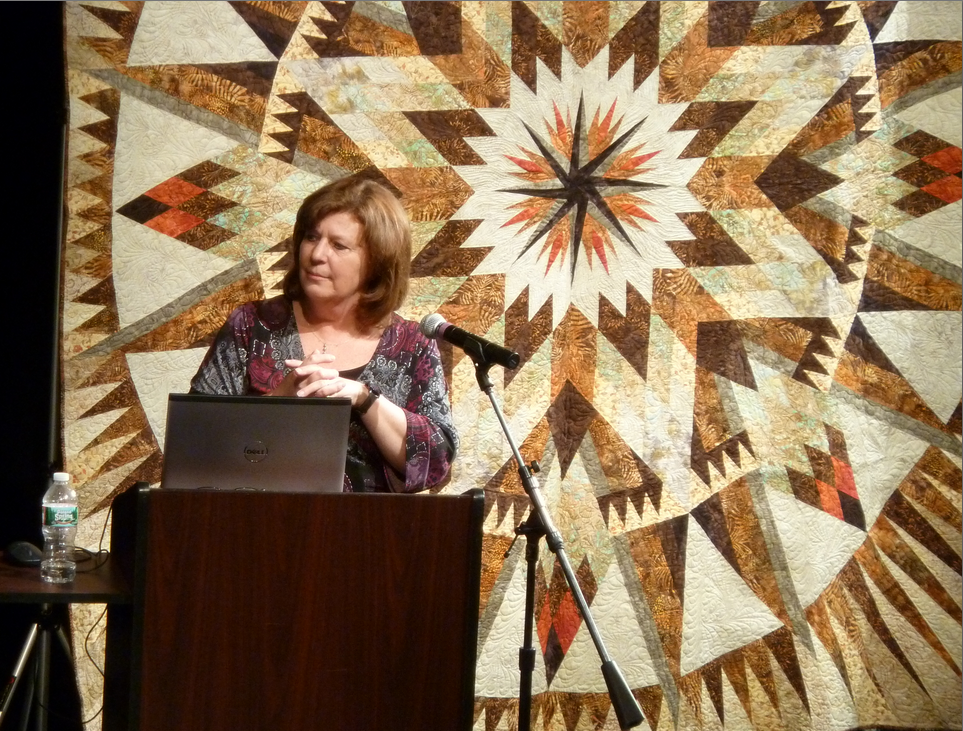
On January 28 quilter Ginny Radloff presented her quilting to our guild. Ms. Radloff is living the dream, turning her quilt hobby into a business as a certified instructor of Judy Niemeyer quilt patterns. Wyoming-based  Ms Niemeyer, whose son Brad is now also involved in her enterprise, is a quilt designer whose patterns are ultimately derived from the Mariner's Compass and New York Beauty quilt traditions.

Antique New York Beauty quilt. Source: http://www.rockymountainquilts.com/files/antique_quilts_18.php

Ms. Niemeyer has perfected a method for piecing these types of quilts using paper piecing techniques, in which over-sized fabric pieces are stitched onto a pre-printed paper substrate; each piece is trimmed before the addition of the next piece. The paper is removed when the blocks are finished. Ms. Niemeyer's patterns and methodology are very popular, so she has licensed a team of certified instructors to meet the demand for workshops and lectures.

Team Ginny included her three children, who were obviously, and justifiably, very proud of their mother's accomplishments as they displayed her quilts.

Three offspring, three quilts.
Influenced by the Red and White quilt show at the Armory, perhaps.

I really liked the red and white quilt above, and it was refreshing to see solid fabrics used, as opposed to the ever-present batiks.  Ms. Radloff quilts her own tops; her machine quilting is lovely and would show up even more on solid fabrics, so I hope she might consider using solids in some of her future work.

One of Ms. Niemeyer's newer designs.
Table runners too.

For those not ready to commit to a large quilt, Ms. Radloff sells Judy Niemeyer patterns for table runners and placemats too. This is a good way to "get your feet wet" with the techniques.  

Quilt top.
Another quilt top.
Judy Niemeyer patterns as beautifully interpreted by Ginny Radloff.

As is usually the case, prior to the quilt guild presentation the instructor led week-end workshops. Ms. Radloff is a very good teacher - organized and clear but still fun, helpful and enthusiastic, as was her helper Susan.  We each made one block of a Niemeyer pattern called Desert Sunrise. 

My finished block, in sorbet colors.

11 February 2013

Blizzard of 2013

Parting the snow sea.

Thirty-five years, almost to the day, after DH and I survived the Blizzard of '78, we have renewed our New England weather bragging rights. From early Friday, February 8, until the afternoon of the next day, fierce winds flung 24.9 inches of snow at us, the fifth deepest snowfall on record.  The good news is that we did not lose power, as we did during Hurricane Sandy, when a Norway maple tree on the next block toppled onto a power line.

My car is under there, somewhere.
The Sunday sky was a brilliant, crisp azure, the brightness of the white snow contrasting with the blue shadows. My heroic DH made like a suburban Hercules and dug us out.

Clearing the sidewalks.

A traffic island becomes a very short piste.

  
Source: http://www.petrexgmbh.com/year-of-the-snake/chinese-paper-cut-out-snake-as-symbol-of-year/

On a warmer note, February 10 marks the beginning of the Year of the Snake, according to the Chinese zodiac cycle, so Happy New Year to everyone who celebrates the lunar calendar.