07 October 2018

Rising Star Quilt Show

Susan Campos, Autumn Glow pattern.

Autumn in New England - russett leaves, crisp, cool air, pumpkin spice flavoring overkill - and a highlight of the season, the Rising Star Quilt Guild's annual show, held this year on October 5 and 6, at St. Brigid's Church in Lexington, Massachusetts.  This is always a delightful show, and below are a few of the quilts which particularly resonated with me.

Falls colors and imagery featured in several quilts.  This year, I've tried to give links to the quilt patterns used by the quilters where applicable, just click on the pattern name. These links are provided only for convenience, I have no connection to the designer or vendors and no endorsement is implied.

Jessica Gillis, Fall Sunshine. Sunrise Sunset pattern.

Carolyn O'Hara, Bali Blast. Prism quilt pattern by Nancy Rink.

The show included a lovely tribute to the late Delores McCravy, a long-time guild member and some of her work was on display, including the appliqued and pieced quilt below.

Delores McCravy, Turning Leaves.

Turning Leaves, detail.

Folks of all ages enjoyed the show.

One thing which sustains us through the New England winter is our memories of summer, and several artists were involved with a group challenge related to summer, recalling memories of the beach, colorful tote bags, blooms, and rippling water.

Beach Buoys, Barbara Tarrh.

Marilyn Jackson, Happy Baskets.

Cathy Papazian, Reflecting on Monet's Waterlilies. 


The pattern above is based on the Japanese Jigsaw Block.  Elizabeth Habich was also inspired by flower imagery in the work below; Ms. Habich created the pattern from her photograph. Note the background fabrics, which Elizabeth hand-dyed.

Elizabeth Habich, Honeysuckle, detail.

In addition to her skill with applique and hand-dyeing, Ms. Habich is also an expert at painting with thread.

Elizabeth Habich, Eagle Lake, Acadia, detail.

Some of the small quilts have great graphic impact. I have to confess I am also partial to cardinals.

Deborah McKenna, Birds at the Feeder.

Since we have birds, why not butterflies? I did not know what a "QAL" is - it stands for Quilt Along, projects individually but as part of an online group all working to the same pattern, in this case one of Tula Pink's designs.

Angie Fitzreiter, I-Heart-QALs, detail.

Moving on to mammals, the quilt below made a big impression. (Sorry, couldn't resist. I have no idea who Susan B is.) In case you would like to make your own elephant, the pattern is at this site.

Peggy Boning, Susan B Elephant.

There's something about black, white and gray with yellow....but also rainbows.  The pattern for the Ombre quilt can be found here, https://huntersdesignstudio.com/product/ombre-star/.

Jean Necheles, Paul's Ombre. 

Christina Crouch, Hoops in the Dark, pattern Metro Hoops.

Dorothee Kennedy, Spring Fling Fun.

The Boutique.

This show always has a good selection of vendors and The Boutique features items made by guild members.  Finally, some quilts featuring red, always a fan favorite. Love to the Moon and Back is a Dresden Plate variation. The last quilt in this blog post goes wild with many, many traditional blocks together in a delicious scrum of red and white.

Jeanne Funk-Geddes, Love to the Moon and Back.

Susan Campos, Red and White Sampler.

Red and White Sampler, detail.

28 September 2018

Public art on the Greenway

Through the Herculean efforts of a motivated group called the Friends of the Greenway, a former railroad bed was converted to a linear park here in my neighborhood of Newton Upper Falls.  The park, officially opened in 2016, is very much a work in progress, but is already well-used and loved.  Thanks to outreach by our local chamber of commerce, the Greenway was host this summer to a wonderful outdoor sculpture exhibit.  The installation was a testament to what can be achieved even on a shoestring budget.

Puppets at the grand opening.

Studio Without Walls mounted the show, called Beyond Boundaries, on view from June 25 to September 9, 2018.  The opening featured our mayor, light refreshments and puppets borrowed from Boston's own Puppet Free Library (who knew there was such a thing?!). In addition, several artists led activity stations.

Fifteen artists participated; this blog highlights just a few of the creations.

Origami birds made from spray-painted insect screening.

I especially liked Janet Kawada's origami birds; my photos don't do them justice, unfortunately.  Artist Kawada used insect screening, folded in the traditional paper crane origami pattern, then spray-painted and suspended the birds from branches.  Ms. Kawada provided colorful origami paper and instruction during the opening.

Folding paper cranes.

Currently much of the Greenway is bounded by a large parcel of land about to be redeveloped. Ringed by chainlink fence, the area would not appear to be much of an inspiration, but Wendy Wolf was not deterred, using the grid framework of the fencing to gently satirize our new mode of communication, the emoji. She wove several emoji on various fence sections for her work titled "We All Speak the Same Language." As you can imagine, these images were very popular with young visitors.

Meow!

A small budget encourages creative reuse of whatever materials are at hand, which is what Louise Farrell did in fashioning "Faux Fleurs"; the design was prompted by a length of found rope.  This piece is particularly resonate, as every year volunteers cut back the invasive vine oriental bittersweet, which entwines itself around unlucky trees, eventually toppling them.  The artwork, however, was a welcome invasion.

Up and up climbs the vine.

A "map" of pompoms by Stacey Piwiniski.

And finally, an artwork which responds to the local wildlife - note the cottontail rabbit, lower left. Is the bunny wishing her tail was a pretty pink color?  This work, "Let's Make Paradise Meet," gets extra points for texture and was a fan favorite, as many children (and adults) made pompoms to add to the fence during the opening.

The tactile delight of working with yarn.

01 June 2018

Rushnyky - Stitched talismans from Ukraine - Part 2

Woven rushnyky.

This is a continuation of a blog post about an exhibit of rushnyky, Ukrainian ceremonial cloths, at the Museum of Russian Icons in Massachusetts. See Part 1 for more background info.  This exhibit was curated by Prof. Franklin Sciacca, of Hamilton College, in New York state, and the artifacts are mostly from his collection.

Some examples on display were not embroidered but woven.  From the exhibit text:
Woven Rushnyky

Spinning and weaving have been practiced in the territory of Ukraine since at least the 5th millennium BCE, as evidenced by the large number of archeological finds of pottery, spindle whorls (priaslo) and weights used with vertical looms.

Weaving on handlooms was a typical domestic practice well into the 20th century in most regions of Ukraine.  In these rushnyky, the designs are woven into the fabric rather than being embroidered later.  A skilled weaver cold create complex geometric patterns, beautiful pictures, and even include inscriptions.

From the mid-17th through 19th centuries, a cottage textile industry developed, as did weaving schools, in diverse regions such as Chernihiv and Galicia.  The most prolific weaving production took place in the town of Krolevets in the Sumy region.  The first mention of Krolevets woven rushnyky dates back to 1639, and by the turn of the 20th century, Krolevets textiles were sold at fairs throughout the central Ukrainian provinces.  Taras Shevchenko, the poet laureate of Ukraine, is said to have ordered Krolevets rushnyky in preparation for his wedding in the mid-19th century.  The oldest surviving Krolevets rushnyk, dated 1839, is preserved in the Museum of Krolevets Weaving.

Krolevets rushnyky were largely woven out of red and white linen threads alone, although on occasion multi-colored textiles were, and still are, produced.  The typical motifs are the Tree of Life and the double-headed eagle, the latter copied from the Russian imperial emblem.  These rushnyky often had the year of manufacture, the name of the town Krolevets, and sometimes the name of the weaver woven into the design.  The name of a prominent family of weaver -Ryndin - frequently appears in rushnyky from the first decades of the 20th century.

Production of woven rushnyky continued well into the Soviet period, when textiles incorporated contemporary political figures and themes in the designs such as Lenin, scenes of [rural] electrification, and the hammer and sickle.  In post-1991 independent Ukraine, the Krovelets hand looms have been adapting to contemporary needs and styles, as is evidenced by the multi-colored rushnyky depicting the Pochayiv Mother of God icon.

Rushnyk with image of writer Taras Shevchenko,

The exhibit text mentions Taras Shevchenko (1814-1861).  My knowledge of Eastern European literature is limited to folk tales and I had never heard of this monumental figure in Ukrainian history.
The text on the rushnyk is from an 1845 poem, "My Testament":
"...and don't forget to remember me
in the great family,
In a family new and free,
With a kind and quiet word."
 - trans. Michael Naydan
Today's protesters may wear "pussy hats;" a few bold Ukrainian women, more limited in their outlets for activism, stitched protest in rushnyky.  From the exhibit text:

Anti-Soviet Sentiments

The linen canvas, on rare occasions, served to promote Ukrainian nationalist or anti-Soviet sentiments.  One rushnyk, created in the 1920 - 30s, is from the northern Chernihiv region [shown below]. The composition depicts traditional apolitical village scene juxtaposed wiht an intriguing verse that is adapted from a common chastushka, a humorous or satirical song:

Dear Cow, eat the straw,
Don't hope for grass,
My darling was drafted
for the Soviet war.

Peasant resentment of the conscriptions, and the young women's anguish over drafted and maimed brothers and sweethearts, endured in the chastushka tradition.  The rushnyk variant takes on political significance in its reference to the "Soviet War," referred to in Ukrainian historiography as the "Soviet-Ukrainian War," which was waged between 1917 and 1921 for control of the Ukrainian regions of the former Russian Empire.

A second political Rushnyk, made in 1937 in the L'viv region, bears a boldly nationalist expression [shown below].  On it are the tryzubar trident, the symbol of Ukrainian independence, and the crest of the city of L'viv.  Both seals are surrounded by hovering angels holding a crown (no doubt a reference to the Galician-Volhynian principality) and bouquets of flowers.

This was produced in Western Ukraine before it had been annexed by the Soviets, in a pre-war atmosphere in which the creation of a free and independent Ukraine was a much anticipated possibility.  The proclamation in defense of Ukrainian nationalism is expressed visually and with inscriptions.

The four inscriptions repeat the single theme of independence: "Struggle, and you will over come" (from Taras Shevchenko's poem "Kavkaz," 1845), "Freedom in Ukraine," "God save Ukraine!" and "Ukraine has not yet perished" (from the Ukrainian National Anthem).

Rushnyk with satirical poem, 1920-30s.

Rushnyk promoting independence, with trident symbol, 1937.

Other figurative rushnyk are more personal, featuring young men and women standing near wells and fences. These are not just pastoral scenes - the stitching in fact conveys a narrative of attachment and separation.  From the exhibit text:

Wells and Fences: Locations of Courting and Separation

Many of the genre scenes that were popularly depicted on rushnyky in the late-19th through 20th centuries reflect the joys of young couples courting and the sorrows of their parting.  The trauma of separation of a young couple usually occurs in the context of the man going off to war, and occasionally due to the loss of the soldier on the battlefield.

Wells hold a sacred significance in Ukraine, and particularly revered wells were marked with a cross, icons and rushnyky.  The village well was a shared community resource, a place where young people could meet without the watchful gazes of family members.

This scene of meeting at the well shows the young man holding a flower, while the girl carries a yoke with water buckets.  A dove flies over the well.  The inscription comes from a popular Ukrainian folk song from the early 20th century, (with some variation of the text):

Here is the little well where a dove was swimming,
Here is the dear girl with whom I fell in love.

The understanding that men who encounter women at wells and end up falling in love and getting married is well attested to in Biblical narratives.  For example, in Genesis 29, Jacob find his future wife Rachel at the well.  The dove, a monogamous bird, is a symbol of faithful love, while the yoke with buckets filled with water symbolizes good fortune and prosperity.

In contrast, a fence functions as a barrier or obstacle, the fitting location for scenes of parting and separation.  In such scenes, the young man is in military garb, often carrying a weapon rather than a flower.  These are emotionally distraught rushnyky that commemorate the potential loss of a husband.

Embroidered rushnyk, mid 20th-century.

Rushnyk with scene of parting at a gate, mid 20th century.

Husband or sweetheart in uniform, leaving home.

Parting scene.

Sadly, not all the men who left their villages to fight came back. Rushnyky were also part of funeral rites, rituals and remembrance.  The act of stitching, as much as the finished product, embued the rushnyk with intercessional power during times of emotional upheaval and crisis. From the exhibit text:
Prayers and Lamentations

Rushnyky function both as talismans to attract good fortune and as amulets to protect against evil.  They are used both in ceremonies and to decorate the home.  Traditionally, a catalog  of symbols and motifs was utilized to indicate the specific function of a particular rushnyk, but during the 20th century, as literacy increased and understanding of symbols waned, textual incantations and prayers reinforced (or even replaced) the use of the motifs.  Inscribed prayer incantations are often addressed to God, the Mother of God, or a saint.

Sometimes reference is made to the prayers uttered by the creator such as: "With a sincere hand I embroidered [this] rushnyk while I begged God for good fortune for my beloved."  By the late Soviet period, overt Christian references were frequently substituted with more secular invocations such as: "May there be harmony and love in the family."

As obydennyi rushnyk is a ritual towel that is made in a single day.  These were believed to have magical talismanic powers and were often made as token of a vow, sometimes in time of famine, illness, or war.  Other rushnyky are private contemplations that express personal loss and tragedy and search for consolation.  Creating these rushnyky is an act of catharsis or emotional therapy, often in the context of the loss of a husband or child, difficulty in getting pregnant, an unhappy marriage, or some sort of social stigma.  Rushnyky of this sort were probably not intended for public display, but would have been secreted away in a chest for only the maker to view.

Overview of exhibit.

Funerary rushynky.

As traditional sewing and weaving skills were abandoned or lost after World War II, mass-produced, printed or machine-woven rushnyky were created to fulfill the role of the rushnyk in rituals and ceremonies. As stated in the exhibit, "One might lament the decline in craftsmanship, but must admire the tenacity of the tradition."

Contemporary printed and machine-woven rushnyky.

Exhibit visitor looking at books.

In one corner of the gallery books on Ukrainian embroidery and other folk artistry were available for perusal.  Finally, if you've made it through both Parts 1 and 2 of my rushnyky blog post, thank you. As there is little information on these artifacts in English, I decided to quote most of the exhibit text in the two posts, making these entries "wordier" than my usual entries.  Too often items which are stitched, instead of painted, printed or sculpted, are dismissed as "merely" decorative. I hope this exhibit, and my attempt to convey its curatorial content, have helped refute that assumption.

Stack of rushnyky.


30 May 2018

Rushnyky - Stitched talismans from Ukraine - Part 1

Rushnyk, detail.

On May 24 a friend and I drove to Clinton, Massachusetts, home of the Museum of Russian Icons, to view an exhibit of a type of textile unfamiliar to both of us: the rushnyk, a cloth imbued with meaning and symbolism.  Most of the rushnyky on display dated from the late 19th century to the middle of the 20th century; the textiles were cleverly draped in pairs over rods which were wall-mounted or attached to panels hung from the ceiling tracks.  From the exhibit introduction:

"A house without a rushnyk is not a home." -Ukrainian proverb

The word rushnyk derives from ruka, "hand," and while it can refer to an ordinary towel, the ceremonial rushnyk is distinct in its ornamentation and its importance.  The typical placement of rushnyky over icons, on crosses, over graves, and at the sites of holy wells indicate [sic] their sacred status.  The belief in the protective strength and sacred natures of these textiles is tremendously ancient.
A rushnyk is made of an un-seamed length of whole white cloth, which represents the pathway of life's journey.   The ends are hemmed, knotted, or finished with some type of fringe or lacework.  Thus they are "sealed," with a beginning and an end.
The talismanic properties of the rushnyk are reinforced by woven or embroidered motifs of each end.  These are nearly always identical, as the cloth is meant to be hung or held with the ends parallel to each other.  The center of the cloth is usually an unadorned expanse of white, although some woven rushnyky include a simple pattern throughout.
In almost any Ukrainian home, the family icons - and, more recently, family photographs - would be draped in rushnyky, to offer protection to family, home, and village.  When honored guests are greeted, bread and salt are presented on outstretched hands that are covered with a rushnyk.  Rushnyky are used in binding rituals to invoke fertility, and are believed to function as an opening to the sacred realm.  The cloths appear in all family rituals: infants are wrapped in them at birth, they play a significant role in betrothal and wedding ceremonies, and are used in funeral rites.
Remarkably, even after the turmoil of the twentieth and twenty-first centuries, the use of rushnyk is still an integral part of Ukrainian culture.
Museum of Russian Icons.

Gallery with rushnyky.

Rushnyk draped over family photos (window is reflection.)

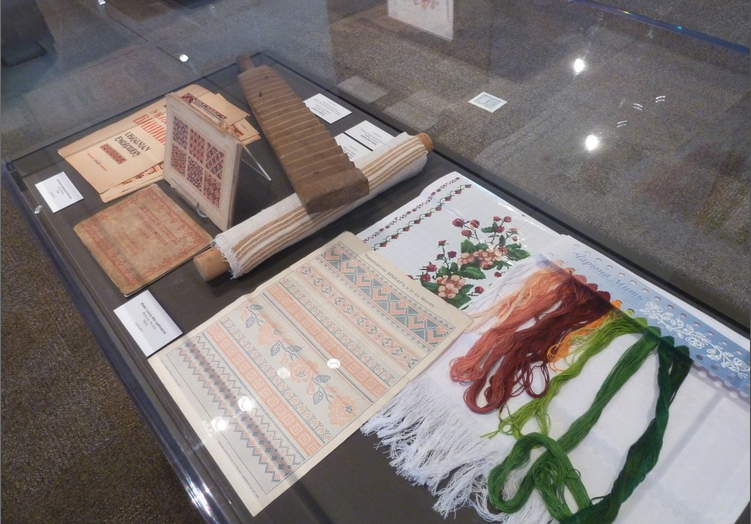
Historically, many types of Ukrainian embroidery stitches were utilized to make rushnyky  However, in a bit of cultural transfer, cross-stitch from western Europe infiltrated Ukraine by way of premiums packed with bars of soap. From the exhibit text:
Cross-Stitch: "Brocard" Embroidery

Ukrainian embroidery is renowned for possessing over 200 distinct stitching techniques, many of which were believed to possess special energies.  You can examine several of these in the embroidered ritual towels on display.  The techniques used in the convent rushnyky from Naddnipianshchyna allowed for the patterns to appear on both sides of the fabric.  Another style, called satin stitch, used long stitches to give the embroidery a smooth, silky appearance.  The Zavolikannia stitch imitates the looks of a woven design.

In the 19th century, the simpler cross-stitching, which was already widespread in western Europe, began to replace traditional complex techniques.  The introduction of the technique displayed here is attributed to a French perfumer, Henry Brocard, who founded a perfume and soap factory in the Moscow region in 1864.  He introduced an inexpensive glycerin soap which was widely distributed throughout the Russian Empire, including central and eastern regions of Ukraine.

As an incentive to buy this product, Brocard & Co. offered embroidery patterns, usually floral, as premiums included in the soap packages.  Within a short period of time these new cross-stitch patterns became very trendy, even in remote villages, and supplanted many of the authentic stitching techniques and patterns.  Women's magazines began to feature elaborate cross-stitching scenes, and pattern books were published in Moscow, St. Petersburg, and Kyiv.  Much of the regional nuance and cultural history of embroidered design was lost with the spread of cross-stitch patterns.

By the last decades of the 19th century, another French firm, the DMC company (Dollfus Mieg et Cie), had introduced strong mercerized thread (thread that is chemically treated to increase luster and strength) in a wide variety of vibrant colors into Ukrainian folk embroidery.
Convent-made rushynyk draped over icon.

Convent-made rushnyky.

Satin-stitch rushnyky.

Satin-stitch rushnyk, detail.

Cross-stitch patterns and DMC embroidery, tools of cultural transfer.

Although I recognize the loss of heritage with the incursion of cross-stitch, this style of stitching does result in textiles with a lot of strong graphic appeal, especially in the black and red color schemes of many of the rushnyky.

Cross-stitch rushnyky.

Cross-stitch rushnyky.

Cross-stitch rushnyky, details.

Floral and geometric rushnyky and cross-stitch detail.

Geometric patterns.

Wonderful red and white design.

Geometry and knotted border.

In addition to geometric patterns and floral motifs, a common motif in many rushnyky is the Tree of Life, a symbol found in many cultures, from Indian palampore bedspreads to American quilts. From the exhibit text:
The Tree of Life (Derevo zhyttia)

One of the most prominent motifs in both embroidered and woven rushnyky is the Tree of Life.  If is a symbol of prosperity, fertility, and longevity, and its display in the home functions as an amulet to protect the family.  This tradition is similar to the Tree of Life quilts made in North America in the 18th and 19th centuries.

The "Tree" can take a variety of forms - a recognizable tree or branch with leaves and flowers; horizontal or vertical bands of leaves or vines; a bouquet of flowers; or even a potted plant.

Birds are sometimes depicted in the foliage.  The tree often sprouts from the upraised arms of the Earth Goddess (Berehynia), while the depiction of the Tree-Cross sometimes seems to sprout with vegetation.

The symbol is archetypal in world mythologies.  The Tree is understood in many cultures, from ancient Assyria to the Germanic tribes, to be the axis mundi, a universal pillar that connects heaven, earth, and the underworld.  It represents the source of life, regeneration and fertility, wisdom, healing, and sustenance.  In Christianity, the Cross of Christ is understood to be the Life-giving Tree, by which believers can enter heaven and be granted eternal life.

Convent-made rushnyk, Tree of Life image, detail.